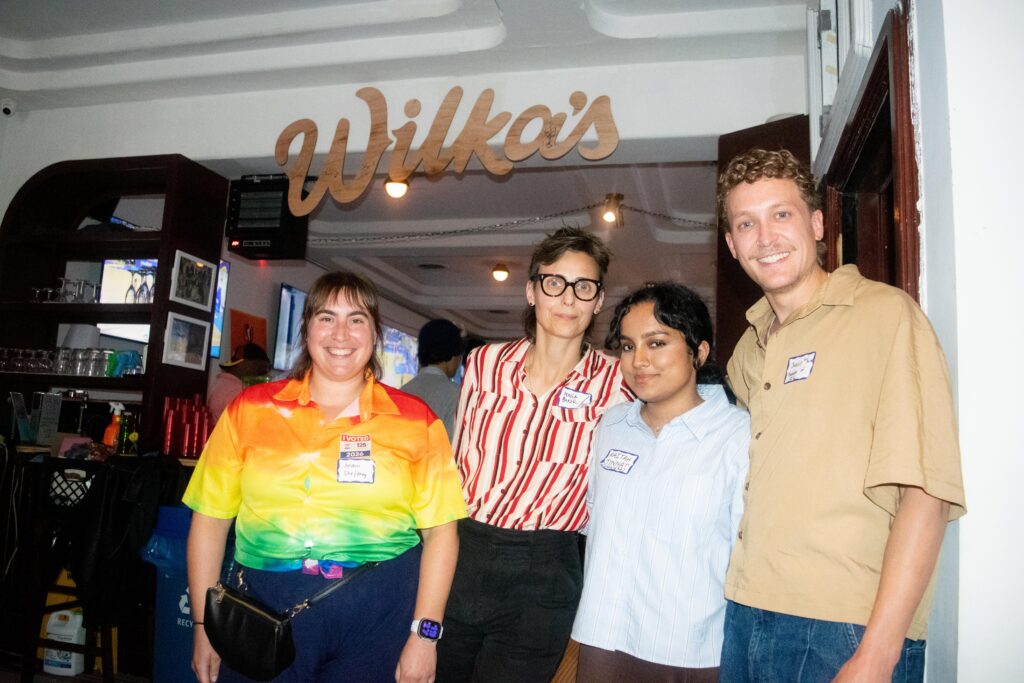
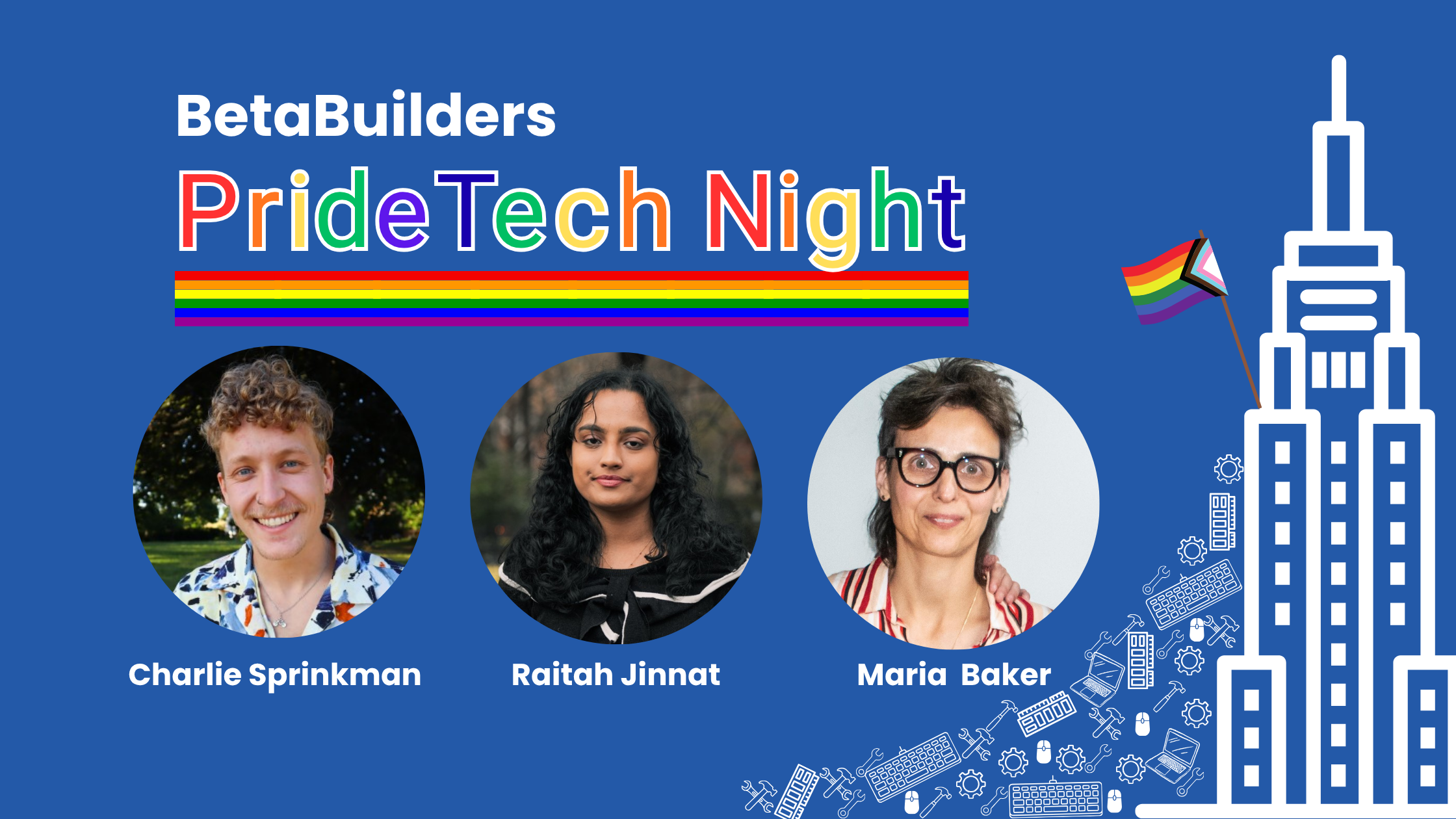
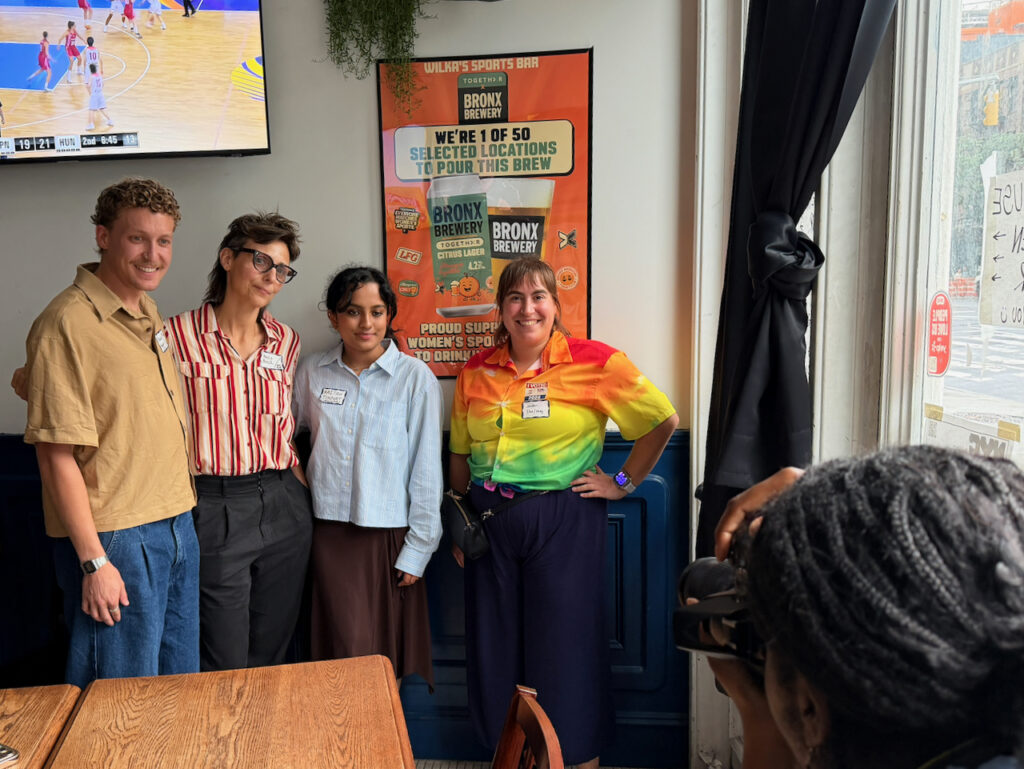
On June 23, 2026, BetaNYC hosted the first installment of BetaBuilders — a new community event for NYC public-interest tech practitioners, organized by the Associates Board. We held the event at Wilka’s, Manhattan’s first and only women’s sports bar. We are so appreciative of their willingness to host us and build an enduring partnership around inclusive events. The evening opened with three lightning talks at the intersection of technology and queer identity, followed by the formal launch of the BetaBuilders sustaining membership program.
Designing Queer-Affirming Human-Robotic Interaction
Speaker: Raitah Jinnat — Computer Scientist and Public Health specialist, Macaulay Honors Program, Hunter College; researcher at the TIER (Trustworthy Intelligent and Explainable Robotics) Lab
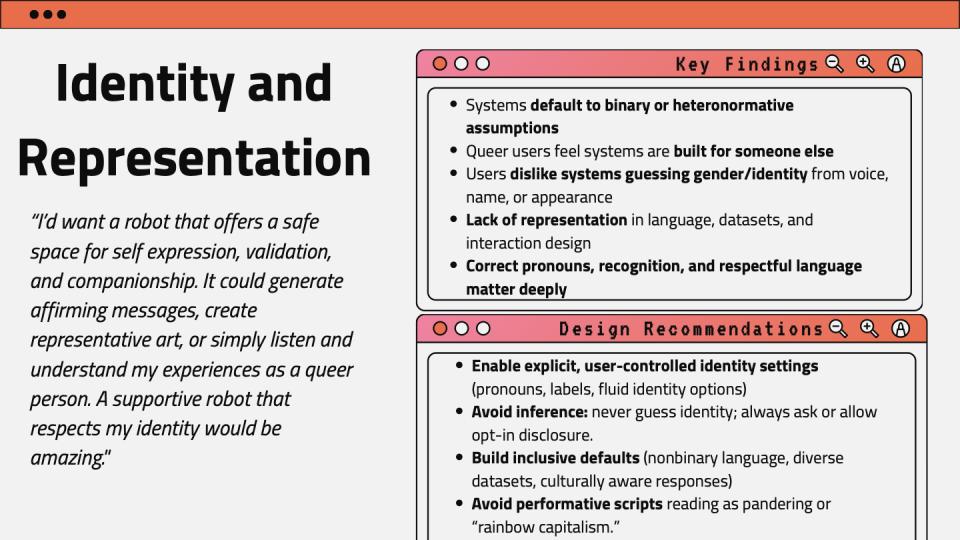
Raitah shared research from Hunter College’s TIER Lab on what it would take to make human-robotic interaction genuinely inclusive for queer communities. The core finding: most robotic companions and chatbots default to cisnormative and heteronormative standards, leaving queer users with a persistent feeling of being “not the intended user.”
Through participatory design with queer participants, the research produced five justice-oriented recommendations:
- Identity and Representation: Avoid assuming user identity; implement inclusive, customizable defaults; steer clear of performative corporate-Pride scripts.
- Emotional Support and Relational Boundaries: Design the companion as a tool — “friendly but not your friend” — with nudges toward real-world social engagement.
- Privacy, Surveillance, and Data Control: Strong preference for local data storage over cloud; privacy-by-default with transparent, granular user controls.
- Safety, Bias, and Institutional Misuse: Audit models with diverse datasets; monitored deployment pipelines to prevent harmful outputs.
- Interaction Control and Embodiment: Users want autonomy over voice tone, prosody, name pronunciation — and a preference for non-human, less anthropomorphic designs to avoid “uncanny” discomfort.
The through line: design is not neutral.
Learn More:
- Hunter College: “Hunter Computer Scientist and Team Test Queer-Friendly Robot”
- ACM/IEEE HRI 2026: “Not the Intended User: Queer Perspectives on Identity, Risk, and Trust in Robot Companions”
Generative AI’s Impact on Lesbian Film Representation
Speaker: Maria Baker — Adjunct Assistant Professor, Pratt Institute
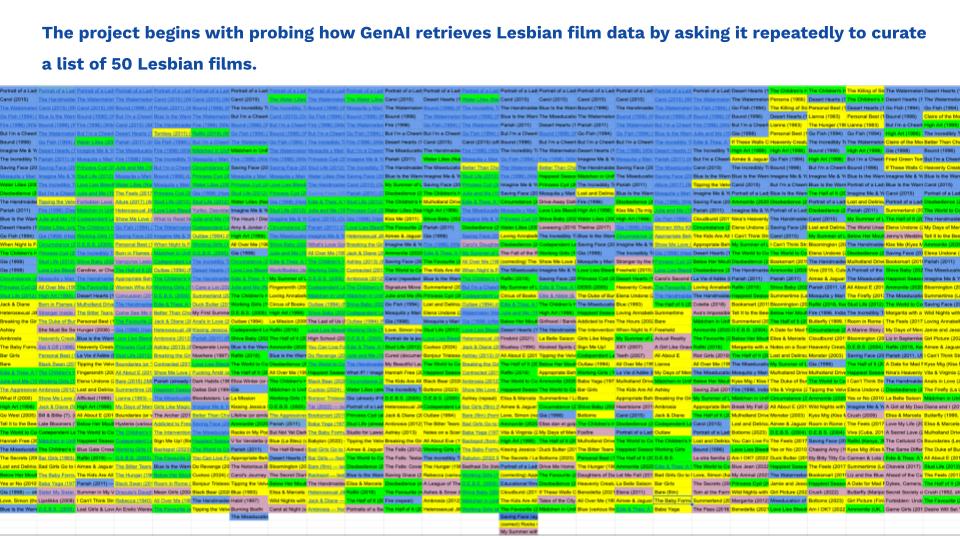
Maria presented “Three Degrees of Representation: How Gen AI Filters Lesbian Film Data” — a research project that prompted ChatGPT 25 times to list 50 lesbian films, then used the 17 most prevalent titles to generate AI images, new loglines, and new film posters.
The findings were striking:
- Visual homogenization: AI posters defaulted to a generic two-women romance trope. “Make their own new closets.”
- Narrative drift: The word “lesbian” was completely omitted from generated loglines — despite the explicit prompt. Focus shifted to generic “dilemmas of choice.”
- Erasure of specificity: Saving Face‘s Chinese-American protagonists were rendered as racially ambiguous. Carol‘s complex facial expressions were replaced by “amber light” and ambiance.
- Heteronormative default: When titles alone were used without the “lesbian film” specifier, results immediately defaulted to heteronormative depictions.
Maria’s conclusion: You cannot prompt your way out of these biases. Models “compulsively fill in every single pixel,” forcing algorithmic choices that quietly reinforce stereotypes regardless of user intent.
Learn More:
“Everywhere Is Queer” — A Global Directory
Speaker: Charlie Sprinkman — Founder, Everywhere Is Queer
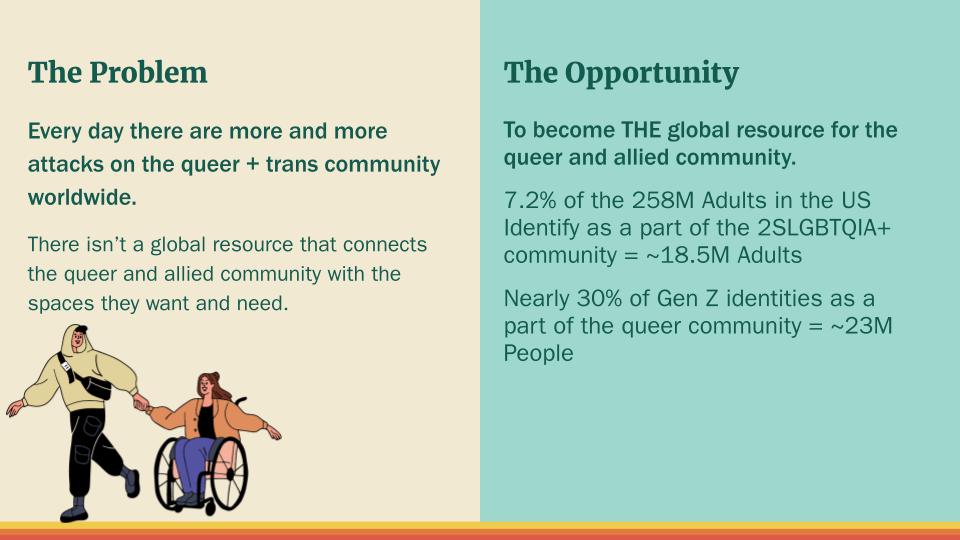
Charlie built Everywhere Is Queer out of a simple frustration: after driving through 41 states for work in 2019, the only queer spaces consistently listed anywhere were gay bars. Launched January 2, 2022, as a Google My Map, the project went viral, moved to a dedicated platform in November 2022, and launched on iOS and Android on February 20, 2024 — with 75,000 downloads on day one.
Today: 350,000 users and 22,500 queer-owned organizations, each personally approved by Charlie for consent.
Coming soon:
- A job board for queer-owned and ally-owned organizations ($5 / 45-day listing)
- Community groups within the app
- Queer-affirming healthcare directories in partnership with Outcare and the Tegan and Sara Foundation/GLMA
- 365 Pride Guides — city-specific guides with safer spaces, gender-neutral bathrooms, and global Pride orgs
- Talks underway to become the official app of NYC Pride 2027
Revenue comes from brand partnerships and optional featured listings — no intrusive ads, money stays in the queer economy.
Additionally, Charlie said, make sure you keep push notifications turned on, as he sends you positive affirmations daily. Just a little Easter egg from their heart.
Learn More:
BetaBuilders — BetaNYC’s New Sustaining Membership Program
Speaker: Jordan Shapiro — BetaNYC
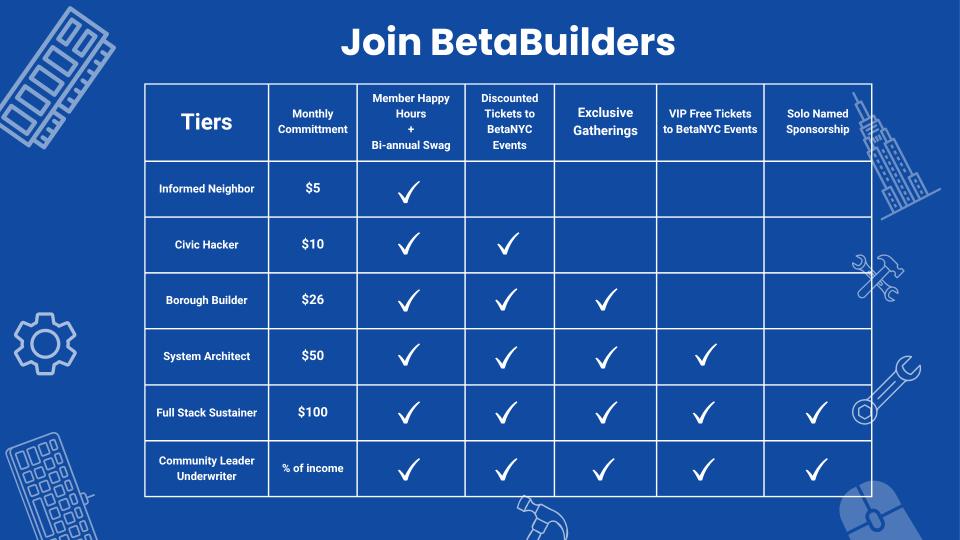
The evening closed with the formal launch of BetaBuilders, a dedicated community for NYC public interest tech practitioners: public servants, advocates, builders, and anyone working toward more just technology.
BetaNYC’s three arms — public interest tech workforce development, civic data services, and public data literacy — have produced tools like RADAR, NYC Urban Heat Map, and Boundaries Map, and in 2025, trained over 1,000 New Yorkers on open datasets across every borough.
Beta Builders is how we sustain and grow that work. The goal: grow from 30 legacy builders to 200 members by end of 2027.
Member benefits include a dedicated Discord server, exclusive events (Stonewall Museum tour, NYC Department of Public Records tour), maker workshops, and more.
Learn More:
Happy Pride. We Love You Just the Way You Are.