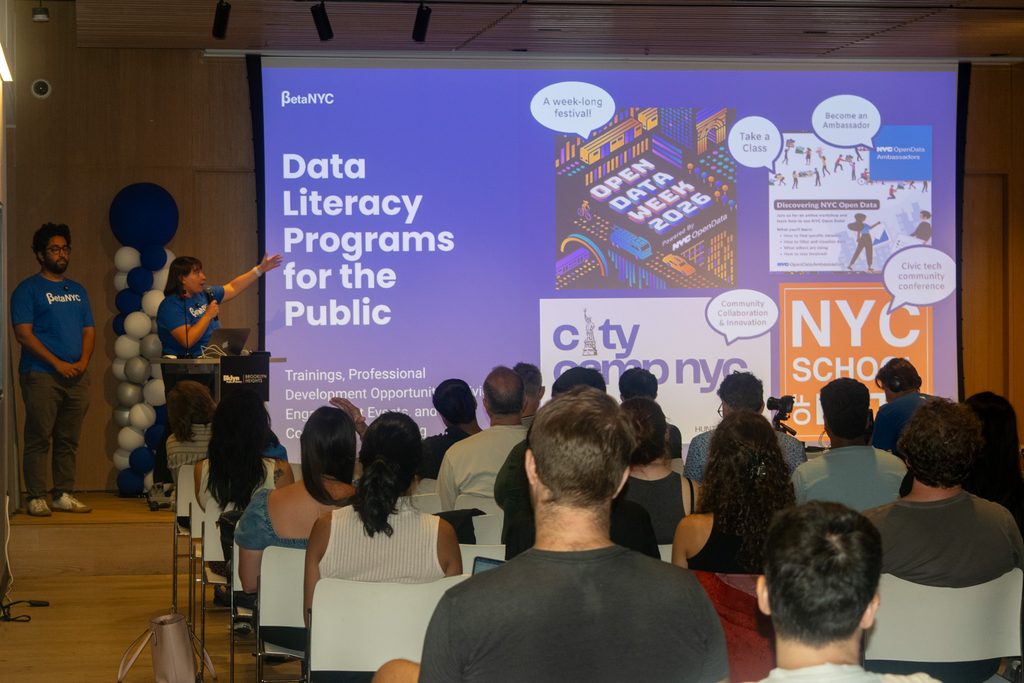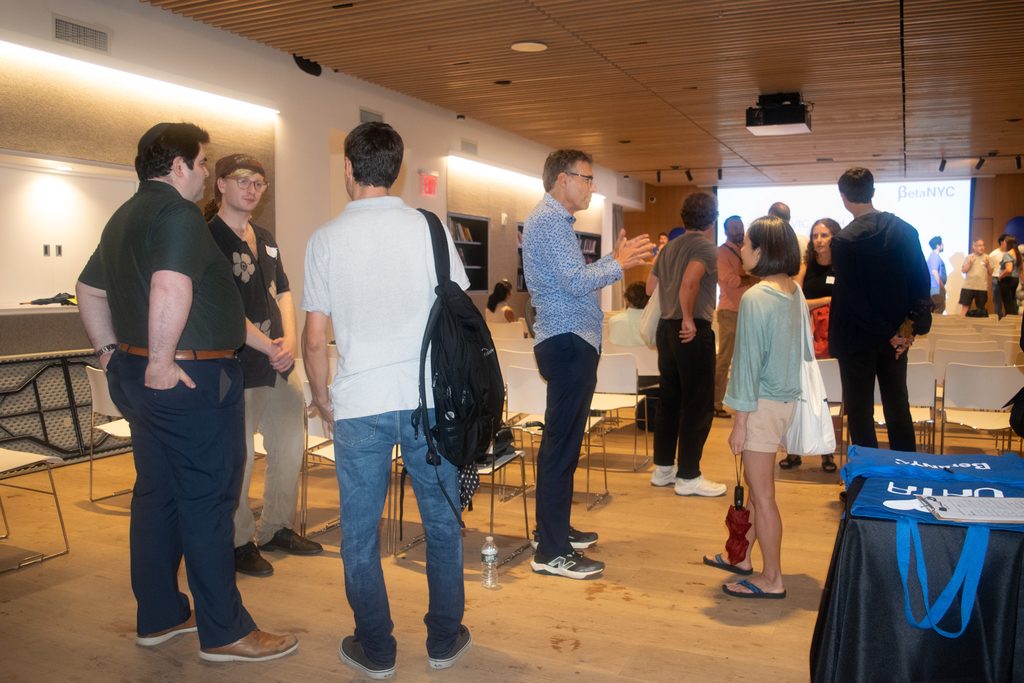
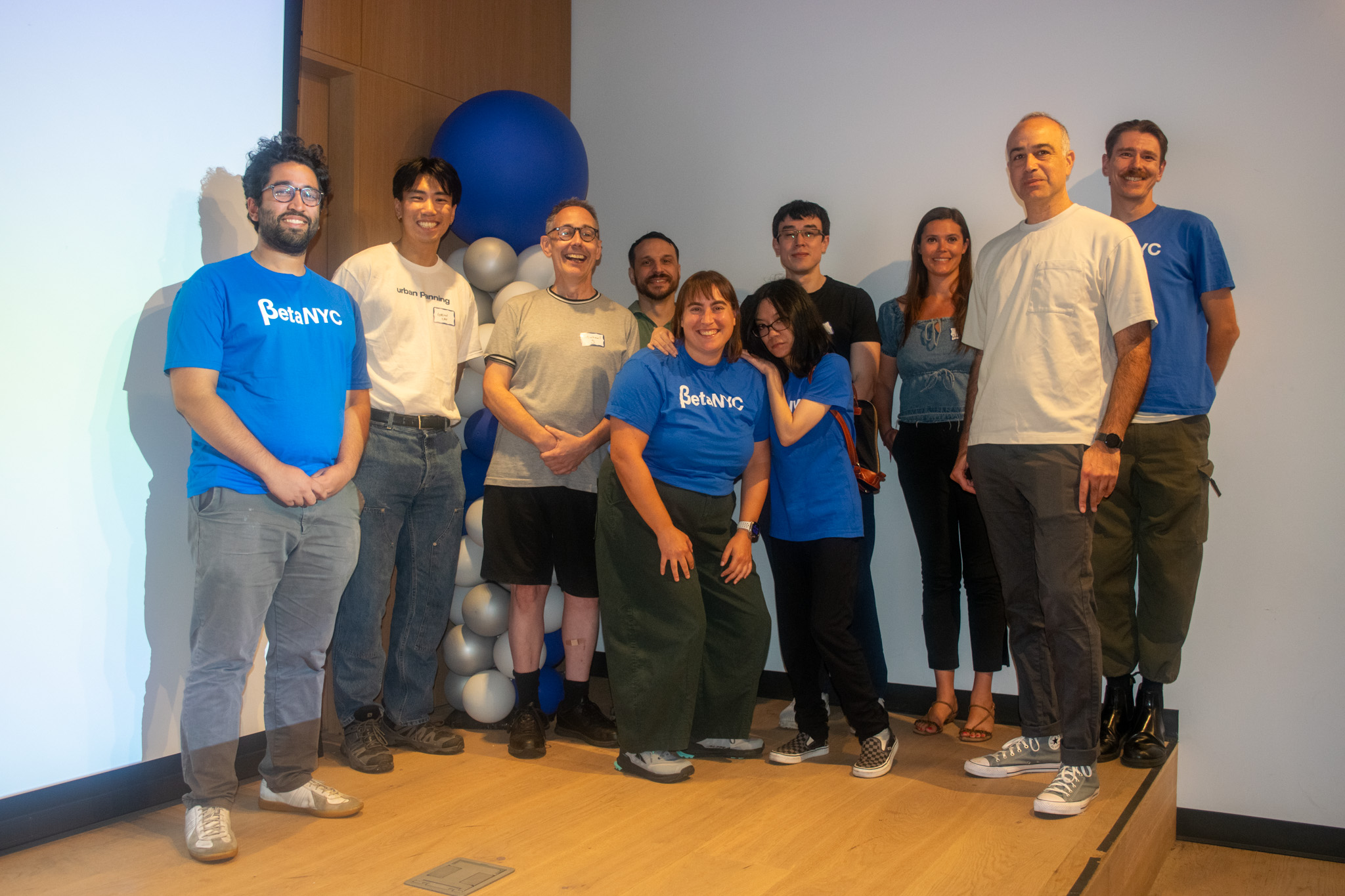
On Wednesday, August 20, we gathered at the New York Public Library’s Brooklyn Heights Branch for the Civic Tech Summer Showcase. 70 of you made the trip in the rain to see five lightning talks presented by the civic tech community.
Sourabh Chakraborty and Jordan Shapiro of the BetaNYC Associate Board emceed. Here are the five projects we heard from:
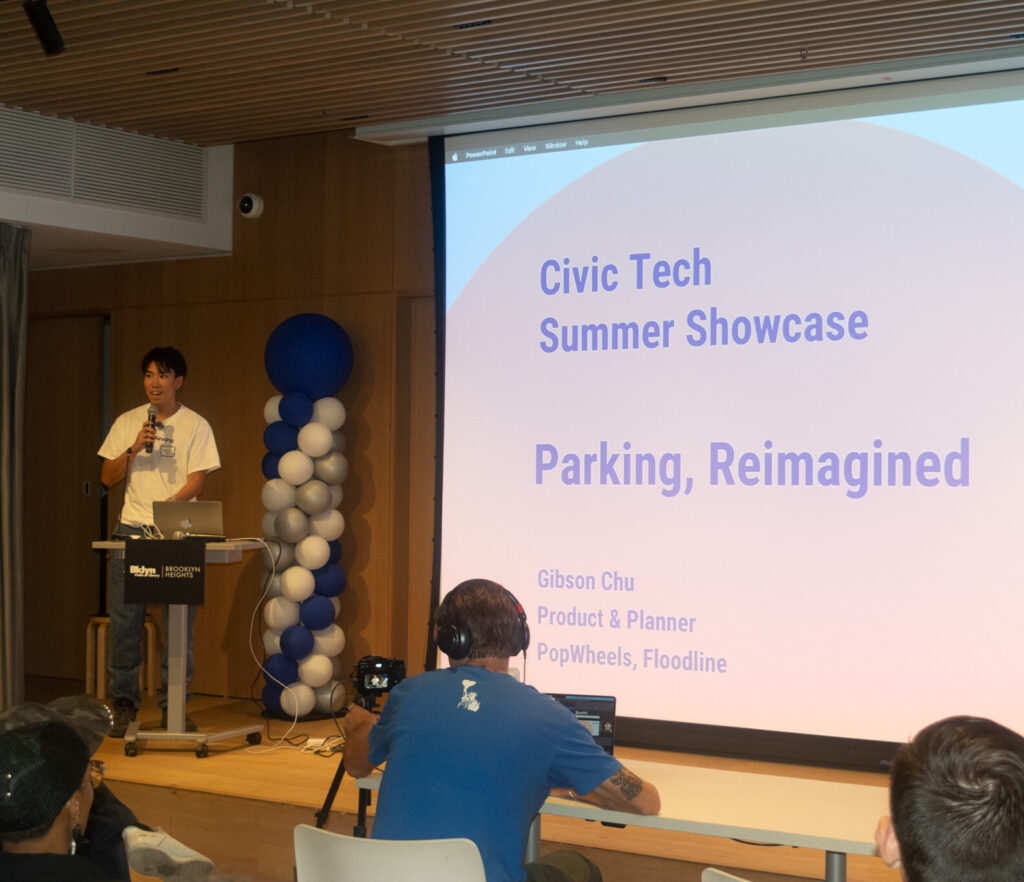
1. Parking Reimagined, by Gibson Chu
https://parking-reimagined.com/ | Contact: gibsontchu@gmail.com
A standard parking space is about 160 square feet, and New York City has enough parking spaces to cover roughly 20 Central Parks. Parking Reimagined is a website that lets residents reimagine a parking space by dropping templates onto it to see what the space could hold, what it might cost, and how land use would shift.
“The question that I’m trying to answer here is: what is better for the community? Two cars, or can we fit biking, seating, trash bins?” Gibson said.
Gibson works as a product manager and city planner whose tool grew out of a graduate research project. The presentation cited Donald Shoup on the high cost of free parking to urban life, Bridget Brown’s 2014 children’s book Spot’s Parking Lot, and a memorable Manhattan Community Board 6 story where a Reddit-plus-AI proposal outperformed the two DOT options in the room.
The site also features a printable workshop kit, so a user can bring the space-use conversation to a community board meeting on paper. It’s built for the community-planning gap Gibson kept naming: people often know what they don’t want, but not what or how to ask for it.

2. Riverkeeper Water Quality Monitoring Portal, by Can Sucuoglu and Sara Eichner, Studio 2263
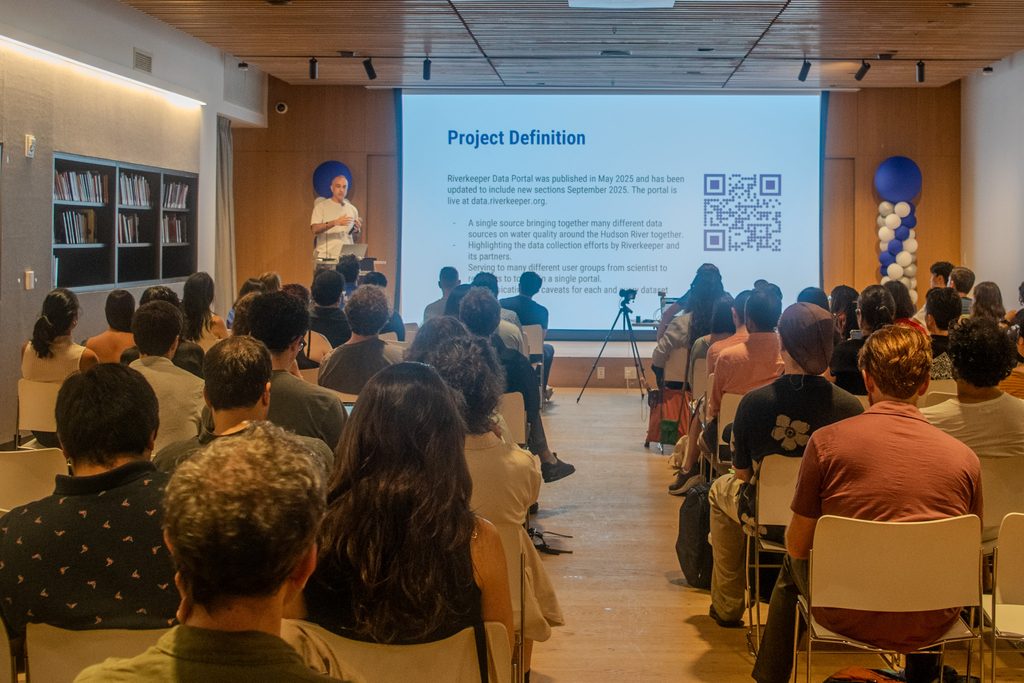
Riverkeeper’s Water Quality Portal visualizes water-quality samples from more than 300 locations across the Hudson River watershed. Can Sucuoglu and Sara Eichner at Studio 2263 spent about a year working with Riverkeeper turning that data, plus drinking-water reports, EPA sampling, state fishing advisories, and climate-trend records, into a navigable portal with 40+ datasets.
The site is organized around four use cases: recreation (swimming, boating, kayaking), fishing, drinking water, and long-term climate change. Their design philosophy borrows Edward Tufte’s data-ink ratio, which asks what can come out of a visualization without losing the story. Studio 2263 coordinates color, cartography, and interface across the whole portal so that maps, charts, and copy read as one system.
“Water quality data is not easy to visualize, we spent quite a lot of time trying to find the right language, the right visual grammar, to make sure that it very simply gets across,” Can said. “We always ask ourselves: what is it we can remove from this visualization that’s getting in the way?”
The tricky part turned out to be the timeliness of the data: sampling only happens when the weather allows, so the site is always serving historic data. Long-term climate trends over the Hudson River, Can noted, should reflect a hundred years of records rather than the 20-30 years that exist.
3. CityScroll, by James Carroll and Michael Sheehan
The City Record has existed since 1873, created by gilded-age reformers to force procurement into daylight. It still comes out every day, but good luck finding what you’re looking for.
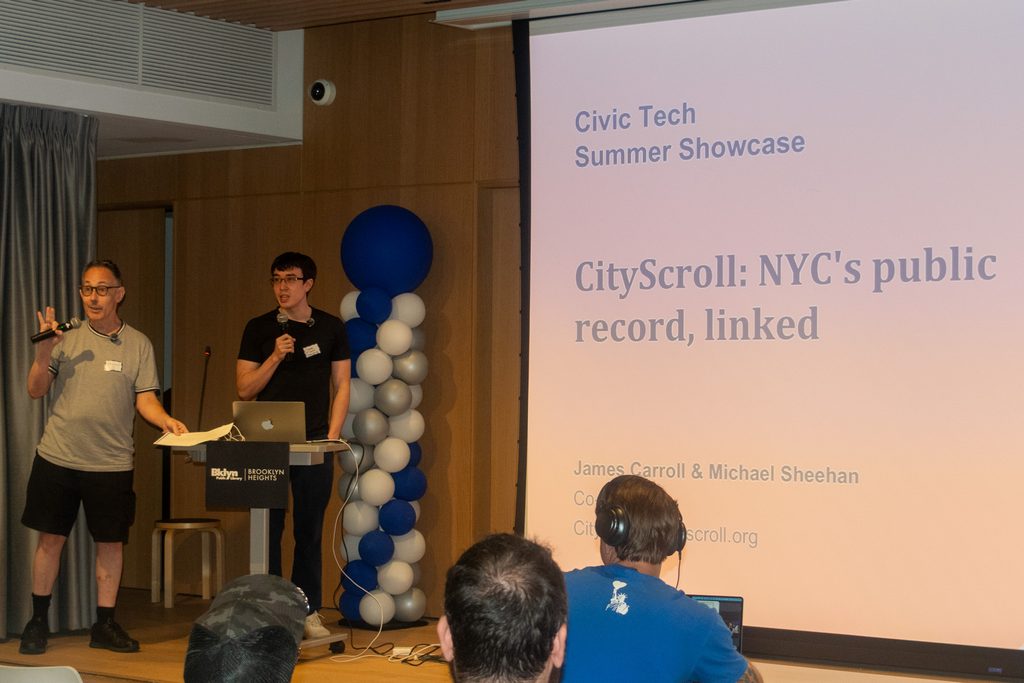
James Carroll and Michael Sheehan met at a civic tech hackathon two months before the Showcase, and came up with CityScroll: a website that displays City Record notices, plus adjacent civic sources like PASSPort, Checkbook, and community board postings, by neighborhood, agency, topic, or keyword. Each alert comes with the meeting time, the calendar link, who to email, and where to comment. They translated contextual and actionable information into eleven languages, while keeping the official records in their original form.
“All of these systems are not designed to be linked together. That’s a social problem, we’re not solving that, but we’re taking in information from all of these systems,” James said.
They walked through a few demo scenarios: a Harlem resident tracking Community Board 10 health meetings, and a Brooklyn tenant watching for rezonings on their block. Under the hood is entity-resolution work that matches one project across the City Record, PASSPort, and Checkbook, so a single project does not fragment into three unrelated feeds.
If you deal with city notices, deadlines, or procurement, they want to hear from you: you can contact them at feedback@cityscroll.org.
4. Codenow.nyc, by Matt Keough
codenow.nyc. Contact:
While there is no shortage of good intentions in civic tech, the platform-engineering work between a demo and a production service is the invisible tax that stops most volunteer teams.
Matt Keough presented CodeNOW NYC, the local civic branch of the Czech Republic-based platform CodeNOW. As the company’s first North American employee, he convinced the CEO to give free resources to civic projects.
Four servers sit underneath Matt’s kitchen counter in North Bergen, NJ, running the same CodeNOW tools used by major corporations in Europe like Raiffeisen Bank and DHL. A civic tech team can run their product on these servers, ensuring that their websites can run reliably and with enough computing power to meet increasing demand. All it takes is a single YAML file to set up the configuration specific to CodeNOW.
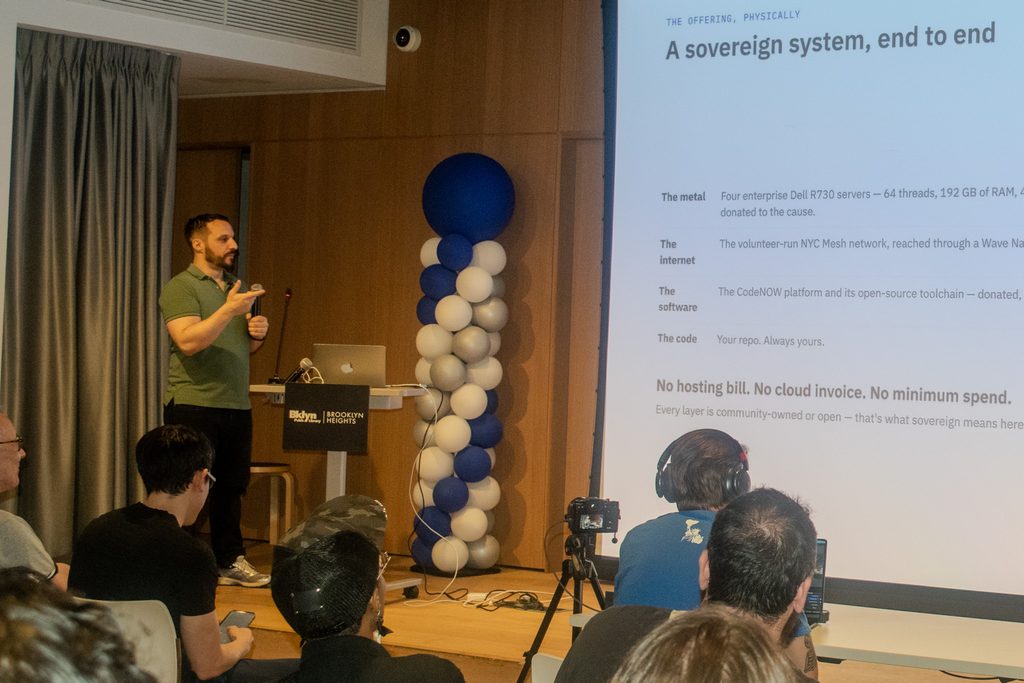
“At the end of the day, it’s just free stuff that we get to share with everybody that wants to build good stuff for the community,” Matt said.
If you have a civic project stuck at localhost, apply through codenow.nyc and Matt will help you get it into production.
5. Good Standing, by Ashley Taylor
goodstanding.app. Contact: ashley@radiicalsystems.com.
Good Standing came out of Radiical Systems (two i’s), a venture studio, after case-study work with community organizations in Baltimore and beyond. The platform has four roles: volunteers, organizations, artists who design the badges, and brands who sponsor campaigns. Volunteers earn artist-designed badges for real-world action, and local businesses turn those badges into special deals, discounts, and other tangible rewards.
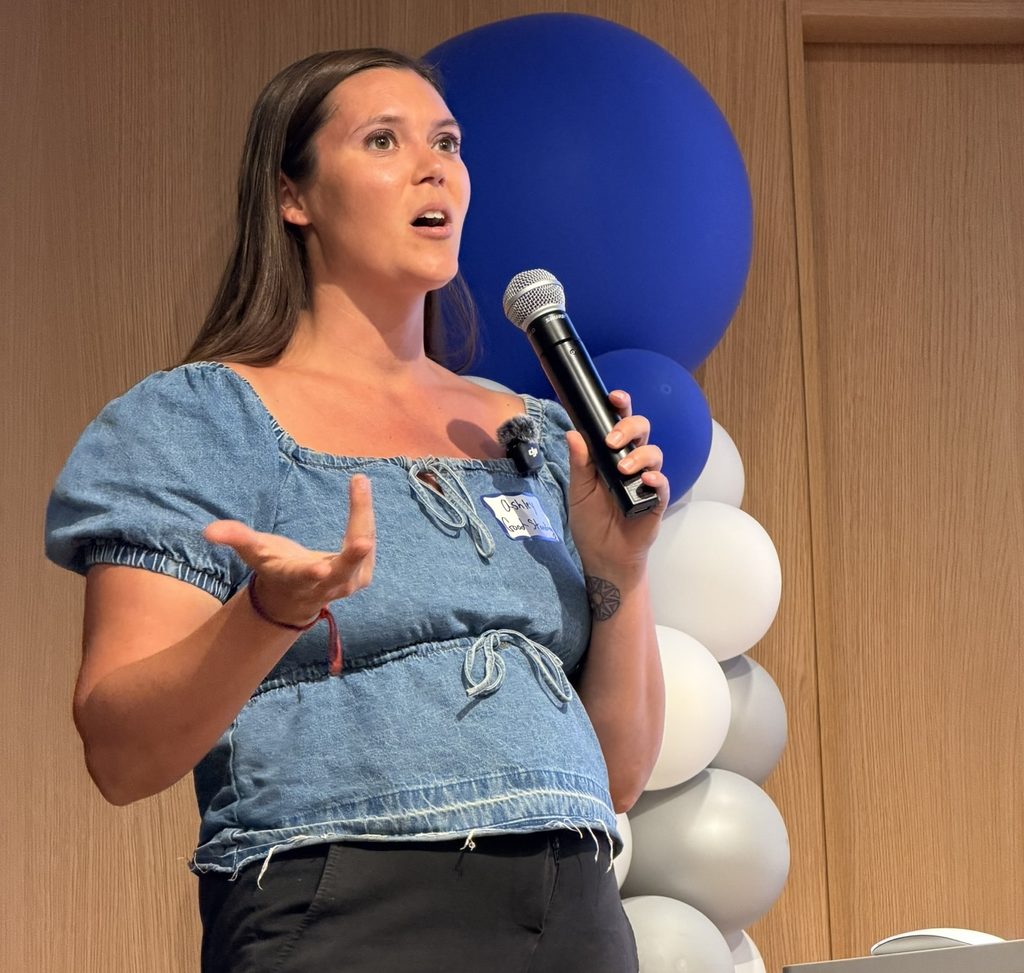
“The point is: [volunteers’] impact right now doesn’t have value within the real world, even though we all know it does have value in these intangible ways,” Ashley said. “We’re trying to make a space where it feels good to demonstrate that…and potentially unlock some real tangible value.”
One recent example: 150 river cleanups on the same day, one of them in Red Hook, Brooklyn, run in partnership with Riverkeeper. Volunteers who showed their cleanup badge afterward got a free drink at Sunny’s Bar, a free slice of key lime pie, and a discounted lobster roll, demonstrating IRL value for real-world action.
The bigger picture is coalition-building across mission-based nonprofits. Good Standing wants to be the third party that makes it easier for aligned organizations to co-sponsor each other’s work. Its next test of that model is Climate Action Day, on Saturday, September 27, in Battery Park, Manhattan.
What’s next
Thanks to everyone who came out despite the torrential downpour, to BetaNYC Associate Board members Sourabh and Jordan for keeping the show moving, and to the Brooklyn Heights Branch of the Brooklyn Public Library for hosting us.
If any of these projects speak to you, the links above go directly to their teams and the presenters would love to hear from you.
If you want to keep spending time with people building for New York City, CityCamp NYC is on Saturday, September 19, at Hunter College.
And if you’d like to be part of the community that makes evenings like this happen, join Beta Builders.
Photos in this blog post by Zanna A, Jordan Shapiro, & Duncan Ballantine