Somebody at a senior center, a tenant meeting, or a job training class is going to ask what ChatGPT is and whether they should trust it. Who answers? The answer, according to the New York City Council, is someone that person already knows.
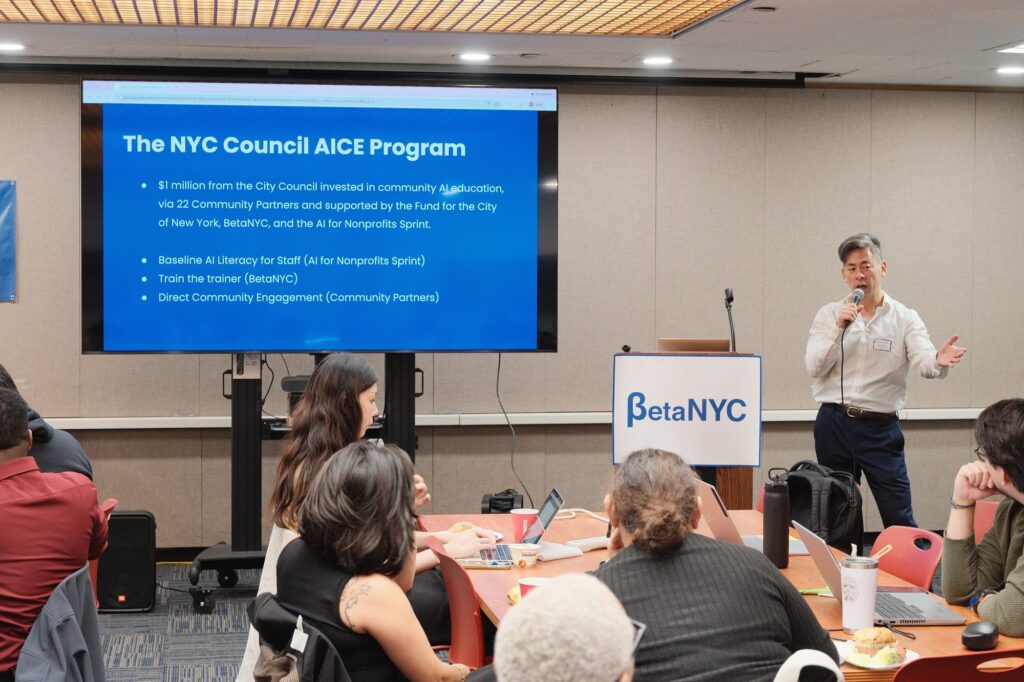
In fall 2025, the Council launched the Grassroots AI Education & Engagement Initiative, now known as AI Community Engagement (AICE), to give New Yorkers a voice in how AI is used in their city. It funded 22 community organizations across all five boroughs to teach AI basics and to listen to what their neighbors think about it. The Council chose them for their neighborhood roots, and none had to be an AI expert. BetaNYC is one of the initiative’s three coordinating partners and is funded through it.
Why BetaNYC Trains Trainers
The people best placed to teach AI in a neighborhood are the ones already working there. A staff member at a settlement house, a workers’ center, or a senior program knows their community best, who is in the room, and what those folks are worried about.
AICE works in stages. The AI for Nonprofits Sprint, a program of the Fund for the City of New York (FCNY), gives partner staff a baseline in AI. BetaNYC trains those staff to teach. Then they run classes for their own communities, in their own languages and on their own terms.
Each year, the AI for Nonprofits Sprint surveys nonprofit staff for the AICE initiative. Its AI Use Survey drew 1,027 responses last fiscal year and 872 this year. The two groups are not necessarily the same people.
In this year’s survey, 72 percent of respondents said they have used AI at work, up from 63 percent last year. Two in three have noticed their clients or community members using it. Asked a new question this year, what they want AICE to cover, 37 percent chose privacy and security, more than any other topic. These insightful findings helped to inform our recent Train-the-Trainer Workshop.
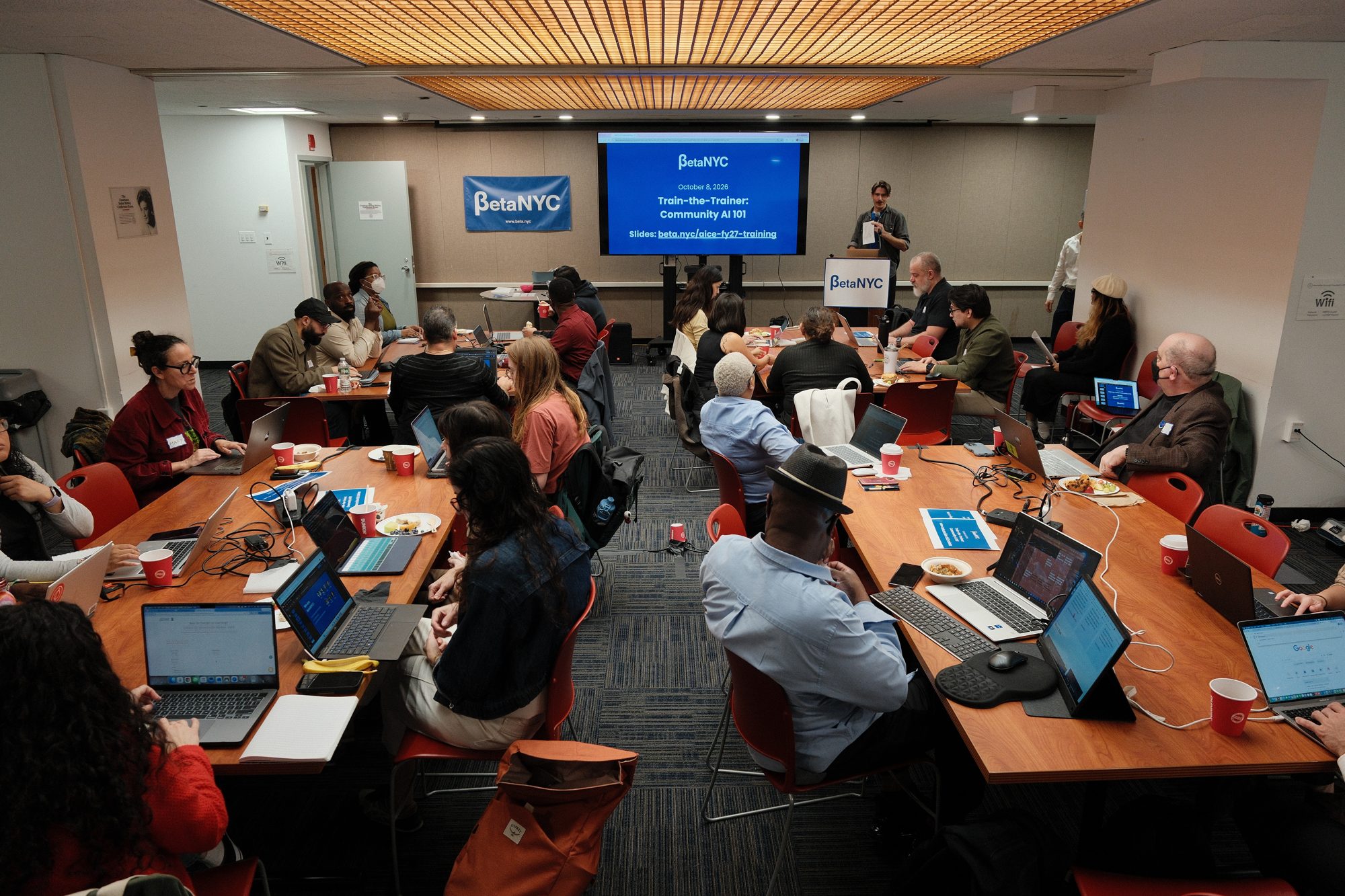
On October 8, 2026, during Digital Inclusion Week, BetaNYC held this year’s Train-the-Trainer Workshop at the Manhattan Borough President’s Office at 1 Centre Street. Esther Caroline, Director of Policy for Manhattan Borough President Brad Hoylman-Sigal, welcomed 34 staff from 22 nonprofits. Many were back for a second year, and there were new faces as well.
Teaching: Laying the Groundwork
We spent the first part of the morning on teaching, with the laptops closed. Naeema Haque, Development and Strategy Manager at BetaNYC, opened with the line that framed the day: “AI isn’t magic. It’s manufactured.” She compared it to plastic…it’s cheap, it’s everywhere, and it has an environmental cost most of us never see because we only touch the finished product.
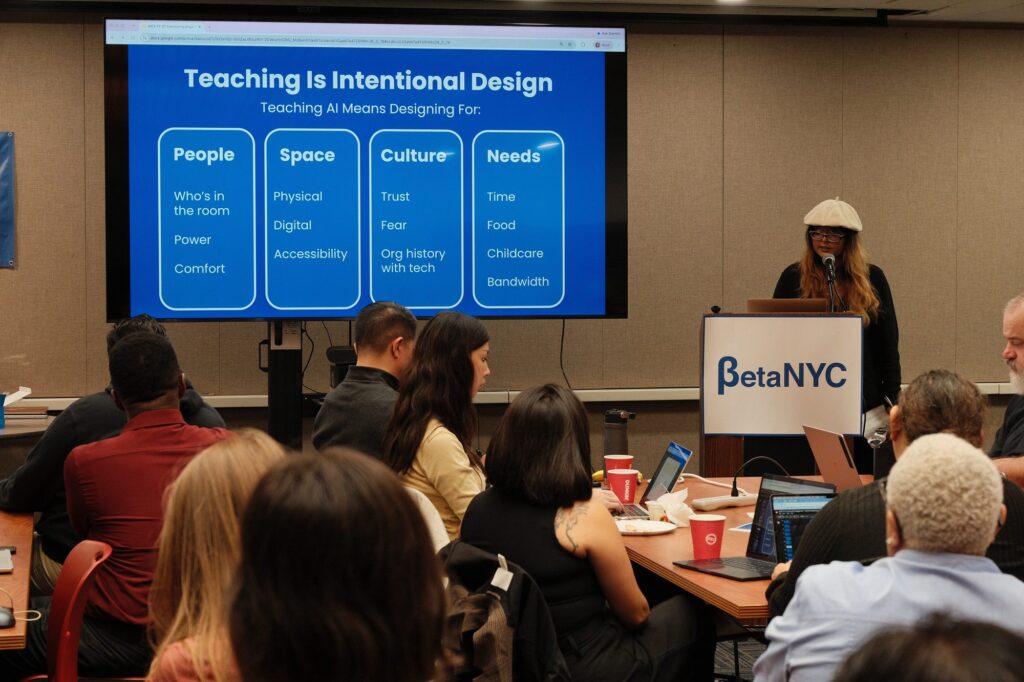
A good AI class is planned around the people in the room, the space, the organization’s history with technology, and what participants need to be comfortable enough to learn. That includes food, childcare, and time. It also means acknowledging fear and skepticism before opening a single AI tool.
Guardrails, Starting with Privacy
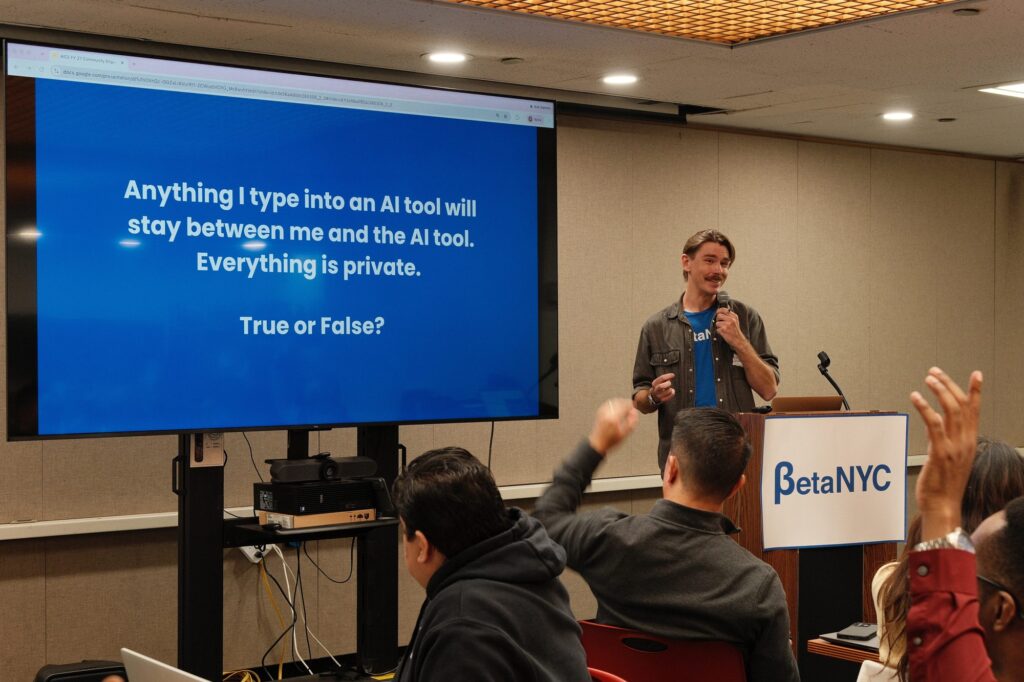
Duncan Ballantine, Director of Public Programs, ran the guardrails section as a true or false game:
Anything I type into an AI tool stays between me and the tool.
FALSE. What you type may be stored, reviewed, or used to improve the model, and policies can change. BetaNYC’s rule of thumb: if you would not post it on a public website, do not put it into an AI tool. That covers names, addresses, immigration status, health details, and case notes.
AI can make up facts, sources, and quotes that do not exist.
TRUE. It sounds confident, but it is predicting words, and it is no calculator. Ask it the same question twice, and you may get two different answers.
One line from this section is easy for any trainer to repeat: if it affects someone’s rights, safety, or legal status, a human decides.
Then, Hands-On Practice
Gabrielle Langston, Director of Workforce Development, led the hands-on activity portion.
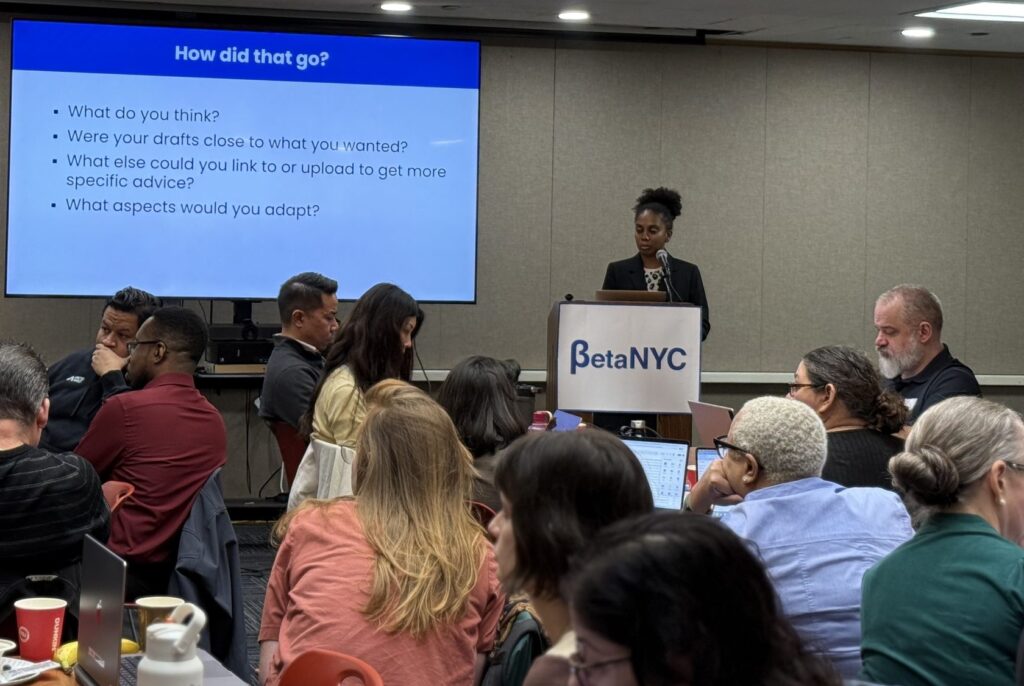
Everyone started with privacy settings. From there, trainers summarized an article, tried prompt templates from the Decoded Futures prompt cookbook, made a flyer, and drafted a letter to their Council Member, using our tool Boundaries Map to find their district first.
One activity we did together was called Strong and Wrong. You tell an AI Tool something you know is false and watch what it does. Often it goes along with you. Watching a tool agree with a lie you just made up is a quick lesson in checking its answers.
AI Built by New Yorkers, for New Yorkers
We wanted trainers to leave with local examples:
- Roxanne, from Housing Court Answers, helps tenants get repairs made.
- Reclamo AI, from Justicia Lab and the New York Legal Assistance Group, helps workers understand their rights over WhatsApp, in their language.
We showcased two of our own.
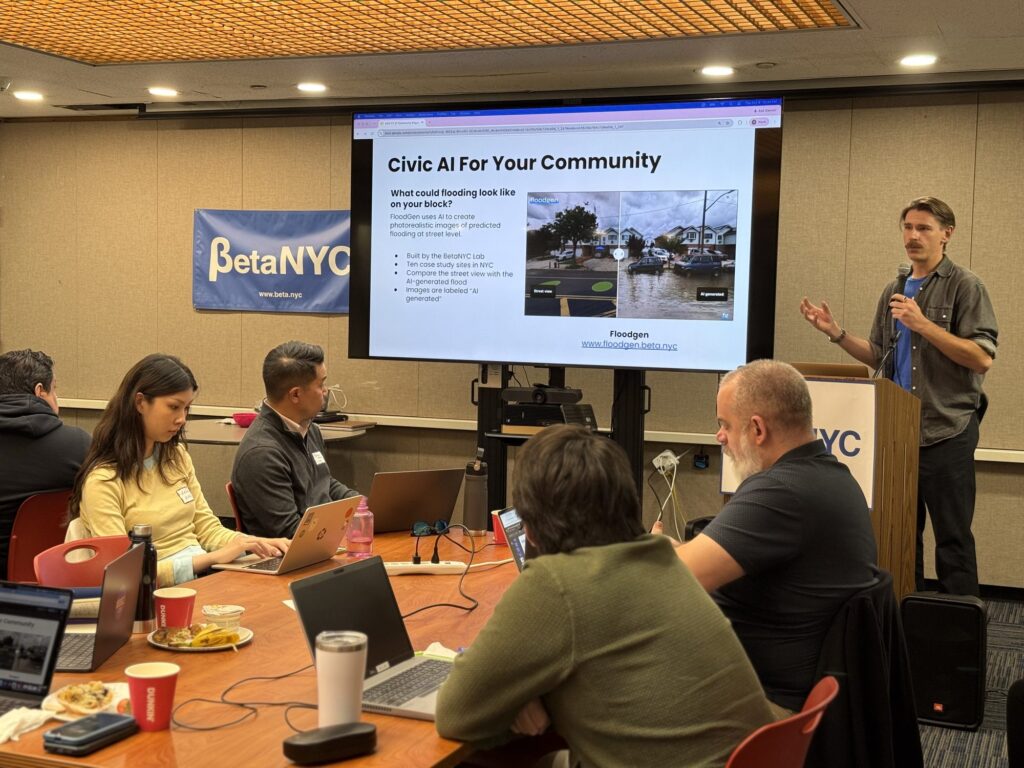
- FloodGen creates labeled, AI-generated images of what predicted flooding could look like on a New York City block.
- Our AI Tools for NYC Democracy MCPs connect AI assistants to official City and State records, so a question about Council legislation or city spending is answered from the source. You still check the answer.
What the Trainers Took Home
Every trainer left with materials from BetaNYC they are free to reuse and adapt for their AI workshops:
- A takeaway deck written in plain language, built to be copied and tailored for each community
- A teaching tips guide for planning an inclusive workshop
- A glossary of AI terms with everyday analogies
- A private Discord channel to trade notes with other trainers
What Comes Next
The trainers now take this to their own communities. One workshop is a start, and learning sticks when people come back to it, which is why office hours and the trainer community matter as much as the slides.
In our testimony at the Council’s October 5 hearing on AI, we asked the Council to make public AI and digital literacy a standing budget line.
Take the Class
You do not need to work at a partner organization to learn this. BetaNYC’s AI 101 class runs for 90 minutes, is open to anyone, and needs no tech background. See a select number of our AI 101 recordings on YouTube!
Thank you to the Office of the Manhattan Borough President for hosting us, to the New York City Council for funding this work, to FCNY, the AI for Nonprofits Sprint, and Equitas Partners for their partnership, and to Data & Society, whose material informed the curriculum.
Most of all, thank you to the trainers, who work tirelessly to empower the communities they serve!
All content is copyrighted by BetaNYC, a project partner of the Fund for the City of New York, and is licensed under Creative Commons Attribution-ShareAlike 4.0 International (CC BY-SA 4.0).
Sources
- New York City Council, “City Council Launches First-of-Its-Kind Grassroots AI Education Initiative,” November 24, 2025.
- AI for Nonprofits Sprint, “AI Use Survey: FY26 vs. FY27” (AICE initiative)
- BetaNYC testimony, NYC Council hearing on artificial intelligence, October 5, 2026.