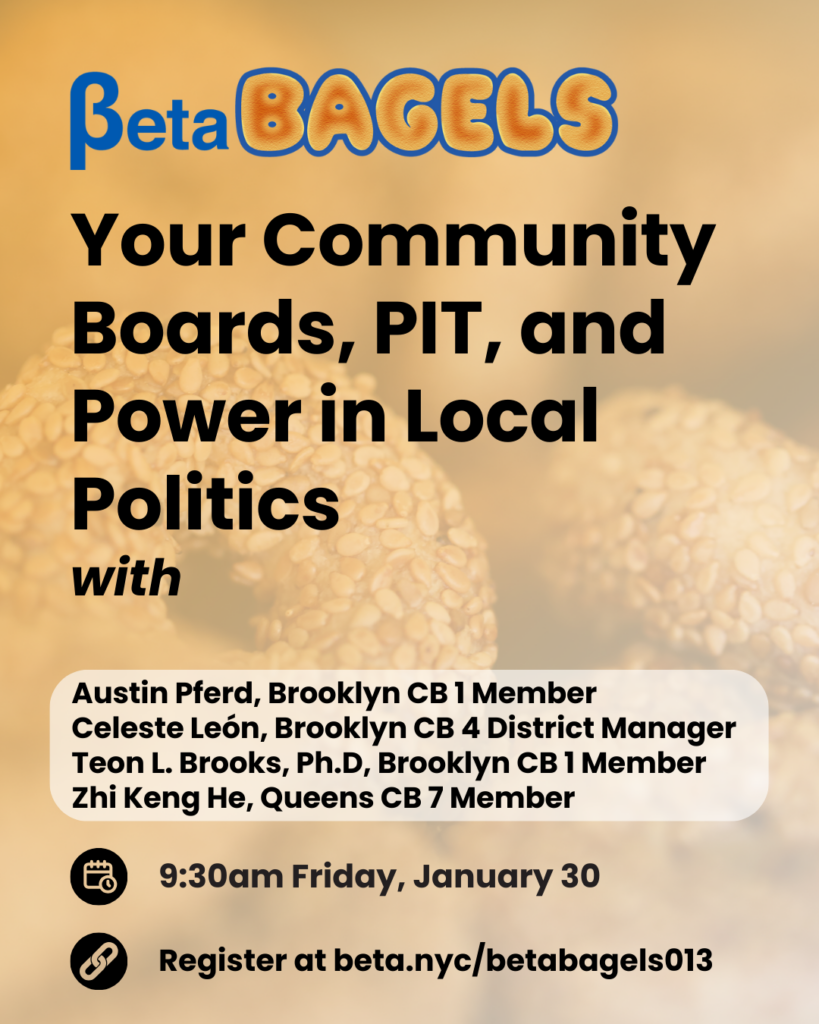
ICYMI: we’ve posted Friday’s BetaBagels 013 to our YouTube.
We hope all of you are doing as well as you can. As a pre-K parent, I’m still a little overwhelmed by these huge snow mounds at crosswalks and the nearly impossible bus stops. Maybe in the second half of this century, we’ll finally find a way to prioritize pedestrians and people with mobility devices and/or strollers.
Are you ready to serve your community?
The beginning of the year is always Community Board application season. Since many of you have asked, “How can I volunteer my professional skills?” At this time of the year, we always respond with, “Have you thought about your Community Board?”
While imperfect, Community Boards are a unique framework for hyperlocal democracy in New York City. Community Boards need our skills just as we need to learn from our neighbors.
Join us on Friday morning as we explore how public interest tech can support our neighborhoods!!
Are you ready for NYC School of Data 2026?
This year, NYC School of Data will be a TWO-day adventure. Not only will we feature three floors of amazing conversations on Saturday, March 28, but we will also continue the conversation on Sunday, March 29, with an unconference. There are TOO many things happening in this City and this nation to limit the conversation to one day.
This Saturday, we will launch early-bird ticketing and our call for volunteers. Be sure to bookmark schoolofdata.nyc for the latest information! If you submitted a proposal to organize a session at School of Data, we will be in touch and continue to follow up.
Our beliefs are not neutral.
We deeply believe that we all have something to offer each other. The quest for a better life and community is what makes this City exceptional.
Right now, many of us are grieving. These are not normal times. We are facing the greatest test of our democracy. America is at war with itself, and our fundamental beliefs of life, liberty, and the pursuit of justice are being questioned.
In 2020, many of us supported our neighbors through the darkest time we’d seen. Six years later, the days are filled with a different type of darkness.
Let me help you shine a bit of light. My neighbor, friend, and reporter, Anya Kamenetz, wrote this week’s newsletter as a note to her “friend who isn’t political.” In it, Anya highlights Elizabeth Svoboda’s research, “taking a small action, in line with your values, improves well-being and reduces symptoms of depression and anxiety…action amplifies a sense of agency—not the other way around.”
As a parent of a medically complicated toddler who is d/Deaf, I understand what it is like to be scared, tired, frustrated, angry, and grieving.
Personally, the murder of Alex Pretti hits hard because I spent last week in the ICU with my son. Actually, I have spent MANY weeks in the ICU with him and my wife. Together, we have only seen the best of those who have given comfort, care, and support to families in extreme situations. Then, seeing photos of Mr. Pretti hiking, biking, and engaging in Mutual Aid, I recognized someone from many of the communities I live in.
While it might seem like this is a new attack on liberty, many communities across the country have faced terror from the state. Minneapolis is a clear statement that this federal administration will wield state terror on all.
In the 21st century, technology enables this terror. We can not separate technology from the world we live in. The tools we use to live our lives reflect the society we live in. We cannot talk about building better systems without discussing where those systems will be used and who will benefit from them. We must ask, who will be harmed, and who will profit?
If you’re out in the streets, we encourage you to know that the federal government will not care if you’re providing mutual aid or protesting. According to a number of news sources, everyone is being considered an enemy of the state. We saw this in the creation of gang databases, and we see it now in Federal databases.
Please stay safe. With solidarity and love, we hope to see you soon.
— Noel Hidalgo
Support BetaNYC Today! 💗
Because of this community, 2025 was a big year for public programs! New Yorkers showed up in record numbers: 6,394 people joined NYC Open Data Week, and 564 attended NYC School of Data, building the relationships and skills that make civic participation easier, and more powerful.
If our events have helped you feel more informed, connected, or empowered, please consider giving today. Join us in reaching our goal of 200 sustaining donors: https://beta.nyc/donate
What’s New at BetaNYC? 🚀
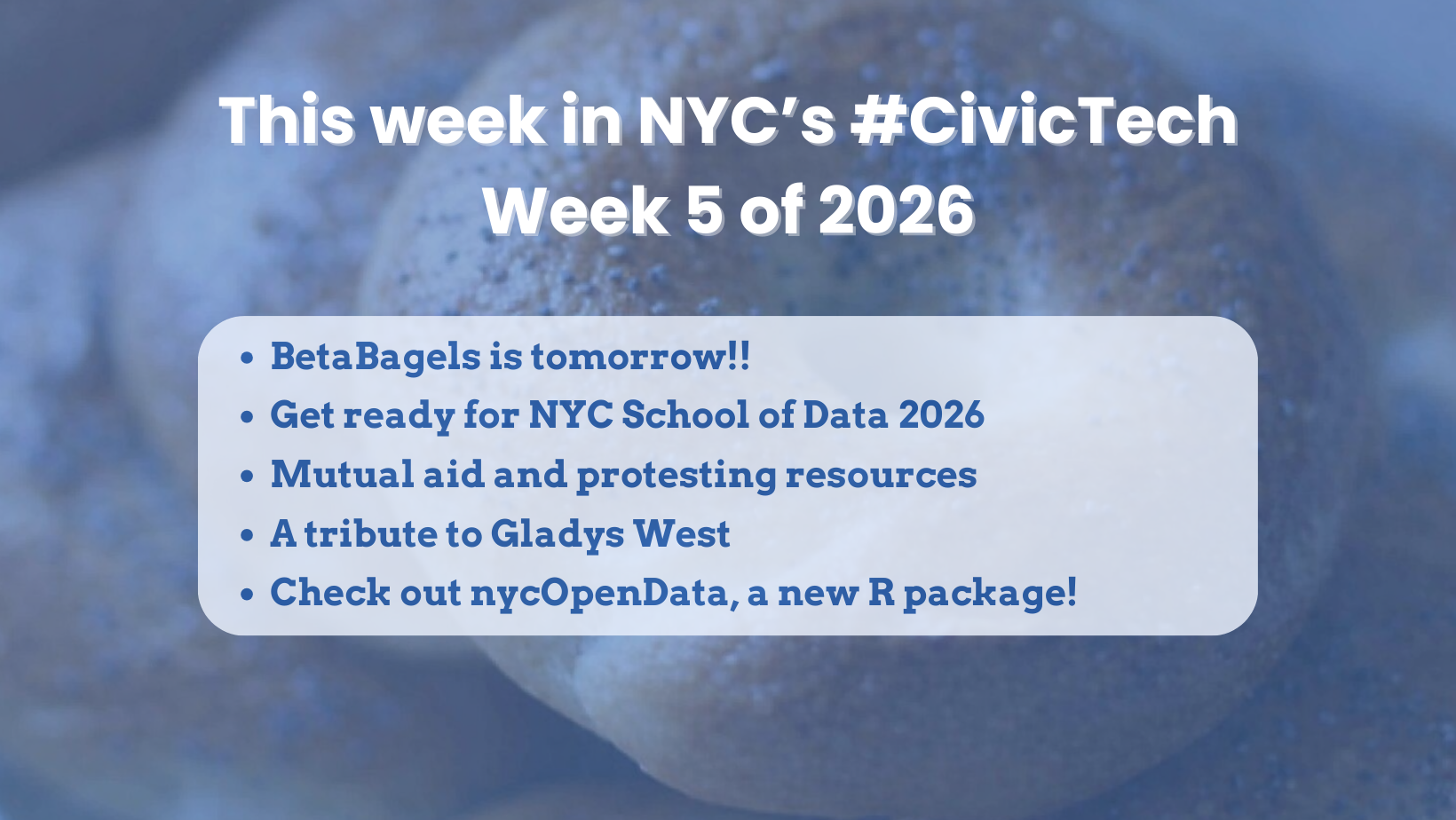
- Apply to your Community Board! ICYMI, Community Board applications are now open for Brooklyn, Manhattan, Queens, and Staten Island, with The Bronx launching earlier this week.
- A local spotlight on the PIT Pop-Up: Baruch’s The Ticker recaps the CUNY PIT Pop-Up relaunch at the Oculus and what visitors experienced.
Upcoming Events with BetaNYC 🎊
- January 30 at 9:30 am BetaBagels 013: Your Community Boards, PIT, and Power in Local Politics
- February 9 at 6 pm Discovering NYC Open Data: Online Session: February 2026
- March 22 to 29 NYC Open Data Week 2026 — save the date!
- March 28 NYC School of Data — save the date!
Election Corner 2026 🗳️
- NYC’s budget gap, explained: THE CITY reports on Mayor Mamdani framing a multibillion-dollar deficit as the result of years of underbudgeting, and what the early budget fight could mean for services.
- A BetaNYC community member takes on AI oversight. City & State has a profile of Assemblymember Alex Bores’ NY-12 run, centered on accountability and rules for AI.
- Borough presidents now have more housing power: Gothamist takes a look at NYC’s changed land-use landscape and how borough presidents may influence housing decisions going forward.
- Need a primer on DSA in NYC? Start here. City & State’s explainer breaks down what the Democratic Socialists of America (DSA) are, how they operate locally, and why they matter in city politics.
This Week’s Media Watchlist 🎥
- A tribute to the person behind modern navigation: NPR has an obituary for Gladys West, the mathematician whose geodesy and satellite modeling work helped make GPS possible.
- A U.S. Border Patrol history lesson: The Intercept traces how U.S. Border Patrol culture and enforcement practices developed over time, and why critics say the institution has been shaped by brutality since its early years.
- ICE surveillance, revisited. On The Media digs into tools and tactics used for enforcement and tracking. Plus, check out John Oliver’s refresher on gang databases as context.
- Inside Palantir’s ICE debate: Wired reports on internal conflict and messaging around Palantir’s work with ICE/DHS in the wake of multiple killings and employee pushback. (Paywall)
- Recap of NYC schools’ remote snow day: THE CITY’s has a rundown of NYC’s remote-learning snow day and the tech hiccups families reported, including problems tied to Google Classroom/logins.
Toolkit Spotlight 🛠️
- A new way to use NYC Open Data in R: Christian Martinez published a post introducing nycOpenData, an R package that wraps dozens of NYC Open Data datasets into tidy, classroom-and-civic-work-friendly functions. Their companion site walks through what nycOpenData covers and how to use it.
- Public art, mapped in a dataset. Jordan Engel uses a vision-language model developed by Sean Hardesty Lewis to analyze and map how public art is distributed across Manhattan.
Data Privacy Watch 🔐
- A privacy wake-up call: NPR reports on concerns that DOGE improperly accessed and shared Social Security Administration data, and how lawmakers are pressing for answers about who had access and what safeguards failed.
- Open source as a national strategy: Dries Buytaert argues that “digital sovereignty” isn’t just policy talk: it requires sustained public investment in open-source infrastructure and maintenance.
- Use data to slow super-speeders: Streetsblog offers a practical guide to using public data (and the right narratives) to push for safer streets and enforcement that actually changes behavior.
Jobs Alert and Announcements 💼
- Adobe is hiring a Senior Fullstack Engineer – Gen Ai solutions.
- The Door is seeking a Data & Evaluation Manager for Health and Counseling Center.
- Mount Sinai is recruiting a Data Analyst I-Emergency Medicine.
- The MTA is searching for a Senior Design Manager (Systems) and a Data Specialist (Capital Strategy).
- New York Edge is recruiting a Data Coordinator.
- The NYC Campaign Finance Board is hiring a Neighborhood Engagement Coordinator.
- The NYS Department of Transportation is searching for a Student Assistant.
- The Office of Council Member Dr. Nantasha Williams is offering a offers a year-round Internship Program.
- Open Plans is seeking a Livable Streets Summer Intern.
- Prospect Park Alliance is seeking a Park Operations + Systems Specialist.
- Tech:NYC is hiring an Associate Director, Workforce Programs.
Upcoming Events 📅
Note: All times are listed in ET
- January 31 at 10 am Civic Tech’ish Coffee Chat
- February 1 at 1 pm Help Us Distribute Whistles in Jackson Heights
- February 3 at 6 pm Deborah N. Archer — Dividing Lines: How Transportation Infrastructure Reinforces Racial Inequality
- February 3 at 6 pm Community Board Social Hour (Brooklyn)
- February 3 at 6:30 pm GenVote Rising: A Movement Fundraiser
- February 10 at 1 pm Co-Existing with AI: Work, Love, and Play in a Changing World: A Conversation with Kay Firth-Butterfield
- February 10 at 2 pm Closing the Climate Adaptation Gap: How AI Can Connect Cities, Investors, and Innovators
- February 10 at 6:30 pm I ♥ Transit Happy Hour
- February 12 at 6 pm Community Board Social Hour (Queens)
- February 18 at 10 am The Next Wave Black History Month Summit
- February 18 at 5 pm Friends of BRL Happy Hour
- Februay 19 FOI Fest 2026
- February 26 at 9:30 am Jobs NYC Bronx Job Fair
- February 26 at 12 pm Cyber Civic Engagement
- March 5 at 5 pm NYU-2026 PIT-UN Tech for Change Urban Informatics for Safe, Just, and Thriving Communities Hackathon
Want to sponsor this newsletter or be featured in future ones? Share your community resources, projects, events, and anything else happening so we can feature them in future posts.
What did you think of today’s newsletter? We’d love to hear your feedback and ideas. Reply to this message.
Did a friend forward this to you? There are three ways you can subscribe to our newsletter. Read it on our website, receive it via email, or via LinkedIn!
Take care of each other, and have a great weekend!