Dear friends,
Some moments remind us why we gather. Where being in the same room opens space for reflection, possibility, and connection that carries beyond the day itself. In these moments, we remember what it means to learn from one another, to build with care, and to move forward together.
This is one of those moments. We are in a unique moment. We are in a special time.
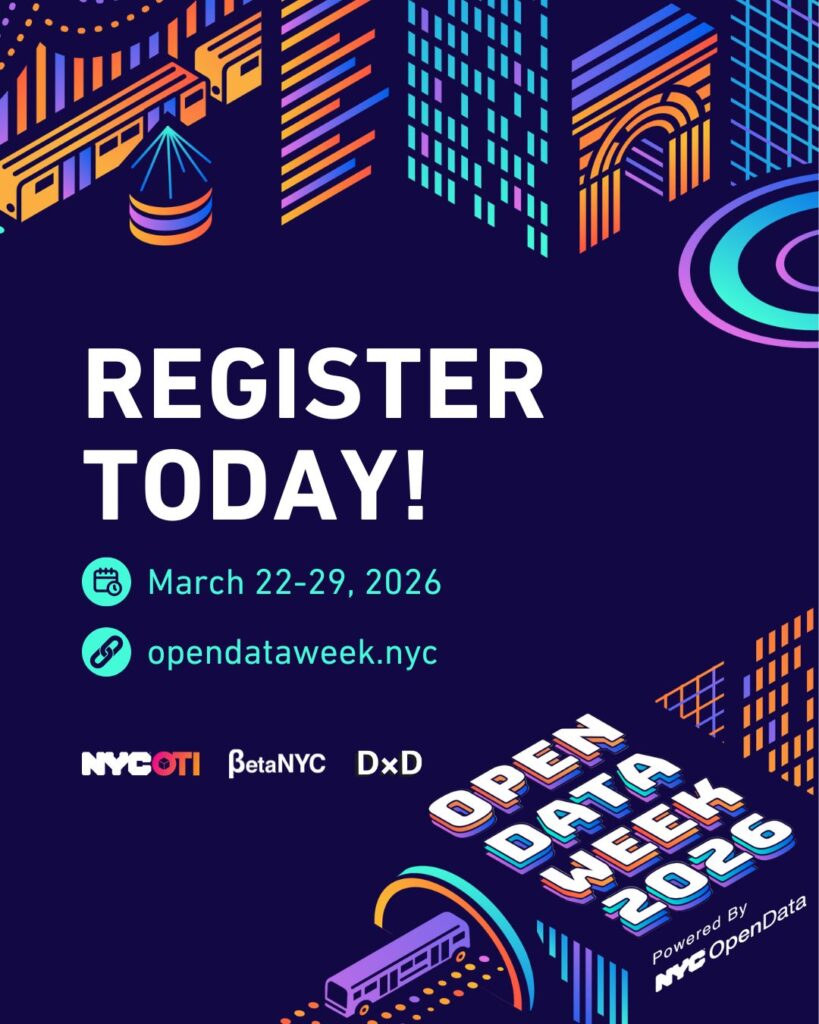
As we mark the 10th anniversary of Open Data Week, we find ourselves in a time that calls for presence, community, conversation, and shared purpose. There is something powerful about coming together now, in person, to exchange ideas and shape what comes next. If you can, we invite you to join us.
The Open Data Week schedule is live!
Now is the time to explore our programming and sign up for events before they sell out! Coming up this weekend, there are numerous opportunities to gather, including:
- Keeping It Urban: Art, Tech, Collective
- Discovering NYC Open Data: An Introductory Class (taking place daily from March 21 to March 27!)
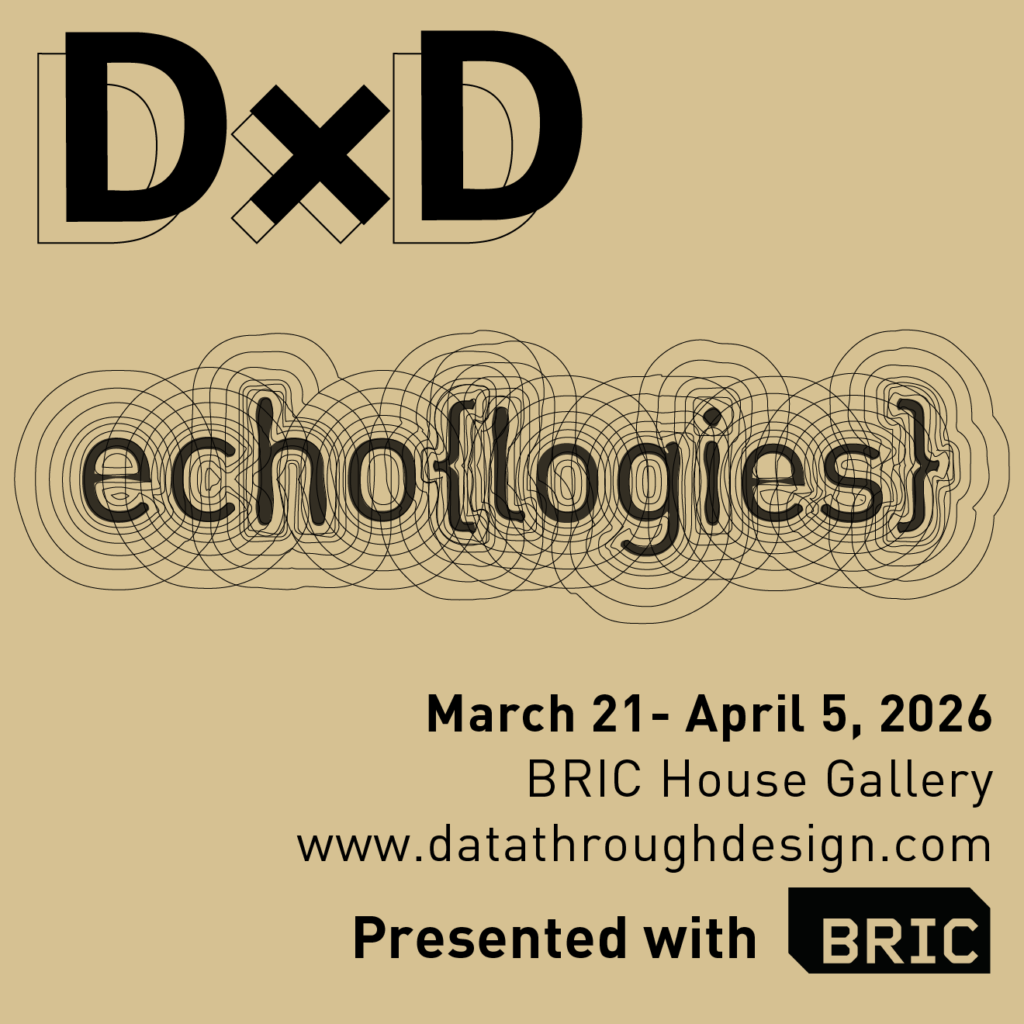
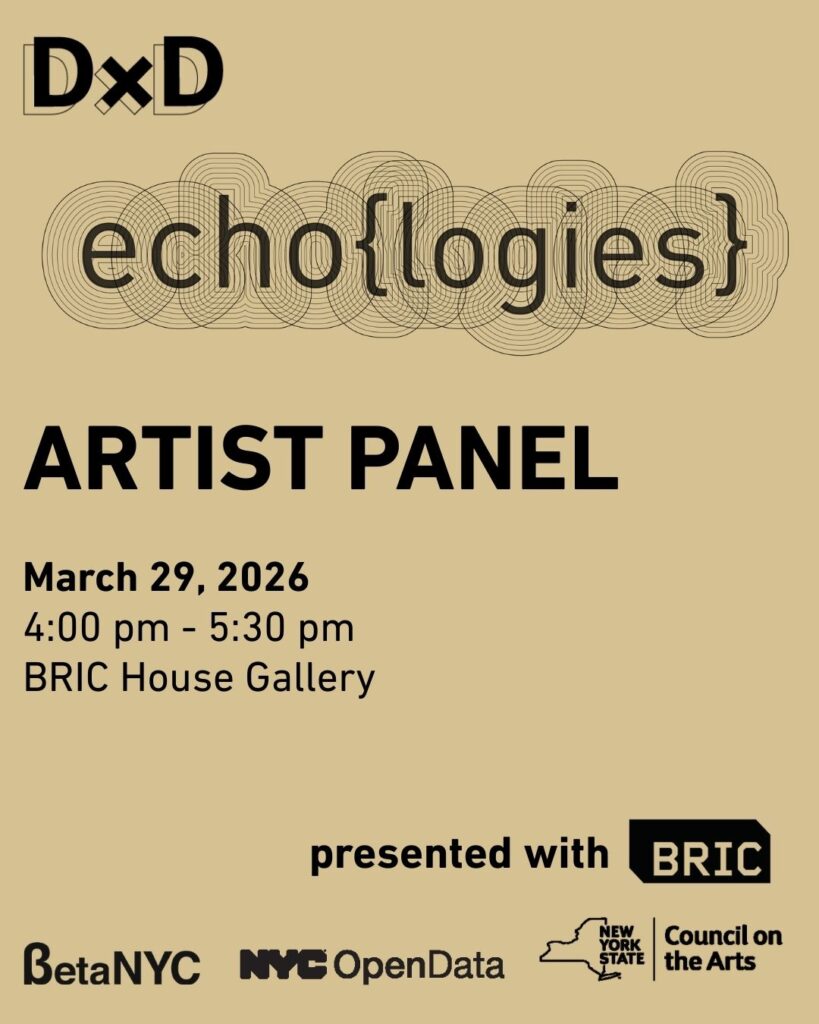
- Data Through Design: Echo{logies} Opening Reception (get your tickets, they will sell out!)
- Data Docs Film Series
- Queens & Me: Neighborhood Stories Beyond the Data
- Stitching the Borough: Embroidering Meaning Through Open Data
Thank you to our festival partners, the Open Data team at the NYC Office of Technology and Innovation, and Data Through Design, for helping to shape this magical festival!
We’ll close the week in community with something especially meaningful.
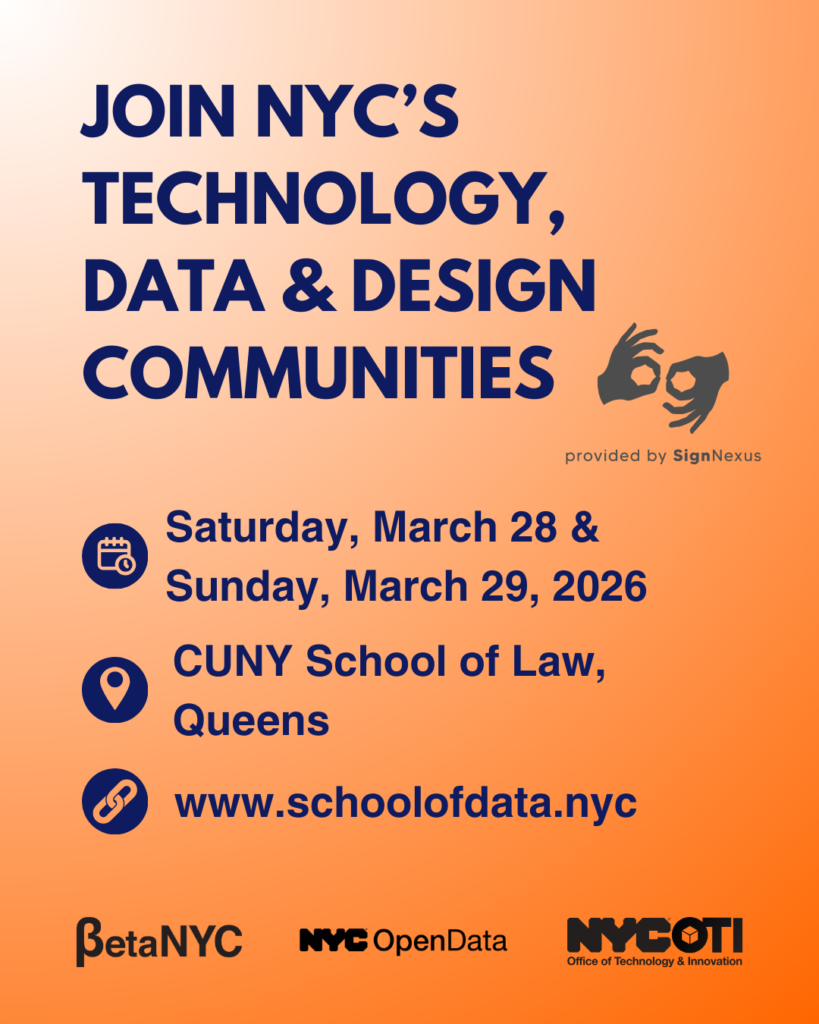
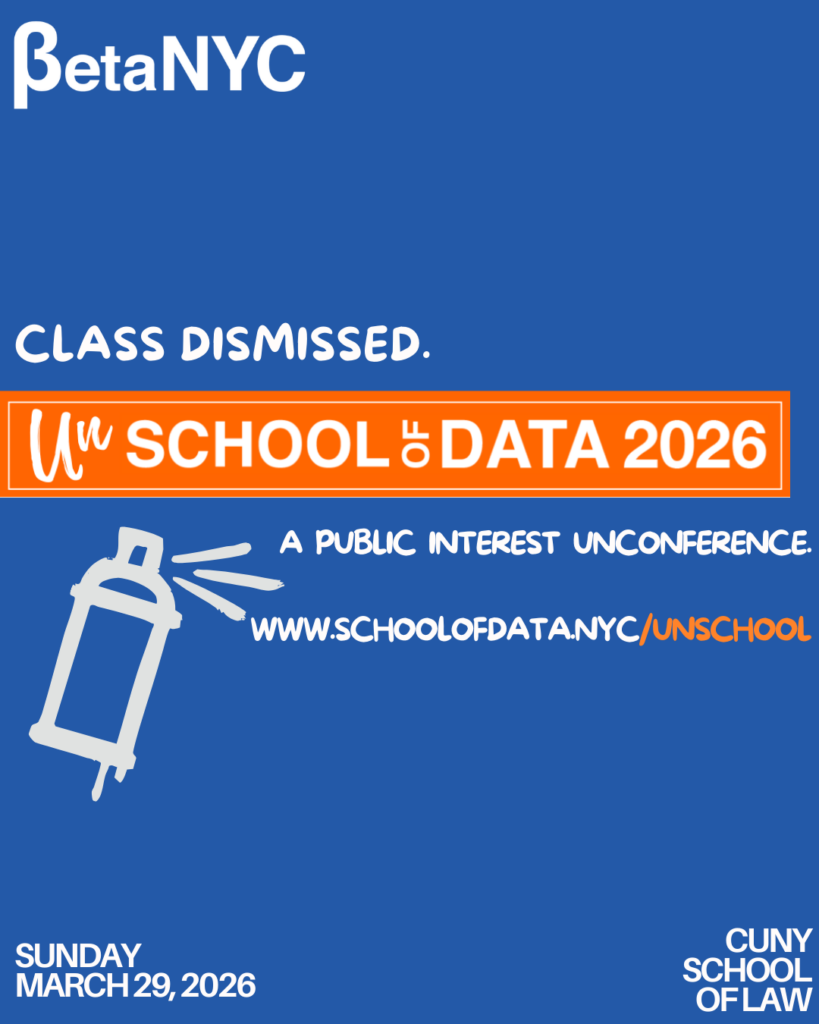
Join us for our 10th School of Data, alongside our first-ever un-School of Data!
School of Data has always been about opening doors and creating space for people to learn, share, and build with data in ways that are grounded in equity and access. This year is no different. You can grab your tickets for School of Data and UnSchool of Data, with opportunities for scholarships, free on-site childcare, and American Sign Language (ASL) interpretation for all mainstage sessions to help make the day more accessible. Head to schoolofdata.nyc for the full details.
Thank you to the Robert Sterling Clark Foundation and all our sponsoring partners: Reinvent Albany, Nava, SVA Masters in Data Visualization and Communication, HaydenAI, CUSP at NYU, Cyvl, Siegel Family Endowment, Rockefeller Brothers Fund, Alfred P. Sloan Foundation, SignNexus, and the NYC Council, for making our biggest year yet possible!
Introducing March’s PITech’er of the Month!
As we countdown to Open Data Week and School of Data, we’re excited to feature a conversation with OTI’s Aryanna Holder! Aryanna is a pivotal part of making open data transparent and has an insightful perspective on how to bring the community together. Check out our interview and learn more about her work!
We hope to see you next week, in community, in conversation, and in this unique moment.
In solidarity,
Gabrielle Langston
Public Interest Technologist of the Month ✨
Our Civic Innovation Fellows, Ayela Janjua and Jillian Melough, sat down with Aryanna Holder to talk about her path into public interest technology, her work making open data more accessible, and why meeting people where they are is key to serving communities.
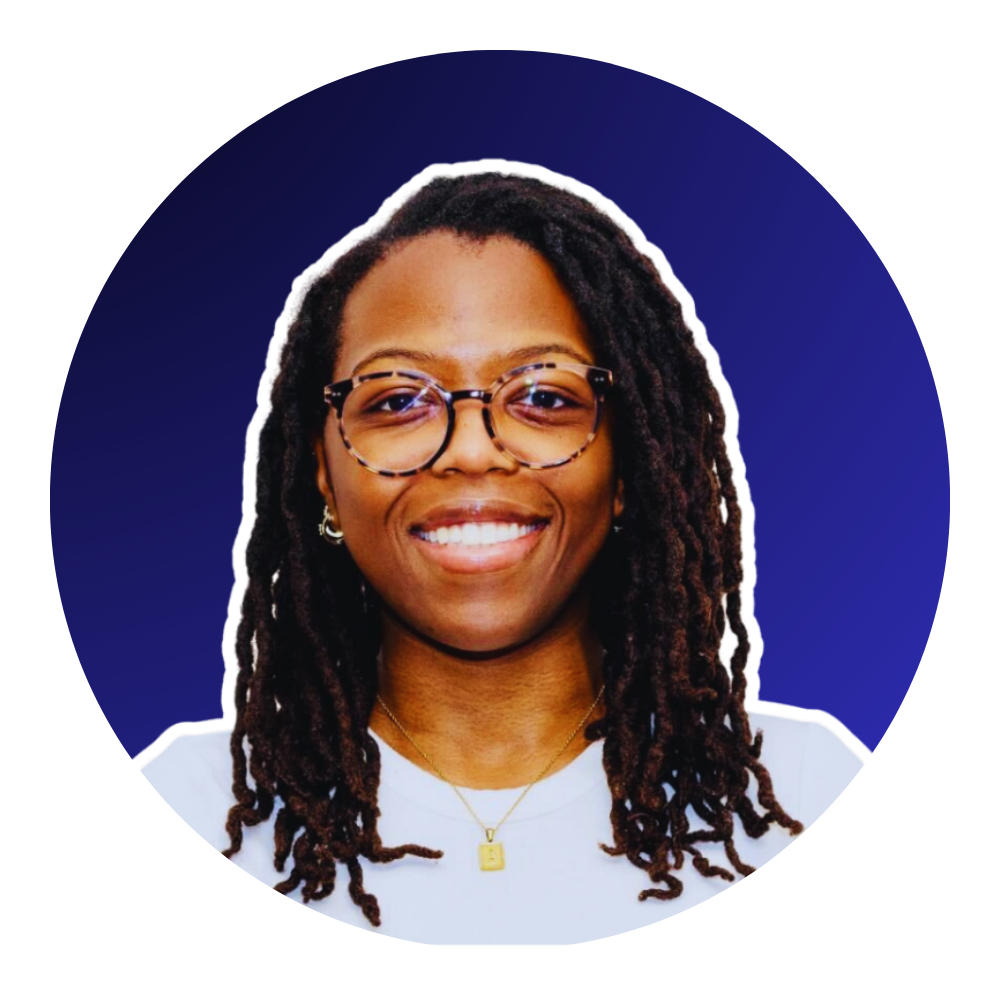
Aryanna Holder, (she/her), Open Data Analyst at the NYC Office of Technology and Innovation’s Open Data Team
Note: This interview has been edited for length and clarity.
Q: How did you get started in public interest technology?
Aryanna: When I was an undergrad, I did a lot of research for the first two years, where I taught people how to work with tech. I taught all age groups from the fourth grade all the way to college. We taught them basic, foundational coding knowledge and the foundations of computational thinking. That was my first spark of noticing how people can use tech for their own interests because we were teaching them how to make classic games like Frogger and Pac-Man.
When I started to look for work, I already had an idea that I wanted to make sure whatever I’m doing is beneficial to the masses, the people. I saw some things the city was doing. At first, it was the IBX, a new train coming through. I remember seeing that and thinking, it would be really cool to work on something like that, to put these tech skills to use in a way that would benefit people, so I started paying more attention to City roles. I wasn’t just applying to private firms. And not to say that there’s no way to engage in public interest technology outside of being a public servant, but that’s where my mind was when I applied.
Q: How do you see your work progressing in the future?
Aryanna: A lot of what I do is use open data to allow government agencies to be more transparent and to grant New Yorkers a bit more insight into all of the things they have at their disposal. I want to build on this and ensure to find the best ways to keep people informed about what they have available to them in the most accessible and inclusive way. Whether that’s making digital tools or interfaces that are accessible and easy to read, and letting people know this is what initiative or program can help you with XYZ, I want to continue to build on using PIT to keep people informed and educated on what they can do, and how their services can best benefit them. I find that a lot of the issues with access are that some people don’t know where to start. You don’t know what you don’t know.
Q: Do you have any ideas, specific ways, or innovations you think could make these tech tools more accessible and generalized to the public?
Aryanna: Meeting people where they are. It’s hard to look at things with a very wide scope— let’s say we wanted to look at or tackle one initiative or one program at a time. Say you were starting with a specific tool or portal website, and find, based on some data, that the majority of users access this site on mobile, than on desktop. And then, if we’re able to get feedback from those users and find that they have the same issue or pain point accessing this, we address it and try to tackle it right away. If you just try to say, “I’m going to fix everything in the city”, and start in your groups, eventually, you can get to a place where “everything works.” I put that in quotes because things always change. We need to make sure these individual parts work, and eventually the whole will feel like a cohesive system.
Q: What gives you hope on a daily basis?
Aryanna: The people—the communities I’ve been able to be a part of through working with my agency, and working with NYC, even in my personal or volunteer capacity. Just knowing that there are so many others, not just like-minded people, but people who are passionate about this, reminds me that it’s not a lonely effort, and I’m not the only person who wants the best for the city or for people in general.
Sometimes, at a professional event or in a personal capacity, I meet people who have brought these passion projects to life and talk about, “I know somebody personally affected by XYZ, so I built this tool to help them,” or, “I am a person who struggles with this, so I made this to help me, and it ended up helping other people.” Seeing the communities being as active as they are gives me hope that we will continue to make everything work for everybody.
Q: What do you think is the best way to tap into your community to get people more engaged?
Aryanna: It goes back to meeting people where they are. It’s not always easy to get people involved if they can’t directly see the impact. So if you’re talking about things in an abstract way, not everybody’s going to be able to see the vision.
Just now, you [Ayela] mentioned bus speeds. If you were to actually go to where people catch the bus, and start asking questions, such as, “Hey, how do you feel about how long it takes you to get to where you’re going on your commute when you use this line?” Or, “Are there any other bus routes that you take there?”
Meeting people where they are, sometimes that’s a literal sense. Other times, it’s trying to utilize the parts of the community that you already have access to. So it’s word of mouth, trying to provide a little insight into what you’re trying to do, the end goal.
Q: What advice would you give the next generation of public interest technologists?
Aryanna: Remember the why; why you started in this field. One of the things that differentiates public interest technology from other technology fields is that it is so community-based and community-focused. It’s always great to nerd out on all the great things that technology can do that it couldn’t do five or ten years ago. But it’s also important to remember that there’s a community of people that are going to benefit from what it is you’re trying to do. Also, it’s okay to pivot if you need to. Whether that’s from your current field to PIT or vice versa, you probably have more transferable skills than you think! Nothing’s super set in stone.
Q: What’s your experience with School of Data and Open Data Week?
Aryanna: I’ve been to Open Data Week since I started working here, but recently I’ve been more involved in planning it. Overall, the whole festival is a great example of the community aspect and getting people together to share their ideas and how they worked with it. I’ve heard so many stories from people after the fact, saying, “I met so and so at School of Data, we were chatting, and now we’ve made this tool together.”
It’s always great to learn about how people use what we work on. Once we publish the data from an agency, our job is mostly done; of course, we make sure it stays up to date and that all the metadata is right. But once it’s out there, that’s it. We don’t really know how it’s being used until somebody tells us.
So when we go through the Open Data Week proposals people submit, comments we get at events, or questions/requests people send to our help desk, that’s how we know people use this data. It’s almost cyclical; we put the data out, people use it and tell us what they use it for, then that informs what new or updated data we can work with agencies to publish, and the pattern continues. So Open Data week is a larger way to represent that cycle of things happening. My experience has been very positive. And it’s great to meet people who find so much use out of what we all work on.
Support BetaNYC Today! 💗
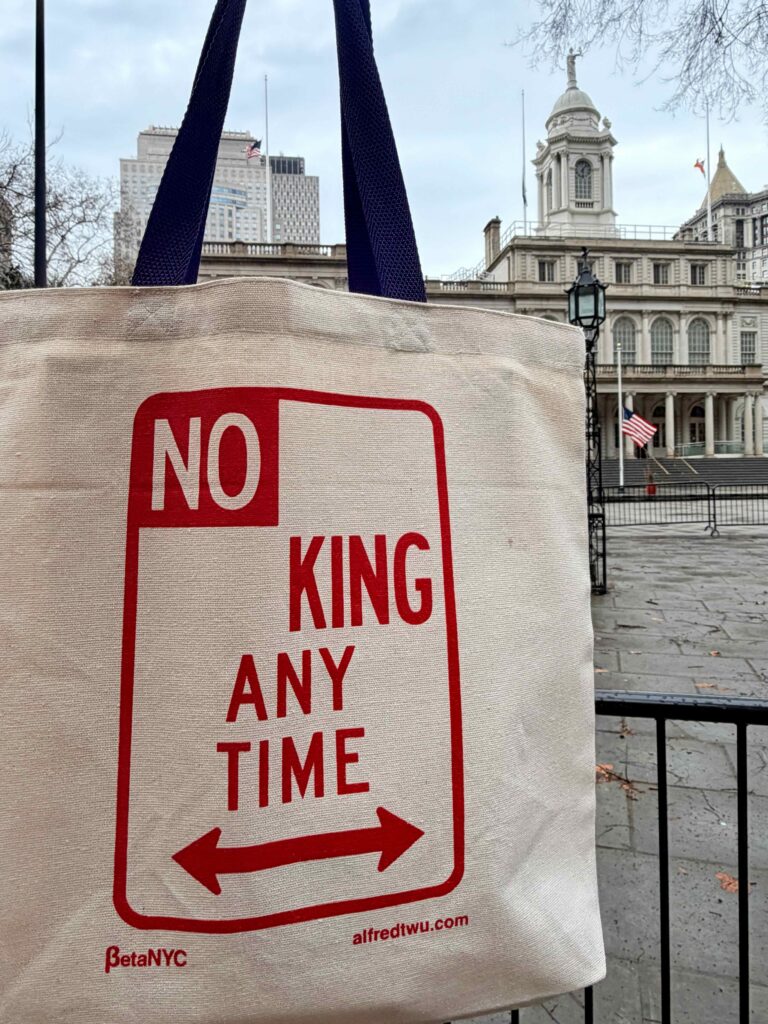
Democracy belongs to all of us, not kings. At BetaNYC, we’re building a more accountable, transparent New York City by equipping communities with the tools and knowledge to take action. Our new “No Kings” tote bag is a small way to carry that message into community board meetings, mapping sessions, and everyday civic life.
Make a donation of $35 or more and we’ll send you one as a thank-you.
Your support fuels our Civic Innovation Lab, our Open Data Ambassadors, and our broader mission to help New Yorkers advocate for their neighborhoods and shape a better city.
Donate and grab your tote today: https://www.beta.nyc/support-us-no-king
What’s New at BetaNYC? 🚀
Read our testimony to the NYC Council: BetaNYC’s Executive Director, Noel Hidalgo, submitted testimony to the NYC Council’s preliminary budget hearing on technology, calling for stronger investment in digital literacy, open data, and public interest technology.
Upcoming Events with BetaNYC 🎊
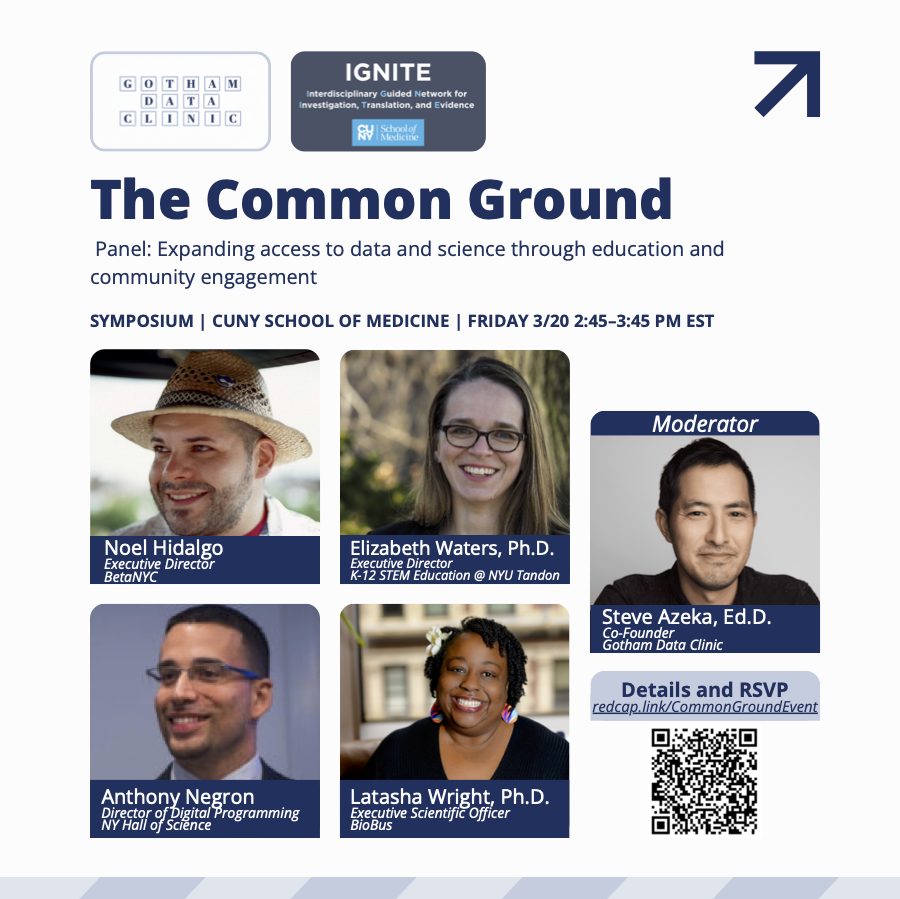
- March 20 at 12 pm The Common Ground Open Science March 20, 2026 Event Reservation
- March 21 at 6 pm Data Through Design Opening Reception: Echo(logies)
- March 22 to 29 NYC Open Data Week 2026 — view the program and register for events!
- March 28 NYC School of Data — get your general admission tickets!
- March 29 UnSchool of Data — get your general admission tickets!
- March 29 at 4 pm Data Through Design: Echo(logies) Artist Panel
This Week’s Media Watchlist 🎥
- What if consent gave people more power, not less? Public Policy Lab revisits its “New View of Consent” and makes the case for research practices rooted in plain language, fair compensation, minimal data collection, and stronger participant control, especially as civic research becomes more public-facing.
- Albany’s annual budget standoff is taking shape. New York Focus breaks down the major fights now driving state budget negotiations, from taxes on wealthy New Yorkers and corporations to energy bills, immigration policy, prison oversight, and competing ideas for how the state should spend roughly $260 billion.
- The climate-cost debate is getting harder to untangle. City & State reports that Governor Kathy Hochul says her push to amend New York’s climate law is aimed at preventing future utility-rate increases, not lowering the high bills New Yorkers are paying today.
- A year into congestion pricing, the ridership gains are getting harder to ignore. New reporting tied to a transit-rider analysis shows NYC subway ridership rose to nearly 1.3 billion trips in 2025, up 7.7% over 2024, with especially strong weekend growth and more riders heading into the congestion relief zone. (Paywall)
- The fight over transit money is now in court. Gothamist reports that the MTA is suing the Trump administration over frozen federal funding for the Second Avenue Subway extension, warning that the delay could drive up costs and put long-promised East Harlem stations at risk.
Jobs Alert and Announcements 💼
- The Beeck Center for Social Impact + Innovation at Georgetown University is recruiting a Researcher.
- Fort Greene Park Conservancy (FGPC) is seeking an Environmental Justice Fellow.
- Gowanus Canal Conservancy is hiring a Communications and Outreach Coordinator.
- HR&A is searching for a Special Assistant & Research Analyst.
- LaGuardia Community College is searching for a Digital Archivist (Art Center Museum Specialist).
- The Mozilla Foundation is recruiting a Program Officer, Arts & Technology (3 Year Fixed-Term).
- The New York City Mayor’s Office is seeking a Senior Advisor, Senior Policy Analyst for Technology & Innovation, and has numerous internship opportunities for high school students, undergraduate students, graduate students, and law students.
- NYC DCAS is searching for a Director of Digital Engagement.
- The Office of Council Member Jennifer Gutiérrez is hiring a Constituent Advocate.
- ONE is seeking a Summer Fellow or Intern – Design and Visualization and a Summer Fellow or Intern – Data and Geospatial Analytics.
- Open Plans is searching for a Community Organizer.
Upcoming Events 📅
Note: All times are listed in ET
- Now through May 31 Printing Black America: Du Bois’s Data Portraits in the 21st Century
- March 25 at 5:30 pm 2026 Open Source Social Event in NYC
- March 25 at 6 pm Shaping Public Memory in NYC Public Parks
- March 30 at 1 pm NYC’S CULTURAL FUNDING DEEP DIVE: Mapping DCLA and City Council Funding
- March 30 at 2 pm Learning Crucial Math for AI
- March 31 at 1 pm DCAS CityTalk – A Panel Discussion Celebrating Women’s History Month 2026
- April 15 at 12 pm Accessibility Jam (A11yJam)
- April 16 at 6 pm 2026 Brooklyn Borough President’s State of the Borough Address
- April 24 at 7 pm City Nerd LIVE at Hunter College Featuring Betsy Plum and Tiffany-Ann Taylor
Want to sponsor this newsletter or be featured in future ones? Share your community resources, projects, events, and anything else happening so we can feature them in future posts.
What did you think of today’s newsletter? We’d love to hear your feedback and ideas. Reply to this message.
Did a friend forward this to you? There are three ways you can subscribe to our newsletter. Read it on our website, receive it via email, or via LinkedIn!
Take care of each other, and have a great weekend!