
Today, we give thanks to community, honor the sacrifices of our neighbors, and pray for peace.
Hello friends, Twenty-five years ago this week, the sky was just as blue and clear as it has been all week. 21st-century optimism was still in the air.
After the towers fell, three communities went to work. First responders sought out survivors and put out fires. The GIS community used their at-home backups to identify critical infrastructure and support the first responders. Neighbors, artists, and creatives provided comfort and care. All of them were told the air downtown was safe. Many of us found this hard to believe, but we were in a crisis.
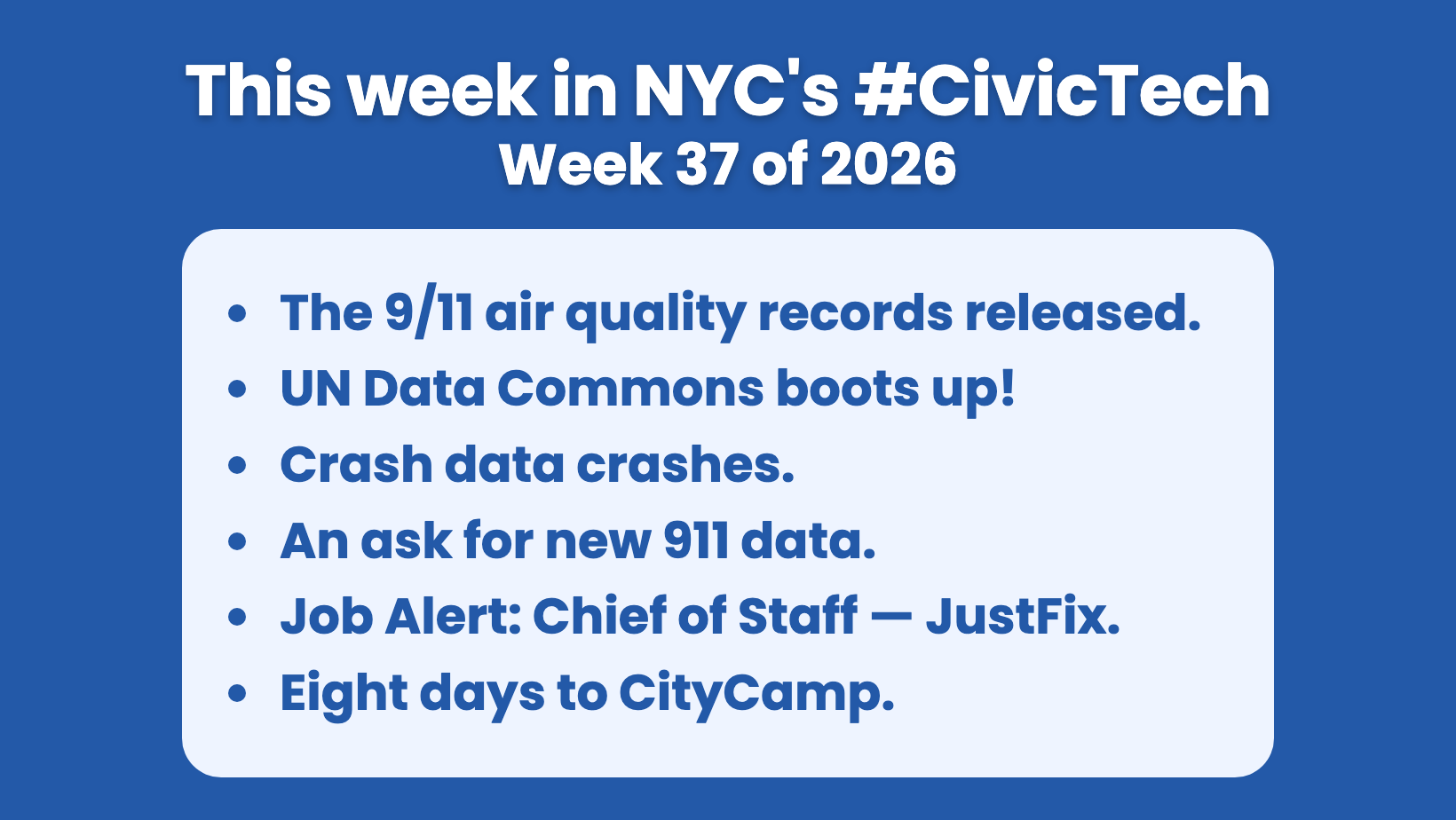
This week, 170,000 pages of city records about that air went online. The documents suggest the City’s air quality was far more toxic than officials said at the time. That is the whole argument for open records in one sentence.
It was an important week for open records; The City Reporter asked the Mayor’s team why its Signal chats with influencers were set to auto-delete when a January memo from the Chief Counsel told staff not to use those apps for city business at all.
Then, the Council spent a morning investigating the seven hours when 911 callers routed through the Bronx could not be heard. Wild that nobody told the public while it was happening. We watched the whole hearing and wrote it up; the CTO’s answers are worth your time.
And then there is the City’s crash data, the dataset behind Crashmapper and every Vision Zero dashboard you have ever looked at. It has not recorded a crash since June 11. I shared my thoughts with Streetsblog NYC on what it would take to get this system back up and running. The short answer: concrete change.
The freedom to know what your government did is only as real as the systems that keep the record. This week those systems aligned with a reporter, a council member, a Streetsblog editor, and decades of advocacy. That is why we do this.
Speaking of doing this: CityCamp NYC is eight days away. September 19, Hunter College, and you set the agenda. Grab your ticket at citycamp.nyc and come build with us.
— Noel Hidalgo
Come Build the Future!!
- Eight days to CityCamp NYC — Our annual unconference runs September 19 at Hunter College. It is the one day a year when New Yorkers set the civic-tech agenda instead of sitting through someone else’s. Tickets fund the programming that makes the rest of the year possible. – citycamp.nyc
Upcoming Events with BetaNYC
- September 16 at 6:00 pm Discovering NYC Open Data: Online Session – BetaNYC
- September 19 at 9:00 am CityCamp NYC 2026 – BetaNYC
- October 4 at 10:00 am Introduction to Artificial Intelligence (AI 101) with BetaNYC – BetaNYC
- October 5 at 12:00 pm AI 101 with BetaNYC at the Bridging the Digital Divide Conference – BetaNYC
- October 15 at 9:00 am Data Days Cleveland 2026 – BetaNYC
- October 16 at 12:00 pm Discovering NYC Open Data: Online Session – BetaNYC
Civic Tech News & Updates
- After 9/11, documents suggest New Yorkers were misled about air quality — More than 170,000 pages, released through an online portal for the 25th anniversary. It is a public-records story as much as a health story: 140,000 people are enrolled in the WTC Health Program and 49,000 have certified cancers. – The New York Times
- Nearly 100 New Jersey towns have banned data centers — Across the river, the response to the AI build-out is happening one zoning board at a time, and Governor Sherrill is not moving toward a statewide rule. – Gothamist
- NYC’s click-to-cancel rule takes effect October 1 — Cancel by the same channel you signed up through, with terms disclosed at both ends and penalties from $525. New York City is the first municipality in the country with its own rule, after the federal version was blocked on appeal. Dark patterns are a service-design problem, and DCWP is treating them like one. – Scripps News
- Comptroller Levine’s 2026 Employer Violations Dashboard is live — Which companies are violating key labor laws, by name, from public enforcement records. – NYC Comptroller
- Navigation apps will keep the Mercator map, UN vote or not — The General Assembly voted 164 to 1, with six abstentions, on September 4 to encourage governments, schools, and tech companies to use the Equal Earth projection when relative size matters. The resolution is non-binding, and Google Maps still serves two billion people a month on a Mercator variant. Equal Earth itself exists because Boston Public Schools changed its wall maps in 2017. City decisions travel. – Ars Technica
- GovTech profiles the PIT Crew — Ex-USDS engineers Luke Farrell and Maya Israni, CTO Lisa Gelobter, twelve-week in-house builds, and more than 4,000 applications. If you are part of this community, you already knew this. Deputy Commissioner Farrell and Sukhi Gulati-Gilbert walked us through the plan at #BetaBagels 016 in August. – Government Technology
Community Wins, and Featured Tools
- A lost archive of NYC’s 9/11 street-art memorials is back online — Michael Townsend’s Tape Art project traced 490 silhouettes across the city in 2001. The 2005 website died with QuickTime and Flash by 2009. Gordon Wintrob rebuilt it in a week for the 25th anniversary. Link rot is a civic problem, and this is what fixing it looks like. – Hannah Frishberg, Gothamist
- Santiago Garces named a 2026 Public Official of the Year — Boston’s former CIO, recognized by Governing for using AI to simplify permitting, improve online services, and expand digital access. Beth Simone Noveck called it “the kind of unglamorous but genuinely impactful work that government technology should be doing more of.” – Governing
AI Roundup
- The EPA wants to let data centers skip public comment — Next City’s Friday roundup leads with a proposed federal rule that would exempt data-center air permits from the notice-and-comment process that gives neighbors a say. – Next City
- The Justice Department sides with OpenAI against The New York Times — A September 1 filing argues that training on news archives is fair use and a national-security interest: the “creative possibilities and public benefits far outweigh any competitive harm.” – Associated Press
- What really happened when OpenAI’s bots “escaped” a cybersecurity test — Heidy Khlaaf, formerly an OpenAI safety engineer, argues the rogue-AI framing is a distraction. The story is a company skipping basic engineering and accountability practices. – AI Now Institute
- OpenAI and MS-ISAC launch an AI cyber-defense pilot for state and local government — Access to OpenAI’s Daybreak tools, with training and hands-on support, for agencies and critical-infrastructure operators. – Government Technology
Jobs & Opportunities
- Call for session proposals, ACT Congress 2026 — Alliance of Civic Technologists — Unconference sessions, workshops, and volunteering at the October 17–18 gathering in Orlando. Email your idea to congress@civictechnologists.org by September 14.
- Project Manager, Division of Housing Incentives — Department of Housing Preservation and Development — Deadline: September 14.
- Youth Apprentice (Architect Apprentice) — Department of Health and Mental Hygiene — Deadline: September 15.
- Service Desk Associate — Mayor’s Office of Criminal Justice — Deadline: September 15.
- Deputy Director of Borough Operations — Department of Transportation — Deadline: September 16.
- Data and Compliance Specialist — Department of Correction — Deadline: October 2.
- Six public-health IT roles, IT Research Scientists Hiring Event — Department of Health and Mental Hygiene — IT economist analyst, GIS and data analytics specialist, service management specialist, health IT manager, application specialist, and data systems developer. Interview day: October 2.
- Special Assistant Intern, Operations — Department of Citywide Administrative Services — Deadline: October 3.
- Policy Assistant — Department of Citywide Administrative Services — Deadline: October 3.
- College Aide — Department of Citywide Administrative Services — Deadline: October 3.
- Schedule Coordinator, Bureau of Bridges — Department of Transportation — Deadline: October 3.
- Construction Intern — Department of Citywide Administrative Services — Deadline: October 4.
- Project Manager — Department of Design and Construction — Deadline: October 31.
- Technical Assistance Specialist, Bureau of Alcohol and Drug Use — Department of Health and Mental Hygiene — Deadline: November 1.
- Planning, Design and Policy Analyst, Public Realm — Department of Transportation — Deadline: November 1.
- Arborist Liaison — Department of Design and Construction — Deadline: November 1.
- Supervisor of Water Microbiology, Public Health Laboratory — Department of Health and Mental Hygiene — Deadline: November 2.
- Senior Drug Checking Epidemiologist, Bureau of Alcohol and Drug Use — Department of Health and Mental Hygiene — Deadline: November 2.
- IT Intern — Financial Information Services Agency — Deadline: November 3.
- Application Support Lead — Department of Consumer and Worker Protection — Deadline: November 3.
- Chief of Staff — JustFix — Strategic thought partner to the Executive Director at the housing-justice technology nonprofit. Rolling.
- Urban Analyst — WXY — Rolling.
- Software Engineer — Yext — Rolling.
Events
- September 16 at 1:00 pm FormFest 2026 — Better Government, One Form at a Time – Code for America and the Beeck Center (virtual)
- September 17 at 2:30 pm Getting Started with the CUNY AI Lab Sandbox – CUNY AI Lab, Graduate Center. First in a fall series: Vibe Coding I–III on September 22, September 29, and October 13; custom models on October 1 and October 15.
- October 3 at 11:30 am Sustainability Networking Fair – Shaping Sustainability, at Essex Market
- October 17–18 ACT Congress 2026 – Alliance of Civic Technologists, in Orlando
Hearings
5 hearings ahead, and one you can still weigh in on. Dates and runway below, so you know what you have time to prepare for.
Already heard, written testimony still open
The Council accepts written testimony for 72 hours after a hearing adjourns.
- September 9 at 10:00 am — heard; written testimony open through September 12 · NYC Council
Oversight – Examining New York City’s 911 Emergency System Outage
Joint hearing: Committee on Fire and Emergency Management, Committee on Technology, Committee on Public Safety, Committee on Governmental Operations, State & Federal Legislation
Short notice
Less than 7 days out. Written testimony is the realistic route here.
- September 15 at 1:00 pm — 4 days away · NYC Council
Oversight – Examining Screen Time and the Use of Digital Devices in New York City Public Schools
Joint hearing: Committee on Oversight and Investigations, Committee on Education
Coming up
Enough runway to write and submit testimony.
- September 16 at 1:00 pm — 5 days away · NYC Council
Oversight – NYPD Crime Statistics
Committee on Public Safety - September 22 at 10:00 am — 11 days away · NYC Council
Oversight – Access to City Government and the Mamdani Administration’s Civic Engagement Efforts
Committee on Governmental Operations, State & Federal Legislation - September 22 at 10:00 am — 11 days away · NYC Council
Oversight – Municipal Recruitment and Civil Service Pathways
Committee on Civil Service and Labor - September 22 at 10:00 am — 11 days away · NYC Council
Oversight – Examining the Executive Order 13 of 2026 Report of Audit Findings and Recommendations
Committee on Immigration
How to testify at a City Council hearing. In-person testimony needs no pre-registration. Virtual testimony requires signing up in advance. Written testimony is accepted up to 72 hours after a hearing adjourns. Details at council.nyc.gov/testify, or email hearings@council.nyc.gov. State hearings are often invitation-only for oral testimony. Check the individual notice.
Media to Watch, Listen, or Read
- [READ] Civil libertarians knew this would happen. We should have listened. — Radley Balko, on the 25th anniversary: how Patriot Act-era surveillance and emergency powers ratcheted up across four administrations and are now aimed at protesters, activists, and cities. – The New York Times
- [READ] How Big Tech captured American schools — Natasha Singer’s investigation: a $23 million AFT deal with Microsoft, OpenAI, and Anthropic, industry-written AP courses, and a decade of Chromebooks. It opens on a Microsoft workshop for 200 teachers in downtown Manhattan. – The New York Times
- [READ] In the US, caution rules on AI ahead of the K-12 school year — Thirty-five states have guidance, 60 percent of educators report unclear district policy, and 200-plus organizations want a five-year moratorium. Written August 31, before NYC’s September 2 moratorium. – Tech Policy Press
- [READ] Teachers fight AI cheating with classes that make students show they are learning — Educators redesigning assessment instead of relying on detectors. – The Washington Post
- [READ] Boston’s CIO has a simple rule for technology: solve problems — Santiago Garces on Wi-Fi in public housing, removing gender boxes from marriage forms, and using 25 years of permitting data to redesign the process. Peer-city service design worth stealing. – Governing
- [READ] After the data centers — On the backlash, and what comes next for the communities organizing against the build-out. – Dissent
- [WATCH] The backlash against data centers — Josh Tyrangiel on a special edition of Washington Week With The Atlantic. – The Atlantic
- [READ] To change data centers, flip the narrative on sustainability – Tech Policy Press
- [READ] The largest data centers are being planned in rural counties — Are developers targeting communities least likely to push back? The Rural Index tests the hypothesis. – Benton Institute for Broadband & Society
- [READ] Data-center permitting models are forgetting transportation costs — Part of Next City’s In the Shadow of the Server series on who builds urban tech infrastructure and who pays. – Next City
- [READ] Cape Town is approving data centers with rules that still treat them like warehouses – Tech Policy Press
- [READ] What Hochul’s data-center moratorium says about New York’s AI future — An op-ed making the industry’s case for a “clear and predictable regulatory framework.” Read it to know the argument. – Crain’s New York Business
- [READ] Meta turns on a $1.2 billion data center, promising water efficiency – Government Technology
- [READ] Brian Romero brings a NYCHA perspective to a Queens Assembly seat — The Democratic nominee for AD 34 lived in public housing for over a decade and couch-surfed for a year. – City Limits
New Data to Note!
New this issue. Every week, this section closes the newsletter with what just landed on the city and state open data portals, pulled straight from data.cityofnewyork.us and data.ny.gov, plus any dataset a reader sends us. A new year of an old series gets flagged so you can tell a fresh subject from a re-upload. A quiet week gets reported as a quiet week.
Community Data to note!
- The UN Data Commons goes fully public on September 17 — An open-source, queryable knowledge graph of statistics from about 17 UN agencies, with API and MCP endpoints. Five days later, Google Data Commons and UN partners host a Builders’ Day at Google NY during UNGA week; applications closed September 10, so this one is for the record, not your calendar. – UN Data Commons Builders’ Day open call (PDF)
NYC Open Data (data.cityofnewyork.us) — 5 new
- 2024 High Volume FHV Trip Data (new edition of a recurring series) · 2026-08-25 — Taxi and Limousine Commission (TLC) These records are generated from the trip record submissions made by High Volume For-Hire Vehicle (FHV) bases. On August 14, 2018, Mayor de Blasio signed Local Law 149 of 2018, creating a new license category for TLC-licensed FHV businesses…
- 2024 For Hire Vehicles Trip Data (new edition of a recurring series) · 2026-08-24 — Taxi and Limousine Commission (TLC) These records are generated from the For-Hire Vehicle (“FHV”) Trip Record submissions made by traditional livery, luxury, and black car bases. The FHV trip records include fields capturing the dispatching base license number and the pick-up…
- 2024 Yellow Taxi Trip Data (new edition of a recurring series) · 2026-08-20 — Taxi and Limousine Commission (TLC) These records are generated from the trip record submissions made by yellow taxi Technology Service Providers (TSPs). Each row represents a single trip in a yellow taxi.
- 2024 Green Taxi Trip Data (new edition of a recurring series) · 2026-08-20 — Taxi and Limousine Commission (TLC) These records are generated from the trip record submissions made by green taxi Technology Service Providers (TSPs). Each row represents a single trip in a green taxi.
- Parking Violations Issued – Fiscal Year 2026 (new edition of a recurring series) · 2026-08-18 — Department of Finance (DOF) This dataset provides data on Parking Violations Issued between July 1, 2025 to June 30, 2026. In New York City, the fiscal year begins on July 1st of one calendar year and ends on June 30th of the following calendar year.
NYS Open Data (data.ny.gov) — 7 new
- Learning and Enrichment After-School Program Supports (LEAPS) Map: 2025-2026 (new edition of a recurring series) · 2026-08-27 — Children and Family Services, Office of Included in the data set are elements that will help the public learn about the agencies currently contracting with New York State to provide LEAPS Program services.
- Learning and Enrichment After-School Program Supports (LEAPS) Data: 2025-2026 (new edition of a recurring series) · 2026-08-24 — Children and Family Services, Office of Included in the data set are elements that will help the public learn about the agencies currently contracting with New York State to provide LEAPS Program services.
- Statewide Multifamily Building Study (SMBS): 2022 General Survey · 2026-08-20 — Energy Research and Development Authority The 2022 NYSERDA Statewide Multifamily Building Study (SMBS) is the first multifamily building stock assessment to characterize the estimated 2.6 million multifamily dwelling units throughout New York State (NYS).
- Statewide Multifamily Building Study (SMBS): 2022 Occupant Survey · 2026-08-19 — Energy Research and Development Authority The 2022 NYSERDA Statewide Multifamily Building Study (SMBS) is the first multifamily building stock assessment to characterize the estimated 2.6 million multifamily dwelling units throughout New York State (NYS).
- New York Sire Stakes Participating Broodmares, Stallions and Yearlings: Annual State Breeding Statistics: Beginning 1964 · 2026-08-12 — Agriculture & NYS Horse Breeding Development Fund These annual state breeding statistics report the number of mares bred, registered NY stallions, and yearlings nominated to the program.
- MTA Subway Hot Car Work Orders: Beginning 2015 · 2026-08-12 — Metropolitan Transportation Authority This dataset contains records of NYCT subway hot car work orders, aggregated monthly by car, car class, and service line. For each grouping it includes the fleet size for that car class, the car’s years in service, and the total number of…
- Tickets Issued by DEC’s Division of Forest Protection: Beginning 2022 · 2026-07-30 — Environmental Conservation, Department of A listing of the tickets issued by DEC’s Division of Forest Protection
This first edition looks back six weeks. From here on it covers the week since the last issue.
Conclusion
What did you think of today’s newsletter? We’d love to hear your feedback and ideas.
Want to sponsor this newsletter or be featured in future ones? Share your community resources, projects, events, and anything else happening so we can feature them in future posts.
Did a friend forward this to you? There are three ways you can subscribe to our newsletter. Read it on our website, receive it via email, or via LinkedIn!
We use AI tools to help scan and organize civic tech news each week — all editorial decisions are made by the BetaNYC team, per our AI Policy.
Build with NYC’s civic data. BetaNYC publishes free, open-source MCP connectors giving AI assistants direct access to NYC Council legislation, city spending and contracts, Council discretionary funding, 311 service data, the City Record, the NYC Charter and Administrative Code, and NYS Open Legislation. If you’re building with AI and civic data, explore them on GitHub.
Take care of each other, and have a great weekend!
BetaNYC is a civic organization improving lives through civic technology, design, and open data. Subscribe to the newsletter · Support our work · Follow us on Bluesky, LinkedIn, Facebook, Instagram, Threads, Mastodon, Reddit, and YouTube.