
The doomers, the boomers, and the assumers — What a wonderful boat we’re all in!
Hello friends,
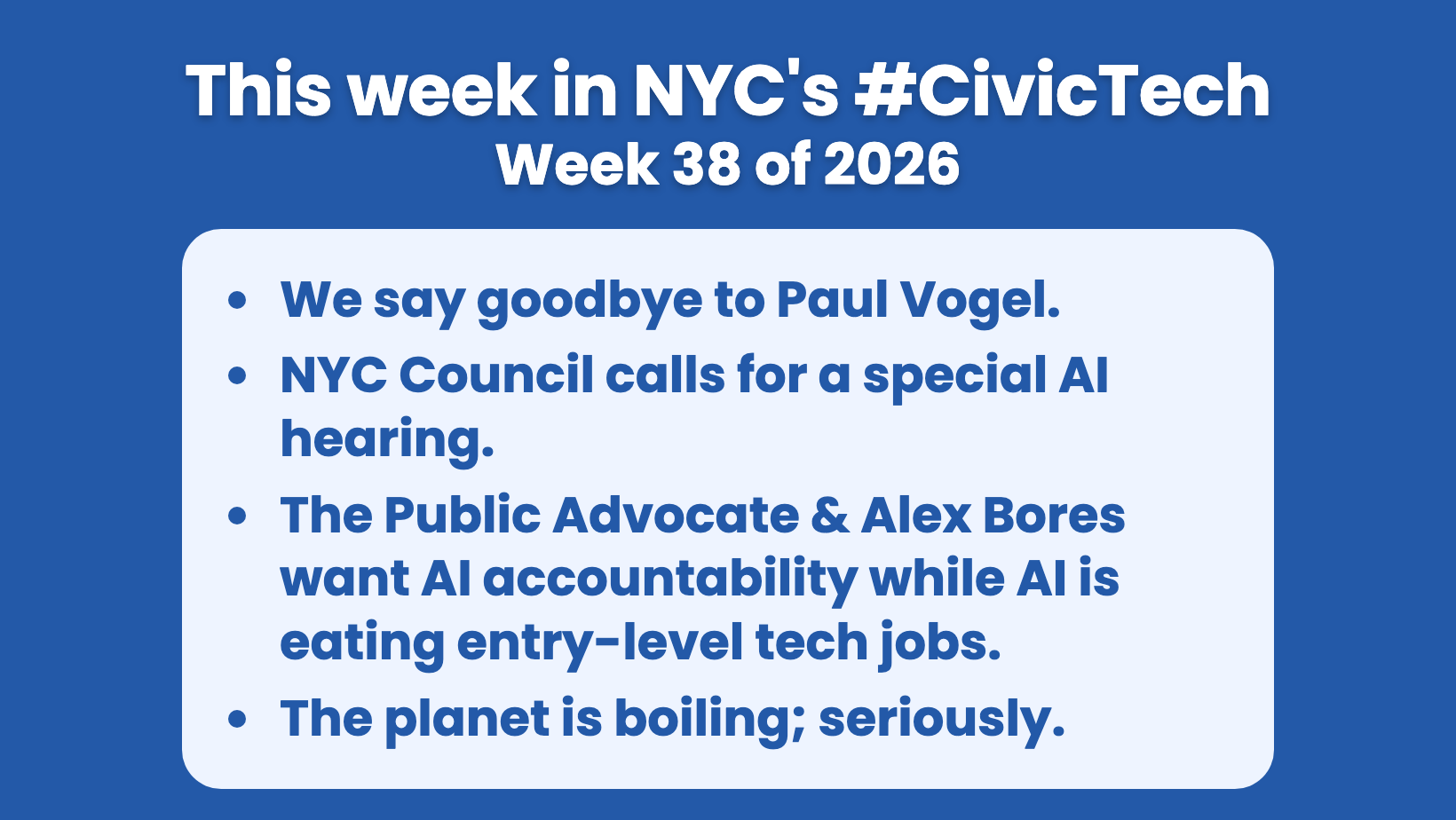
We pay our respects to one of the city’s builders. You may not think complaining on social media is constructive, Paul Vogel leveraged his social media accounts and 311 to ensure our bike lanes and dangerous driving would be addressed. By creating a visible paper trail, Streetsblog was able to pick up his issues and investigate how 311 complaints were being ignored and dismissed. Persistence brought about accountability. Paul, we will miss you. Friends and allies are gathering to remember him at 11:00 am on September 26, at McLaughlin & Sons, 9620 Third Avenue in Brooklyn. Read Streetsblog’s farewell edition
We are a few days out from CityCamp NYC, and this is the largest civic tech unconference this city has seen. New partners, a new venue at Hunter College, and close to 300 of you. We open the morning in a historic auditorium better known for rock concerts, where our friends at The War on Cars played a sold-out live show last year.
Here is the thing about an unconference. Nobody hands you the agenda. The sessions are programmed and organized by the community, for the community, about the things that hit the community. We set the agenda. We set the narrative. We control our own destiny.
This week, the news sorted itself into three piles.
The doomers, who think the world is ending, and who are not entirely wrong. (See the UN Report and the news about the strengthening El Niño.) Their complaint is that safeguards have to exist before AI technology gets away from us. That was most, if not all of the AI news this week. On Monday, our Public Advocate produced a pretty thoughtful AI policy piece with a focus on procurement. And the Council is taking the case seriously enough to clear its calendar: on October 5 all 51 members will sit as a Committee of the Whole on the risks of AI, with letters out to the heads of OpenAI and Anthropic asking them to appear.
The boomers, and I mean the people actually building the thing. Alex Bores lost his congressional primary this year, after $21 million of AI industry money was spent on that race for and against him. This week he launched a $30 million effort, “Who Decides”, to get Democrats to one position on AI safety by 2028, and it says it will take no corporate money and nothing from frontier AI executives. What is booming is our collective consciousness, and it is eager to see unchecked power checked. This is what we will be discussing at CityCamp!
And the assumers. The Center for an Urban Future’s answer is to put people to work. Its director, Jonathan Bowles, told Business Insider: “Put them to work on civic tech, working for government, for nonprofits, for small businesses. There are clear opportunities to get people the experience that would help them in the job market, and that’s what we recommend.” A paid service corps beats another training program, and we would take it tomorrow. But placement is not capability. You cannot train someone, hand them a placement, and expect civic tech to happen; people need mentors and years inside the work before they can carry it. For over a decade, we’ve been arguing for a comprehensive digital and data literacy program at CUNY. The time has come to build an institute around it — more to announce later this year. Don’t assume policy papers will lead to action.
Saturday we will continue to build a better future for all. We will have tickets at the door, but we prefer that you register ahead of time.
And a quick thank you to this year’s CityCamp sponsors. Without them, we would not be able to do this. Our 2026 Lead Partner, Reinvent Albany. Our Community Sponsor, Nava. Our Venue Partners, HunterWorks and Hunter College Urban Policy and Planning. And our Tabling Sponsor, Database Tycoon.
We want to see you on Saturday. If not, we will see you at one of our trainings in October.
Noel, Naeema, Jordan, Duncan, Andrew, Gabby, and all of the amazing volunteers who are bringing you CityCamp!
Two days from now, CityCamp NYC. Come set the agenda.
Upcoming Events with BetaNYC 📅
- September 19 at 9:00 am CityCamp NYC 2026 – BetaNYC
- October 4 at 10:00 am Introduction to Artificial Intelligence (AI 101) with BetaNYC – BetaNYC
- October 5 at 2:00 pm AI 101 with BetaNYC at the Bridging the Digital Divide Conference – BetaNYC
- October 15 at 9:00 am Data Days Cleveland 2026 – BetaNYC
- October 16 at 12:00 pm Discovering NYC Open Data: Online Session – BetaNYC
Civic Tech News & Updates 🗽
- The dissent is now institutional. Richard R. Buery, Jr., CEO of Robin Hood, one of the city’s largest anti-poverty funders, came out against the blanket K-8 AI ban: “While well-intentioned, a blanket one-year AI ban, without exceptions, on all uses through middle school is not the right call.” He supports the high-school exceptions and wants an evidence-based framework for bringing AI back to younger grades. That follows Justin Reich’s argument in Vital City that the policy is political rather than evidentiary. This is a real split. – Robin Hood and Justin Reich, Vital City
- The Public Advocate’s AI report says the city already has the tools to count its own AI — Artificially Inevitable, a 28-page report from the Office of the Public Advocate released Monday, walks through the machinery: Local Law 35 of 2022 requires annual agency reporting on algorithmic tools, and the 2024 round found 55 tools across 13 agencies and offices, with the Department of Health and Mental Hygiene accounting for 16 of them. Local Law 195 of 2025 requires a centralized list of AI approved for agency use. Local Law 188 of 2025 created an Office of Algorithmic Accountability inside OTI, expected to begin operating this year. The report judges Local Law 144, the nation’s first AI hiring-bias law, to have been “hampered by a lack of transparency, with many employers determining the law doesn’t apply to them.” Its central city recommendation is procurement reform, including a requirement that vendors deliver data portability and API standardization. That is an open-standards argument sitting inside a purchasing rule, and it is the most useful sentence in the document. – Office of the New York City Public Advocate (PDF)
Disclosure: Noel Hidalgo, BetaNYC’s Executive Director, was interviewed for this report and attended its launch. He is the Public Advocate’s appointee to both the Commission on Public Information and Communication (COPIC) and the City’s Internet Advisory Board. - A partisan think tank has staff inside the Census Bureau — At least seven America First Policy Institute employees are detailed to the Census Bureau through the Intergovernmental Personnel Act, all holding the “special sworn status” that reaches sensitive Census data. They work under one project doing ad hoc analyses for senior leaders at Census and Commerce, led by political appointee Michael Lachanski. In August the bureau published an anonymously authored report claiming thousands of noncitizens voted in 2020; WIRED found the methodology faulty and two of the authors employed by AFPI. Talking Points Memo separately found the bureau’s data-stewardship charter was amended in July to strip the provisions keeping political appointees out of its data. danah boyd, who studies the census at Cornell, put it plainly: “This is a partisan group with an agenda.” The census is the substrate under nearly every city dataset in this newsletter. – Vittoria Elliott, WIRED
- Entry-level tech postings are down 49%, and the split inside that number is the real finding — The Center for an Urban Future reports the steepest drop in postings of any field since 2022. Underneath it: entry-level roles with the highest AI exposure fell 29%, roles with minimal AI exposure rose 21%, and entry-level AI-focused roles grew 20%. This is displacement inside tech, not a shrinking sector. The report’s six recommendations include a $10 million NYC AI Service Corps placing early-career technologists in small businesses, nonprofits, and agencies, a Workforce AI Readiness Fund, and a real-time labor-market dashboard. – Will Markow and Eli Dvorkin, Center for an Urban Future and Greg David, The City Reporter
- COGE is just the opening act — Tal Roded argues the five charter ballot questions take necessary steps on state capacity but leave technology off the ballot. Two of his five next steps are ours: a separate technology procurement track, and restructuring OTI so it is central to every agency’s technology adoption process. Set that beside the Public Advocate’s procurement recommendation and our own record that no technology measure reached this year’s ballot, and three independent arguments are converging on the same gap. – Tal Roded, NYCuriosity
Community Wins, and Featured Tools 🛠️
Pun intended. This is a superblock of news about superblocks.
- Find out whether your block is a candidate for a low-traffic neighborhood — A free census-tract map of the whole city, scoring which neighborhoods best fit a Low Traffic Neighborhood intervention. Three preset scenarios: Air Quality ranks tracts by PM2.5, Vehicle Use looks for low car ownership and low car commuting, and Environmental Justice combines median income under $100,000 with PM2.5 above 7.0µg/m3. Built on Leaflet and OpenStreetMap, so you can check the reasoning yourself. – Open Plans
- FINALLY, DOT lays groundwork for a low-traffic neighborhood in Greenpoint — Two traffic diverters, two slip-lane closures, and parking cleared near new crossings around P.S. 110 and McGolrick Park. DOT says more than half the drivers on Driggs Avenue are cut-through traffic. – Streetsblog NYC (Disclosure: Noel Hidalgo has spent years advocating for these safe street treatments, particularly on Driggs, as he is a resident of the neighborhood.)
- [READ] A Brooklyn dad on five years of safe streets advocacy — Chris Roberti leads the P.S. 110 PTA safe streets committee. The DOT plan above is what five years of volunteer organizing looks like when it lands. – Chris Roberti, Streetsblog NYC
- Five New Yorkers just won $200,000 each — The David Prize named Aaliyah Duah (financial literacy), Dr. Dave Ores (healthcare access), Isaac Adlerstein (religious institutions as homelessness support), Oded Oren (transparency about the judges and courts that shape New Yorkers’ lives), and Regina Carter (redirecting discarded furniture). Oren’s work is our beat directly. – The David Prize
- A K-12 AI framework you can hand a teacher tomorrow — The Kapor Foundation’s Responsible AI and Tech Justice guide, updated this year, is a downloadable curriculum framework built on six competencies: algorithmic awareness, data fluency, ethical design, environmental consciousness, human-centered agency, and dynamics of power. It aligns to CSTA standards and links out to NYCPS curricula. This is what the city’s high-school AI literacy course could look like with content behind it. – Kapor Foundation
- Proudly serving: public service with and for the people — A practical handbook for government workers on designing and delivering public services, from 29 contributors including Joy Bonaguro, Luke Fretwell, Kirsten Wyatt, and Rebecca Woodbury. Structured around five sections from initiation through inspiration, and covering team building, accessibility, data management, and community engagement. Free EPUB, HTML, and PDF from the site. – Proudly Serving
AI Roundup 🤖
- Data centers poll badly everywhere — In a New York Times and Siena University survey of 1,503 likely voters, 61% oppose building data centers to power AI. Politicians are already responding to that number. – The Verge
- Former EPA staff say deregulation is making the data-center boom a health problem — Researchers now at the nonprofit Environmental Protection Network count at least 30 separate actions since January 2025 weakening pollution safeguards, permitting, and inspection practice. About 3,000 data centers operate in the United States today. – Mother Jones
- Lima, Ohio passed an 18-month data center moratorium — Mayor Sharetta Smith described Ohio as “one of the fastest-growing states in terms of data centers looking to locate here.” Local pauses are becoming the default response where state rules are absent. – Government Technology
- Broken valves spilled 5,000 gallons of diesel at a Meadowlands data center — The backup generators that make a data center resilient are also a fuel depot next to a wetland. – Gothamist
- Alex Bores is launching a $30 million effort to unify Democrats on AI — The Assemblymember who wrote New York’s frontier-model safety law has launched Who Decides, which aims to get Democratic candidates running on a common AI safety agenda by 2028. A state legislator setting a national agenda on this is a New York story. – Jason Beeferman, Politico
Jobs & Opportunities 💼
- Contract Analyst — Department of Transportation — Deadline: September 20.
- Associate Retirement Benefits Examiner, Level 3 — NYC Employees’ Retirement System — Deadline: September 24.
- Volunteers: Governing at the Speed of AI, UNGA 81 — AI Safety Connect — Unpaid logistics work at a high-level evening on international AI crisis coordination, September 24 at UN Headquarters, co-hosted by the Permanent Missions of Canada, Estonia, and Kenya, the United Nations Foundation, UNESCO, and UNDP. Roles are grounds passes, registration, and event operations. Details on the ITU’s Digital@UNGA2026 schedule.
- Senior Director, IT Operations — Mayor’s Office of Criminal Justice — Deadline: September 25.
- AI Policy Fellowship, Spring 2027 — Institute for AI Policy and Strategy — Applications due September 27. Remote worldwide, February 22 to May 14, 2027, with a mandatory two-week in-person kickoff in DC. No technical or prior policy background required.
- Assistant Chief Plan Examiner, Sidewalk Shed and Construction Progress Monitoring — Department of Buildings — Deadline: September 28.
- Senior Data Associate, Children and Family Well-being — Commission on Racial Equity — Deadline: October 1.
- Data Manager for Program Supports, Bureau of Children, Youth, Families and Developmental Disabilities — Department of Health and Mental Hygiene — Deadline: November 8.
- Vector-borne Disease Epidemiologist, Bureau of Communicable Diseases — Department of Health and Mental Hygiene — Deadline: November 8.
- OEI Research Assistant, Bureau of Environmental Disease Prevention — Department of Health and Mental Hygiene — Deadline: November 8.
- Field Research Assistant, Bureau of Environmental Disease Prevention — Department of Health and Mental Hygiene — Deadline: November 8.
- Senior Project Manager — Department of Design and Construction — Deadline: November 8.
- Investigative Analyst — Manhattan District Attorney’s Office — Deadline: November 8.
- Urban Designer — Manhattan Borough President’s Office — Deadline: November 9.
- Java Developer — Financial Information Services Agency — Deadline: November 9.
- Data Quality Analyst — Fire Department — Deadline: November 9.
- Unit Head, Compliance and Monitoring — Office of Management and Budget — Deadline: November 9.
- Analyst, Department of Citywide Administrative Services portfolio — Office of Management and Budget — Deadline: November 9.
- Hearing Officer — Tax Commission — Deadline: November 9.
- Hearing Officer — Tax Commission — Deadline: November 9.
- Analyst, FEMA Revenue Accountability and Reporting — Office of Management and Budget — Deadline: November 10.
- Senior Policy Analyst — Office of the Mayor — Deadline: November 13.
- Deputy Chief of Staff for Campaigns — Office of the Mayor — Deadline: November 13.
- Project Manager — Department of Design and Construction — Deadline: November 13.
- Junior Project Manager — Department of Design and Construction — Deadline: November 13.
- Engineer, Capital and Scope — Department of Design and Construction — Deadline: November 13.
- Data Scientist, AI Evaluator and Auditor — Eticas.ai — End-to-end AI system evaluations: performance, bias and fairness methodologies, and reproducible evaluation pipelines in Python. Global remote, rolling.
- Communications Manager — Association for Neighborhood and Housing Development — Rolling.
Events 📅
- September 19–27 “Please Don’t Flush!” – Rainy Day Plays with NYC Emergency Management and the Waterfront Alliance. A municipal comedy about flood preparedness, performed in public spaces across Queens, Brooklyn, and Staten Island for Climate Week NYC.
- September 24 at 9:00 am Reducing Driving as Climate Action – Open Plans and the Parking Reform Network, part of the Urban Climate Solution Track at Climate Week NYC.
- September 26 at 2:00 pm Math Walk 4 – Jordan Jones. A public walk modeling median gross rent against network walk time to the L, using ACS tract data and OSMnx over the Brooklyn street network. Teams pick buildings, predict the rent, then check the prediction against the model. No math background needed. Meet at DeKalb Avenue and Wyckoff Avenue, by the DeKalb Av L station in Bushwick, not the DeKalb Av B/Q/R in Downtown Brooklyn. $5 covers printed packets and materials.
- September 27 at 4:00 pm NYC Climate Day of Action – At The Classroom at Wagner Park Pavilion. The launch of a collective climate action effort to reduce emissions at scale.
- September 28 at 6:30 pm Who Gets to Decide How AI Enters Our Schools? – New York Public Library with Data & Society, at the Stavros Niarchos Foundation Library, 455 5th Ave. Free, in person and livestreamed. Meredith Broussard moderates, with Natasha Singer, Amanda Lenhart, and Scott Kern. Data & Society executive director Janet Haven introduces. The framing is how tech companies use schools to mainstream their AI tools, which is the vendor push Chancellor Samuels described from the inside.
- October 5 Committee of the Whole on the risks of AI – New York City Council. All 51 members sitting together, which the Council itself calls rare. Speaker Menin has invited the chief executives of OpenAI and Anthropic to present. Time and location are not yet posted.
- October 7 at 8:00 am What Will It Take to Deliver Livable Streets to More of NYC’s Neighborhoods? – Open Plans. Includes a fireside chat with DOT Commissioner Mike Flynn.
- October 17–18 ACT Congress 2026 – Alliance of Civic Technologists, in Orlando.
- February 24–26, 2027 Net Inclusion 2027 – National Digital Inclusion Alliance, at the Hilton Columbus Downtown in Columbus, Ohio. Early-bird registration is open now.
Hearings 🏛️
5 hearings ahead. Dates and runway below, so you know what you have time to prepare for.
Short notice
Less than 7 days out. Written testimony is the realistic route here.
- September 22 at 10:00 am — 5 days away · NYC Council
Oversight – Access to City Government and the Mamdani Administration’s Civic Engagement Efforts
Committee on Governmental Operations, State & Federal Legislation - September 22 at 10:00 am — 5 days away · NYC Council
Oversight – Municipal Recruitment and Civil Service Pathways
Committee on Civil Service and Labor - September 22 at 10:00 am — 5 days away · NYC Council
Oversight – Examining the Executive Order 13 of 2026 Report of Audit Findings and Recommendations
Committee on Immigration
Coming up
Enough runway to write and submit testimony.
- September 30 at 1:00 pm — 13 days away · NYC Council
Oversight – New York City’s 311 System
Committee on Technology - October 6 at 10:00 am — 19 days away · NYC Council
Oversight – Ambulance Response Times
Joint hearing: Committee on Fire and Emergency Management, Committee on Hospitals
Already heard, testimony still open
The Council accepts written testimony for 72 hours after a hearing adjourns. These are still open.
- September 16 at 1:00 pm — heard yesterday · NYC Council
Oversight – NYPD Crime Statistics
Committee on Public Safety
Written testimony until September 19.
How to testify at a City Council hearing. In-person testimony needs no pre-registration. Virtual testimony requires signing up in advance. Written testimony is accepted up to 72 hours after a hearing adjourns. Details at council.nyc.gov/testify, or email hearings@council.nyc.gov. State hearings are often invitation-only for oral testimony — check the individual notice.
Media to Watch, Listen, or Read 🎥
- [LISTEN] Why New York City is restricting artificial intelligence in public schools — Mayor Mamdani and Chancellor Samuels on the record, Ailish Brady on the mechanics of switching vendor AI off, and street interviews in Fort Greene Park. – NYC NOW, WNYC
- [READ] NYC schools are restricting student YouTube access too — The AI moratorium is one piece of a wider pullback on screen time and school-device access. – Chalkbeat New York
- [READ] The most important sanctuary policy is a data retention policy — What a city keeps, and for how long, decides what federal agents can reach later. ICE’s remote ID checks run through a fingerprint scanner and an app called EDDIE, surfaced by a Freedom of Information Act lawsuit. Sanctuary status written in policy but not in retention schedules is a promise the database can break. – Next City
- A secretive DHS unit reads your finances, then has local police pull you over — 404 Media identified Predictive Intelligence Targeting Teams, or PITTs, operating in Border Patrol’s Spokane and Laredo sectors. Agents review law-enforcement-sensitive databases including financial activity, flag what Border Patrol calls “financial activity patterns commonly associated with illicit narcotics activity,” and pass the intelligence to local officers, who make the stop on an unrelated pretext. In the case that surfaced the program, the pretext was an obstructed license plate in Montana. CBP declined to say whether it obtained a warrant before analyzing the records. That refusal is the story. – Joseph Cox, 404 Media (paywalled; Techdirt covers it free)
- [READ] For 9/11 survivors, newly published air quality records bring answers — The Mamdani administration’s disclosure of air quality records gave advocates and survivors documentation for what they had believed for a quarter century. – The City Reporter
- [READ] A safety alert system returns for private and parochial schools — Silenced ahead of the World Cup, the emergency notification system relaunches as part of Notify NYC. – The New York Times
- [READ] The city bought a Stripe Hog — A high-pressure water truck that blasts away old street markings, clearing the way for new bus lanes and safety treatments. Street redesign moves at the speed of the equipment that erases the old lines. – The New York Times
- [READ] 600 curbside EV charging points are coming, and DOT wants comment by September 30 — A Brooklyn firm will install them in curbside spots. Worth asking, while the comment window is open, when on-street e-bike storage and charging gets the same treatment. – Gothamist
- [READ] “We did not invite you.” Residents rage at a town hall over a nuclear-powered AI data center — The University of Michigan and Los Alamos National Labs are building in a small Michigan township. Residents say they were never consulted. – 404 Media
- [READ] A Birmingham resident is suing over data center tax abatements — The claim is that the industrial development board’s May approval was hidden from the public and that the board had no power to abate those taxes in the first place. Procedure is where these fights are actually decided. – Government Technology
- [READ] An Indianapolis school is fighting a data center next door — Irvington Community Elementary is weighing health concerns and a possible effect on enrollment. Chalkbeat’s Indiana bureau on what the build-out looks like from a school building. – Chalkbeat Indiana
- [READ] Oracle promises 2 GW of renewables to offset Stargate — The pledge does not change the data center’s use of gas. – Ars Technica
- [READ] The climate problem that is not on the UN agenda — Data centers, during a week when every other emissions source gets a session. – Politico
- [READ] Trump dismisses new AI guardrails and alleges a “SICK conspiracy” against AI and data centers — The federal posture, stated plainly, against a week of local moratoriums. – New York Daily News
- [READ] The case against blocking data centers — Daniel Castro argues communities forgo tax revenue, construction jobs, and infrastructure investment, and that energy and water concerns are “overstated or readily addressed through better infrastructure planning.” Read it to know the argument. It comes from the Center for Data Innovation, a division of the Information Technology and Innovation Foundation, an industry-aligned tech policy think tank that names corporations among its supporters but does not publish a list of them. – Center for Data Innovation
- [READ] Civic media in the second Gilded Age — Darryl Holliday argues that platform monopolies concentrated power over civic discourse while public media funding fell behind, and that community-scale, locally governed civic media is the workable correction. Open access, so quote it freely. – Darryl Holliday, Dædalus
New Data to Note! 📊
Every week this section closes the newsletter with what just landed on the city and state open data portals, pulled straight from data.cityofnewyork.us and data.ny.gov, plus any dataset a reader sends us. A quiet week gets reported as a quiet week. This one is as quiet as it gets.
Assets published September 9 – September 16, 2026 (7 days). Source: Socrata Discovery API, createdAt.
NYC Open Data (data.cityofnewyork.us) — 0 new
- Nothing new this window.
NYS Open Data (data.ny.gov) — 0 new
- Nothing new this window.
Neither portal published a new asset in the last seven days. That is a real number, not a gap in our reporting, and it is the kind of thing worth noticing in a week when the Public Advocate is arguing the city should publish more about what it runs.
Conclusion
What did you think of today’s newsletter? We’d love to hear your feedback and ideas.
Want to sponsor this newsletter or be featured in future ones? Share your community resources, projects, events, and anything else happening so we can feature them in future posts.
Did a friend forward this to you? There are three ways you can subscribe to our newsletter. Read it on our website, receive it via email, or via LinkedIn!
We use AI tools to help scan and organize civic tech news each week — all editorial decisions are made by the BetaNYC team, per our AI Policy.
Build with NYC’s civic data. BetaNYC publishes free, open-source MCP connectors giving AI assistants direct access to NYC Council legislation, city spending and contracts, Council discretionary funding, 311 service data, the City Record, the NYC Charter and Administrative Code, and NYS Open Legislation. If you’re building with AI and civic data, explore them on GitHub.
Take care of each other, and have a great weekend!
BetaNYC is a civic organization improving lives through civic technology, design, and open data. Subscribe to the newsletter · Support our work · Follow us on Bluesky, LinkedIn, Facebook, Instagram, Threads, Mastodon, Reddit, and YouTube.