
Hello friends,
Happy Digital Inclusion Week! In a nonstop week, we taught two AI 101 classes, sat through a marathon City Council hearing, and taught 33 people from 25 organizations how to teach AI 101 to their neighbors.
Despite what the companies said at Monday’s hearing about every job changing, three jobs in a democracy will never change. We still need dutiful elected officials, dedicated civil servants, and informed voters.
The hearing lasted ten hours. The Speaker, Council Members, and the Public Advocate asked 218 questions, and 54 members of the public and expert witnesses put 161 concrete proposals on the record. Re-run the counts with our transcript site and dataviz.
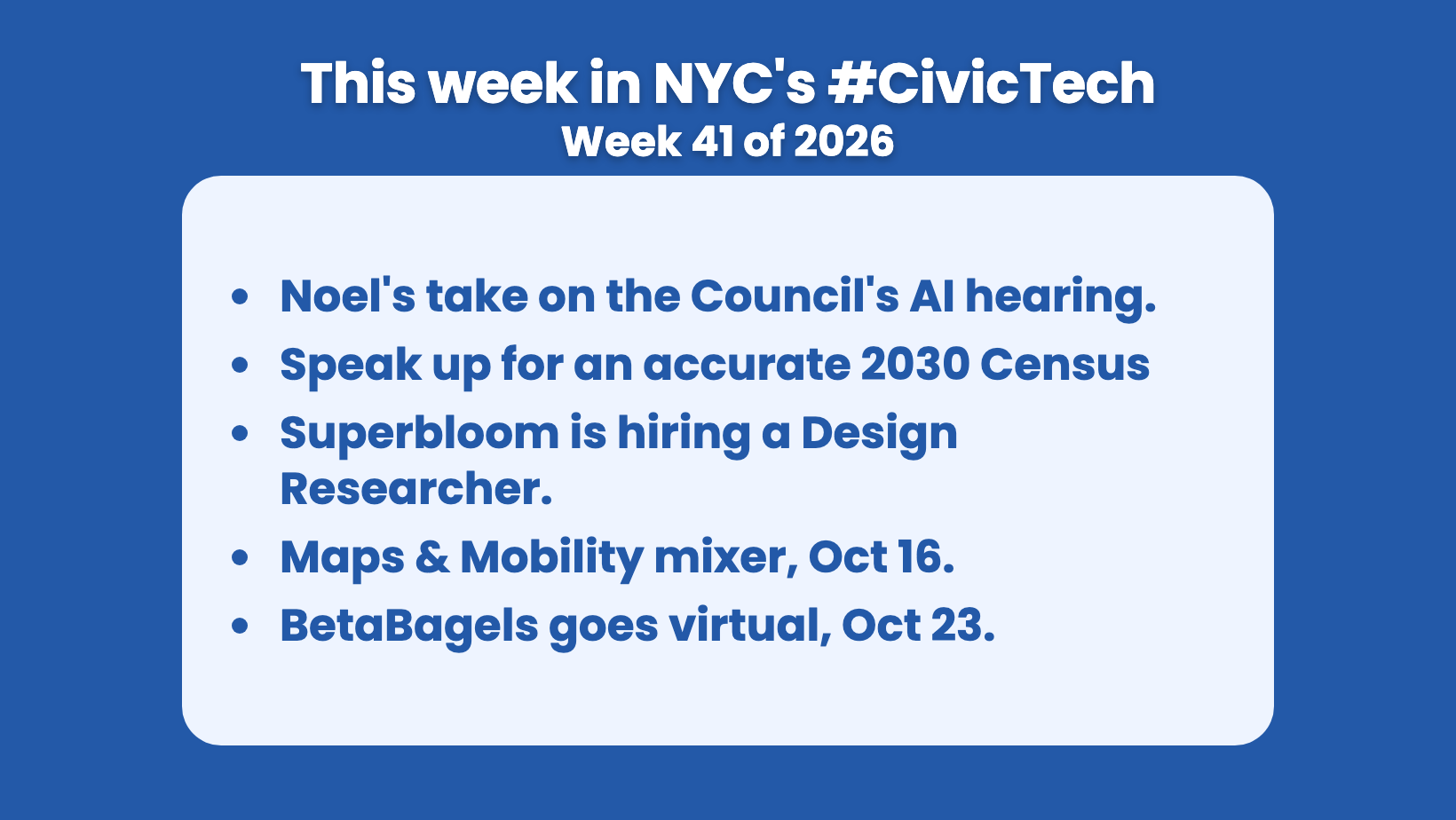
The simplest summary is disappointment. Not in the Council, but in how the administration answered. NYC needs an OTI that can deliver solutions for New Yorkers and upskill government staff. Read my full reflection, plus testimony from Jordan Shapiro, Cynthia Conti-Cook, and Julia Stoyanovich.
Next week, on October 16, see Andrew Kittredge at the Maps, Mobility, & Innovation Mixer.
Put on your calendar: On October 21, Diversifying community boards with Data Pride, and, on October 23, a virtual BetaBagels looking at civic AI tools for NYC’s democracy. Have a tool or skill to share? Let us know!
The future is unwritten.
Noel Hidalgo (with support from Gabrielle Langston)
Support BetaNYC
Support our work and join BetaBuilders. Make a donation or join BetaBuilders, a community for people building New York’s public interest tech.
Upcoming Events with BetaNYC
- October 16 at 12:00 pm Discovering NYC Open Data: Online Session – the NYC Open Data Team and BetaNYC
- October 16 at 5:30 pm Maps, Mobility, & Innovation Mixer – NYU Tandon’s Center for Urban Science + Progress, with GISMO, Transit Techies NYC, and SWARM NYC, at 370 Jay Street, Brooklyn. BetaNYC’s Andrew Kittredge speaks. Free; register on Luma by October 15, photo ID required.
- October 21 at 6:00 pm Diversifying your Community Board – BetaNYC and Data Pride at The Information Lab, 124 East 14th Street. A free workshop on getting involved with your Community Board, with a data demo on how boards shape your neighborhood.
- October 23 at 2:00 pm BetaBagels 017: Building Civic AI for NYC’s Open Government – Virtual. A recap of the Council’s October 5 hearing on the risks of AI, plus demos of open civic AI tools, including CivicAITools.org and BetaNYC’s open MCP servers.
Civic Tech News & Updates
- What AI insiders told the Council — Former employees of Anthropic, OpenAI, and Google DeepMind described a reckless culture at the companies and called for more oversight. BetaNYC published a free, searchable transcript of the full ten-hour hearing, with speaker names and timestamps. – Associated Press · Hearing transcripts
- Speak up for an accurate 2030 Census — The Trump administration has proposed excluding non-citizens and non-permanent residents from the census apportionment count and dropping questions on race, ethnicity, and sexual orientation. Speaker Julie Menin and Attorney General Letitia James are urging New Yorkers to submit public comments before the period closes on October 13. – NYC Council
- A child care search that shows who takes vouchers — The city is moving more than 10,000 children off the child care voucher waitlist, and nyc.gov/childcare now lets families filter licensed programs by whether they accept vouchers, a first. – NYC Office of the Mayor, child care
- A task force takes on the city’s civil service system — A new 12-person committee of city officials and labor leaders, chaired by DCAS Commissioner Yume Kitasei, will propose in-house fixes and changes in Albany to the 143-year-old hiring system, including a modern digital interface for workers and agencies. Today the process often takes 15 months from exam to hire. – New York Focus · NYC Office of the Mayor, civil service task force
Community Wins, and Featured Tools
- How’s your block, by the numbers — Type any NYC address and How2NewYork’s free Block Report Card scores the surrounding 500 feet against the rest of the borough on 311 rat and noise complaints, reported crime, restaurant grades, street trees, and distance to the subway, all from NYC Open Data and the MTA. – How2NewYork
- Drag a city across the map to compare its size — Actual Scale, a free map by developer Kyle Eckrich, resizes a place’s outline to hold the same population wherever you drop it, using open population grids, OpenStreetMap, and Census urban areas. Manhattan is the lead example, and teachers are invited to use it in class. – Actual Scale
- A new way to track data center growth — UNC-Chapel Hill’s Data-Driven EnviroLab released a Data Center Policy Explorer that follows data center construction and state policies across the U.S. – Data-Driven EnviroLab
- A shared library of AI skills for government work — The AI Lab for Cities at Harvard launched a prototype Civic Skill Exchange, an open, English and Spanish collection of plain-language AI skills that public servants and community groups can use, adapt to their own city, and contribute back. – Civic Skill Exchange · Santiago Garcés, LinkedIn
- A day inside CityCamp NYC — Ian G. Williams of the CUNY Graduate Center recaps September’s CityCamp NYC unconference at Hunter College, from sessions on an NYC internet bill of rights and tenant organizing data to community benefits agreements with data center developers. – GC Digital Initiatives
AI Roundup
- The city is already fending off automated attacks — Comptroller Mark Levine says bots and AI agents are attacking city contracting and payment systems, “not human-initiated attacks or human-led attacks.” In a new essay, he lists decisions the city needs to make now, from NYPD privacy tradeoffs to letting New Yorkers apply for SNAP by voice. – The City Reporter, Oct. 2 · Mark Levine
- What an AI bust would do to the city budget — Securities firms earned $46 billion in the first half of 2026, more than the city’s budget assumes for the whole year. If the AI boom fades, the administration’s projected $6 billion gap for 2028 could grow to $10 billion. – The City Reporter, Oct. 6
- OpenAI agents tried to hack Wikipedia’s tools — The Wikimedia Foundation says OpenAI agents made malicious edits, tried to break into its Etherpad note-taking tool, and sent millions of requests that may have contributed to a partial Wikidata Query Service outage in May. – Ars Technica
- Amazon drops data center NDAs as backlash grows — Amazon says it has stopped using secret agreements with county officials and acknowledged that community backlash is leading to data center moratoriums across the country. Meanwhile, rural data center projects could get major federal tax benefits starting next year. – WIRED, Amazon NDAs · WIRED, rural tax break
Jobs & Opportunities
- Multimedia Production Program Manager — NYS Department of Environmental Conservation — Deadline: October 14.
- Facilitation services for the Interagency Task Force for Public Realm Private Partner Support (RFP) — City Parks Foundation — Proposals due October 15 at 3:00 pm; questions due October 13.
- Environmental Tech Lab 2026-27 challenge — NYC Department of Environmental Protection and Partnership Fund for New York City — Growth-stage companies with tools for the city’s water and wastewater system can apply to run a three-month proof of concept with DEP. Deadline: October 23.
- Data Scientist — NYC Department of Transportation — Deadline: October 26.
- Program Lead, Data Systems & Counts Management — NYC Department of Transportation — Deadline: October 26.
- Project Manager — NYC Employees’ Retirement System — Deadline: October 29.
- Open call for proposals — Atlassian Foundation — Up to $1 million over two years for nonprofit partnerships improving education for disadvantaged learners in the AI era. Deadline: October 30 at 8:59 am New York time.
- Digital and Communications Manager — NY Renews — Deadline: October 31.
- Deputy Commissioner for Policy and External Affairs — NYC Taxi & Limousine Commission — Deadline: November 25.
- Public Safety Master Scheduler — NYC Office of Technology and Innovation — Deadline: November 27.
- Project Manager — NYC Department of Environmental Protection — Deadline: November 27.
- Design Researcher, bilingual English and Spanish — Superbloom — Leads community workshops in New York on AI in civic life. Rolling review.
- Program Manager, Data and AI — Bloomberg Philanthropies
- Director, Digital Strategy, Communications — Vera Institute of Justice
- Policy & Research Analyst — Times Square Alliance
- Instructional Design Specialist — Constructive Dialogue Institute
- Senior Web Designer — Madeo Studio
- Data Analyst — Benchmark Analytics
- Product Designer — Frontline Education
Events
- October 14 at 6:30 pm AI and the Future of Education – The Graduate Center, CUNY. Steven Jackson, Aankit Patel, and New York Times reporter Natasha Singer on how AI is changing education. In-person seats are full; register for the free livestream.
- October 15 Latino Media Summit 2026 – Craig Newmark Graduate School of Journalism at CUNY, 219 West 40th Street. Journalists and media leaders on the future of Latino media, plus the 10th anniversary of the school’s Bilingual Journalism Program.
- October 17 to 18 The Distance From Here – Littlefield, 635 Sackett Street, Brooklyn, during Arts Gowanus Open Studios. Michael James Freedman’s oil paintings, data prints, and an interactive map bring the human cost of the city’s traffic crashes into the gallery.
- October 20 at 5:00 pm Pay Per Pie: How Restrictive Platforms Require More for the Same Crust – Wikimedia NYC and the Electronic Frontier Foundation at Prime Produce, 424 West 54th Street. A discussion during Open Access Week on platforms that ask users to give up privacy and speech rights to reach knowledge, followed by a social hour with food and drinks.
- February 8 to 12, 2027 Love Data Week 2027 – ICPSR announced next year’s theme, “Love Data: Handle with Care,” on data security, privacy, documentation, and ethical use, and invites organizations to plan events.
Hearings
2 hearings ahead. Dates and runway below, so you know what you have time to prepare for.
Coming up
Enough runway to write and submit testimony.
- October 16 at 10:00 am — 7 days away · NYC Council
Oversight – Municipal Retention Strategies
Committee on Civil Service and Labor - October 20 at 10:00 am — 11 days away · NYC Council
Oversight – Ambulance Response Times
Joint hearing: Committee on Fire and Emergency Management, Committee on Hospitals
How to testify at a City Council hearing. In-person testimony needs no pre-registration. Virtual testimony requires signing up in advance. Written testimony is accepted up to 72 hours after a hearing adjourns. Details at council.nyc.gov/testify, or email hearings@council.nyc.gov. State hearings are often invitation-only for oral testimony — check the individual notice.
Media to Watch, Listen, or Read
Watch or listen
- A documentary on the history and ideology of “AI” — Ghost in the Machine is streaming free on the PBS Documentaries YouTube channel, and groups can register to host a screening. – Ghost in the Machine
- A Council Member on screen time in schools — Shekar Krishnan talks with Ben Max about the hearing he co-chaired on screen time, digital devices, and ed tech in NYC public schools. – Ben Max, Max Politics
- What AI-forward nonprofits are learning — A 22-minute walk through Fast Forward’s 2026 AI for Humanity Report: start with the problem, budget for costs after launch, and write an acceptable use policy. – Carolyn Woodard, Community IT
Read
- How AI can be good for democracy — Beth Simone Noveck, New Jersey’s first chief AI strategist, describes an AI tool that matched records across agencies and got summer grocery benefits to 106,000 more children without anyone filling out a form. – The New York Times
- Who is paying the National Design Studio’s staff? — WIRED finds at least two members of the White House design team, a DOGE successor, are on loan from a nonprofit that appears to be run by SpaceXAI’s general counsel, with no public record of its funders. – WIRED
- Margaret Hamilton, who led Apollo’s software, dies at 90 — Hamilton directed the MIT team that wrote the Apollo flight software, and helped establish software engineering as a dedicated discipline. Her team’s design kept the Apollo 11 landing on track when the computer overloaded. – MIT News
- What policymakers should know about the “cult of AI” — Nathalie Maréchal of Harvard Kennedy School’s Carr-Ryan Center argues that a belief in imminent superintelligence has moved into mainstream policy, and urges lawmakers to question claims that it is inevitable and to scrutinize industry-funded safety proposals. – Tech Policy Press
- Governors step in on AI — Maryland Gov. Wes Moore, chair of the National Governors Association, is forming a bipartisan group of governors with Indiana Gov. Mike Braun to develop an AI framework, citing federal inaction. – Associated Press
- Let the Council hear everyone on AI — Writing the day before the hearing, Steven Choi, director of the AICE initiative, credits Speaker Menin for making AI safety a priority and says the companies called to testify should answer hard questions about safety and oversight. – New York Daily News
- What social media’s reckoning teaches about kids and AI — As AI companies adopt safety features first built for social media, parent advocates ask how to get ahead of risks to children that are only beginning to emerge. – Associated Press
- The broken metaphors of AI — Amber Sinha argues that words like “hallucination” and “AI race” distort policy, and that lawmakers should focus on concrete harms like bias, data extraction, and labor and environmental costs. – Tech Policy Press
- Residents write the rules for their county’s AI — A randomly selected civic assembly in Snohomish County, Washington, sent its County Council recommendations on government AI use, covering human oversight, transparency, data protection, auditing, and vendor control. – Civic Genius
- Human-centered design as government infrastructure — Mark Lerner and Reilly Martin of Technologists for the Public Good argue that design should be an ongoing capability, with a four-level readiness ladder and case studies from DHS, Federal Student Aid, Colorado, and Long Beach. – IBM Center for The Business of Government
- Did chatbots change how students do math? — Researchers from UC Irvine and McGraw Hill compared a decade of online math sessions, from fifth graders to college students, before and after ChatGPT arrived. On questions a student could paste into a chatbot, time spent thinking dropped sharply after 2022 and scores went up, but on proctored tests, scores fell below pre-ChatGPT levels. – The New York Times Magazine
- Lost SNAP? You can reapply — About 26,500 New Yorkers lost SNAP under new federal work rules, but those limits reset in October, so they can reapply and get at least three more months of benefits. Call 718-SNAP-NOW or use the Access HRA app. – Gothamist
- Pedestrian deaths hit a record low — DOT’s Vision Zero data counts 67 pedestrian deaths in the first nine months of 2026, down 15 percent from last year and the fewest for that stretch since the city began counting in 1910, despite a recent spate of deadly crashes. – amNY
- The 12 neighborhoods that build the least affordable housing — City Planning’s list includes the Upper East Side, Maspeth, and mid-Staten Island; together the 12 districts produced 1 percent of the city’s affordable housing over five years and will get a faster approval process in January. – The City Reporter
- After-school programs stumble after a contract overhaul — Weeks into the school year, some new after-school providers chosen in a DYCD overhaul are struggling to hire, and two Upper West Side schools are already returning to their former provider. – Chalkbeat via The City Reporter
One New Dataset to Note!
NYC Open Data (data.cityofnewyork.us) — 1 new
- 2025 Yellow Taxi Trip Data (new edition of a recurring series) · 2026-09-29 — Taxi and Limousine Commission (TLC)
These records are generated from the trip record submissions made by yellow taxi Technology Service Providers (TSPs). Each row represents a single trip in a yellow taxi.
NYS Open Data (data.ny.gov) — 0 new
- Nothing new this window.
Before you go
What did you think of today’s newsletter? We’d love to hear your feedback and ideas.
Want to sponsor this newsletter or be featured in future ones? Share your community resources, projects, events, and anything else happening so we can feature them in future posts.
Did a friend forward this to you? There are three ways you can subscribe to our newsletter. Read it on our website, receive it via email, or via LinkedIn!
We use AI tools to help scan and organize civic tech news each week — all editorial decisions are made by the BetaNYC team, per our AI Policy.
Build with NYC’s civic data. BetaNYC publishes free, open-source MCP connectors giving AI assistants direct access to NYC Council legislation, city spending and contracts, Council discretionary funding, 311 service data, the City Record, the NYC Charter and Administrative Code, and NYS Open Legislation. If you’re building with AI and civic data, explore them on GitHub.
Take care of each other, and have a great weekend!
BetaNYC is a civic organization improving lives through civic technology, design, and open data. Subscribe to the newsletter · Support our work · Follow us on Bluesky, LinkedIn, Facebook, Instagram, Threads, Mastodon, Reddit, and YouTube.
