
If you’ve watched as many YouTube videos on agentic software development as I have, you’ve been told we’re in a new world. So far that new world looks a lot like the old one: same oppression, same inequality, same distrust in democracy.
Last Friday I spoke to NYU’s Center for Urban Science and Progress (CUSP) graduating class and was direct about it: the shape of this new world will be set by people who can move between technology, politics, and neighborhood-level community dynamics — not just one of the three.
Sixteen years ago, Queens College professor Douglas Rushkoff wrote Program or Be Programmed. His thesis: every technology comes with built-in biases — defaults that shape how we think, communicate, work, and live. Programming, he argued, is the critical literacy of the digital age.
We’ve now reached a point where you can describe a prompt and ask a robot to implement it. Over the last four months, we’ve highlighted tools that might have been built by a well-articulated AI prompt. What can’t be programmed in is human creativity, ingenuity, and judgment. The judgment is still ours.
Black women performed the critical calculations that put men on the moon. The Gallaudet 11, who were Deaf men, helped NASA understand the vestibular system and how the body responds to zero gravity. From the Triangle Shirtwaist Fire, suffragettes and labor activists fought for the fire suppression systems and labor laws we still defend today. After September 11th, the city’s GIS experts served as digital first responders, working to keep New York’s infrastructure from collapsing — work that ultimately led to the city’s open data law.
Everyone in this society holds a piece of the puzzle.
Agentic coding tools have matured to the point where they write competent software, and they’re starting to make decisions on their own — well past the single task you handed them. (Read below) They don’t have to run in the cloud either. OpenClaw — the open-source agent framework Apple’s been crediting for the Mac mini shortage — lets people run a persistent assistant locally on their own machine. Hermes Agent, from Nous Research, takes the same idea further: an agent that builds memory and skills as it goes, getting more useful the longer it runs.
Trust in American democracy is at historic lows, and powerful forces are working to consolidate decision-making in fewer hands. Corporate voices in this conversation will outspend individual ones every time. That’s exactly why literacy and governance still matter — and why we have to keep programming our democracy to serve humanity, not the other way around.
By the end of May, we’re kicking off a small study group on using AI agents for nonprofit work. More to come on that one. (New to the data side? Scroll down for Intro to Open Data on Monday and check out our “Intro to AI” later this month.)
P.S. — Kickstarter United–OPEIU Local 153 members won a resounding strike victory, and Kickstarter has answered by firing several of the union leaders who got them there. On Friday, May 8 at 10:30 am, Kickstarter United and the Brooklyn Borough President will gather on the steps of Brooklyn Borough Hall in support of the union. If you can’t make it, Kickstarter United’s site has a one-click action to email Kickstarter and join the union’s mailing list.
— Noel Hidalgo, BetaNYC
News You Can Double Click
Things to subscribe to:
- Community IT Innovators Podcast — great conversations about AI in the nonprofit space.
- AI for Nonprofits Sprint — our friends and colleagues from FCNY have a four-part workflow for thinking about AI in nonprofits.
- Check out events from these NYC community organizations — they’ve all committed to teaching an intro to AI course and need to execute by the end of the city’s fiscal year: ADAPT Community Network, African Communities Together, Arab American Association of New York, Bronx Tech Hub, Center for Family Life in Sunset Park, Chinese-American Planning Council, East River Development Alliance (Urban Upbound), Educational Video Center, El Puente De Williamsburg, Faith in New York, Hamilton-Madison House, Jewish Community Center of Staten Island, Mosholu Montefiore Community Center, NAACP New York State Conference, New Immigrant Community Empowerment (NICE), New York LGBT Network, Northern Manhattan Improvement Corp (NMIC), Older Adults Technology Services (OATS) from AARP, The Door, The Knowledge House, The Smart Community Initiative, and Union Settlement.
Support BetaNYC
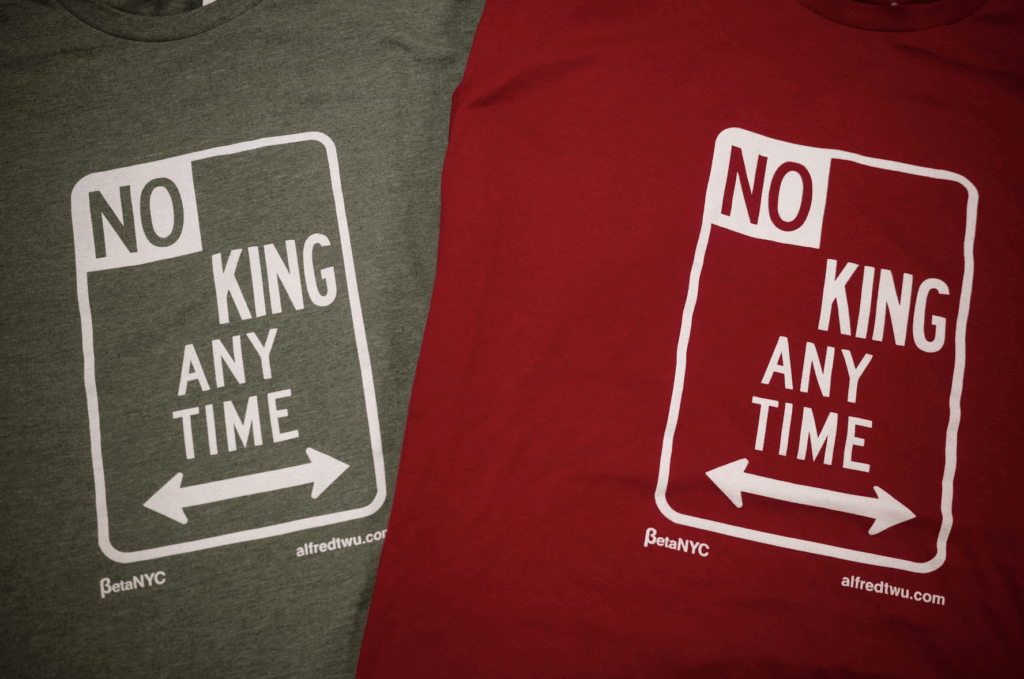
Support the newsletter and BetaNYC’s public programs — Subscribers keep this newsletter free and open, and the No Kings swag page underwrites the public programs we build the rest of our week around: Mapping for Equity, School of Data, and the civic-tech community we convene across the five boroughs. – beta.nyc/support-us-no-king
Civic Tech News & Updates
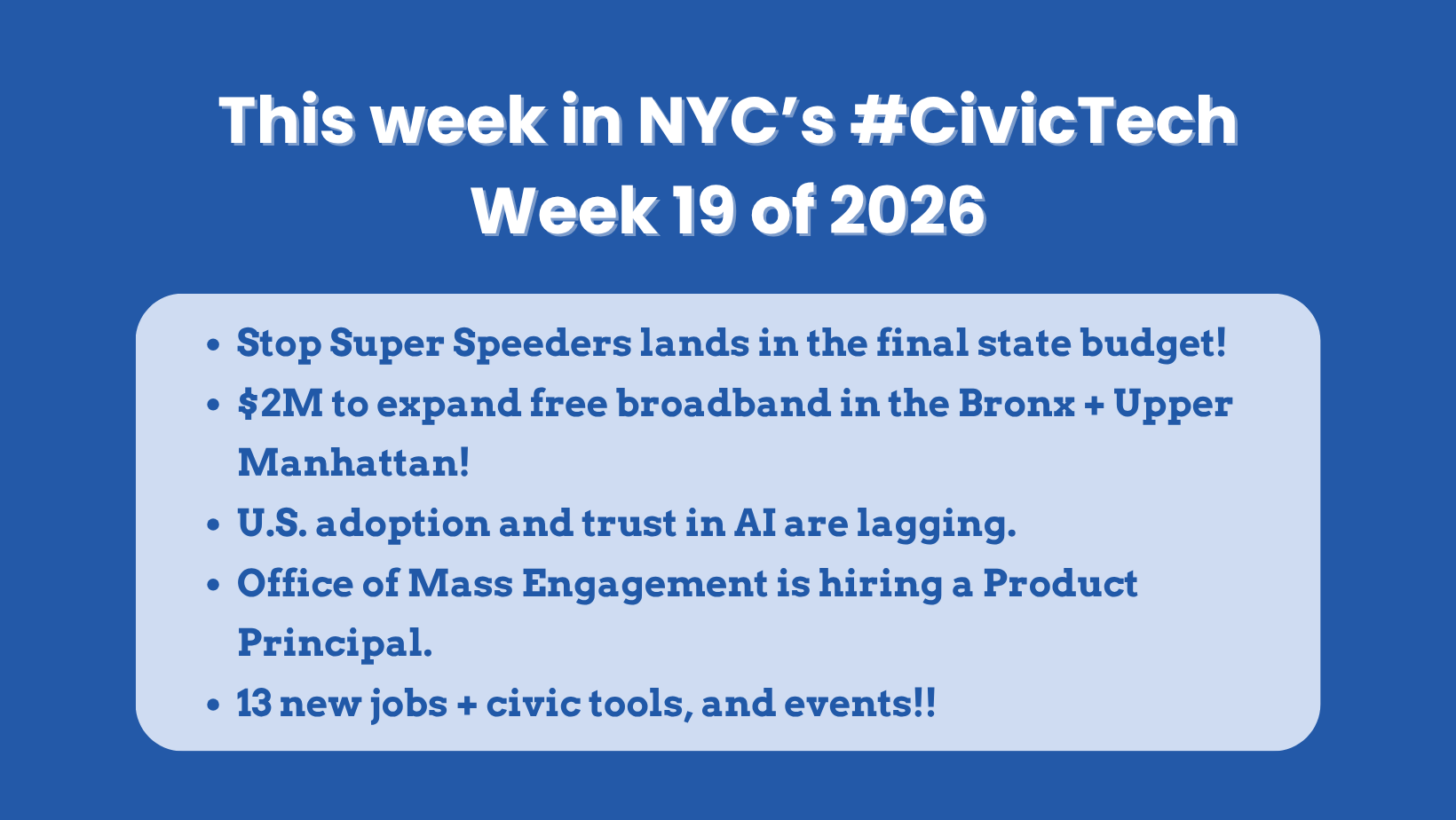
- Stop Super Speeders Act lands in the final state budget — A win for everyone who advocated for safer streets through open data: the law will be folded into the budget, another demonstration of how open data and tech can be turned into a real safety outcome. – Streetsblog NYC
- Mamdani and Torres announce $2M to expand free broadband in the Bronx and Upper Manhattan — The federal investment scales the city’s Neighborhood Internet program into more low-income buildings, the clearest test yet of whether municipal broadband can move past pilot scale. – Bronx Times
- BetaNYC joins 12 groups backing a transparency bill for online FOIL appeals — The coalition’s memo of support pushes Albany to require an online appeals path for Freedom of Information requests, closing one of the most common dead ends in New York’s records system. – Reinvent Albany
- Whose jobs numbers are right? State data sows confusion in NYC — The City unpacks why federal, state, and city employment estimates for New York are diverging — and why the gaps matter for budgeting, policy, and anyone trying to read the local economy from public data. – The City
- Comptroller Levine: ‘Master Agreements’ obscure billions in city spending — A new Comptroller’s office report finds master agreements have become a transparency black hole, with billions flowing through them under reporting standards that civic-tech and good-government groups have been flagging for years. – NYC Comptroller
AI Roundup
- Stanford’s 2026 AI Index lands with a sobering U.S. read — “Where there are high levels of adoption and enthusiasm, there also seems to be a high level of trust that their governments will protect them and regulate this technology effectively. In the U.S., not only is there not as much enthusiasm or adoption, but there’s not as much trust in the government to regulate it in a way that might protect the public.” — Sha Sajadieh, Stanford AI Index lead – Stanford HAI
- Politico Forecast goes deep with the AI Index team — A long interview unpacking what this year’s numbers mean for U.S. policymakers, paired companion to the Stanford report above. – Politico
- An LLM is not a junior engineer — “Over the past few years, AI companies have been drastically discounting their products in the hopes of increasing market-share and gaining advantages against their rivals. At the same time, they have been dramatically expanding their capital expenditures by building out new data centers. At some point, investors are going to want to see returns.” — Jacob Harris – Jacob Harris
- The Department of Labor launches AI 101, a free text-based AI literacy course — A federal text-message course aimed at building basic AI literacy for working adults; useful as a reference even if you’re skeptical about the source. – U.S. Department of Labor
- Federal Data Field Guide imagines federal datasets as a field guide of species — “The guide addresses a fundamental gap: many people need to use federal data, but lack a mental model for the types of data the federal government produces.” Denice Ross’s project gives data users a way to navigate federal sources by what they’re actually for. – Denice Ross, Federal Data Field Guide
Community Wins, and Featured Tools
- Josh Greenman is on a tear: Mamdani transcripts, City Record search, payroll browser, open data explorer — In a single week, Vital City’s managing editor shipped a Mayor Mamdani transcript search, a City Record daily search, a NYC payroll browser, and an NYC open data explorer — a working demonstration of what a small-tools approach to civic data can do. – Josh Greenman, Vital City
- Anthony Castrio’s transit-time cartogram warps NYC by how long it takes to get there — A new interactive map distorts the five boroughs by transit travel time from any chosen point, built from MTA GTFS subway data plus walking access; subway and Staten Island Ferry only for now, no buses or real-time. – Anthony Castrio, Commute POV
Jobs & Opportunities
- Associate Director of Product Design — NYC Campaign Finance Board
- Data Scientist — NYC Taxi & Limousine Commission
- Product Principal — NYC Mayor’s Office of Mass Engagement
- Digital Communications Manager — NYC Department of Veterans’ Services
- Associate, Technology — Partners for Public Good
- Legislative Program Manager — Reinvent Albany
- Program Director, Democracy and Civic Life — The Henry Luce Foundation
- Planner for Community-Based Initiatives — Pratt Institute (Pratt Center for Community Development)
- Just Tech Fellowship — Social Science Research Council
- Senior Coordinator, Exhibitions — The New York Public Library
- Senior Manager, Digital Editorial & Web Content — Whitney Museum of American Art
- Tech Support Associate — Little Red School House & Elisabeth Irwin HS
- iOS Engineer II — Instacart
Events
Note: All times are listed in ET unless otherwise noted.
- May 13, 2026 at 7 am Stop Data Centers Rally — bus to Albany – DSA Tech Action and Food & Water Watch (bus departs 34th and 8th, RSVP for a seat)
- May 13, 2026 at 12 pm Artificial Intelligence, Higher Education, and the Future of Knowledge – New America’s Open Technology Institute and Higher Education Program
- May 14, 2026 at 12 pm ET (9 am PT) AI, ML and Computer Vision Meetup – New York AI, Machine Learning and Computer Vision Meetup
- May 14, 2026 at 1:30 pm Reimagining School Food Systems: Policy Pathways to Reduce Ultra-Processed Foods and Expand Scratch Cooking – CUNY Urban Food Policy Institute
- May 16, 2026 at 12:30 pm WikiTakesPhotos: Long Island City – Wikimedia NYC
- June 3, 2026 at 5 pm Robin Hood Foundation’s Demo Day @ #NYTechWeek – Robin Hood Foundation
- June 6, 2026 at 9 am Code For Climate: Build with AI @ #NYTechWeek – Mentor Me Collective (volunteer sign-up)
- June 11, 2026 at 8:30 am 2026 Nonprofit OpCon – City & State / NYN Media
- December 9–10, 2026 GovAI Coalition Summit – Government Technology
Media to Watch, Listen, or Read
- [WATCH] John Oliver on AI chatbots — Last Week Tonight takes a half-hour at the deepening real-world consequences of consumer AI chatbots — useful viewing for anyone who has to argue the public-interest stakes of this technology with a non-technical audience. – John Oliver, Last Week Tonight (HBO)
- [READ] Reinvent Albany: NYS agencies are failing to make FOIL easier for the public — The companion report to the FOIL coalition memo above, laying out why a digitized appeals process is overdue and how badly current agency practice is performing. – Reinvent Albany
- [READ] State audit slams NYC schools for lack of student data privacy oversight — The state comptroller’s five-year audit lands as NYC expands AI use in classrooms and leans harder on third-party tech vendors with little oversight on how student data is handled. – Chalkbeat New York
- [READ] Big Tech needs our cities — and cities should negotiate like it — A Next City op-ed argues municipalities are giving away leverage on data centers, fiber, and tax incentives that they could be using to shape the terms of tech infrastructure. – Next City
- [READ] Press freedom at lowest level in 25 years amid growing authoritarian pressure — “Established journalism is being asphyxiated.” The 2026 World Press Freedom Index covers 180 countries and reads as a sober counterweight to any civic-tech optimism that assumes a free press as a baseline. – The Guardian
- [READ] How algorithms wreaked havoc with these workers’ schedules and cut their pay — NPR on the rise of algorithmic scheduling tools that minimize labor cost at the expense of working hours, with reporting on the workers fighting back through unionization. – NPR
- [READ] Paris’s school streets are sculpting instant parks where they’re needed most — “Paris’s school streets are effectively sculpting out instant parks in the locations where they’ll provide immense public health benefits to the city’s most vulnerable populations.” — Alissa Walker – Alissa Walker, Torched
- [READ] Cities in the Shadow of the Server: a reading list for urbanists — Next City’s curated reading list on the long arc of tech-infrastructure fights in cities, framed for planners, advocates, and civic technologists. – Next City
- [READ] How Black innovation is rewriting Boston’s economic story — A look at how Black-led entrepreneurship and civic infrastructure are reshaping Boston’s tech and economic landscape, useful as a reference point for similar work in NYC. – Next City
