
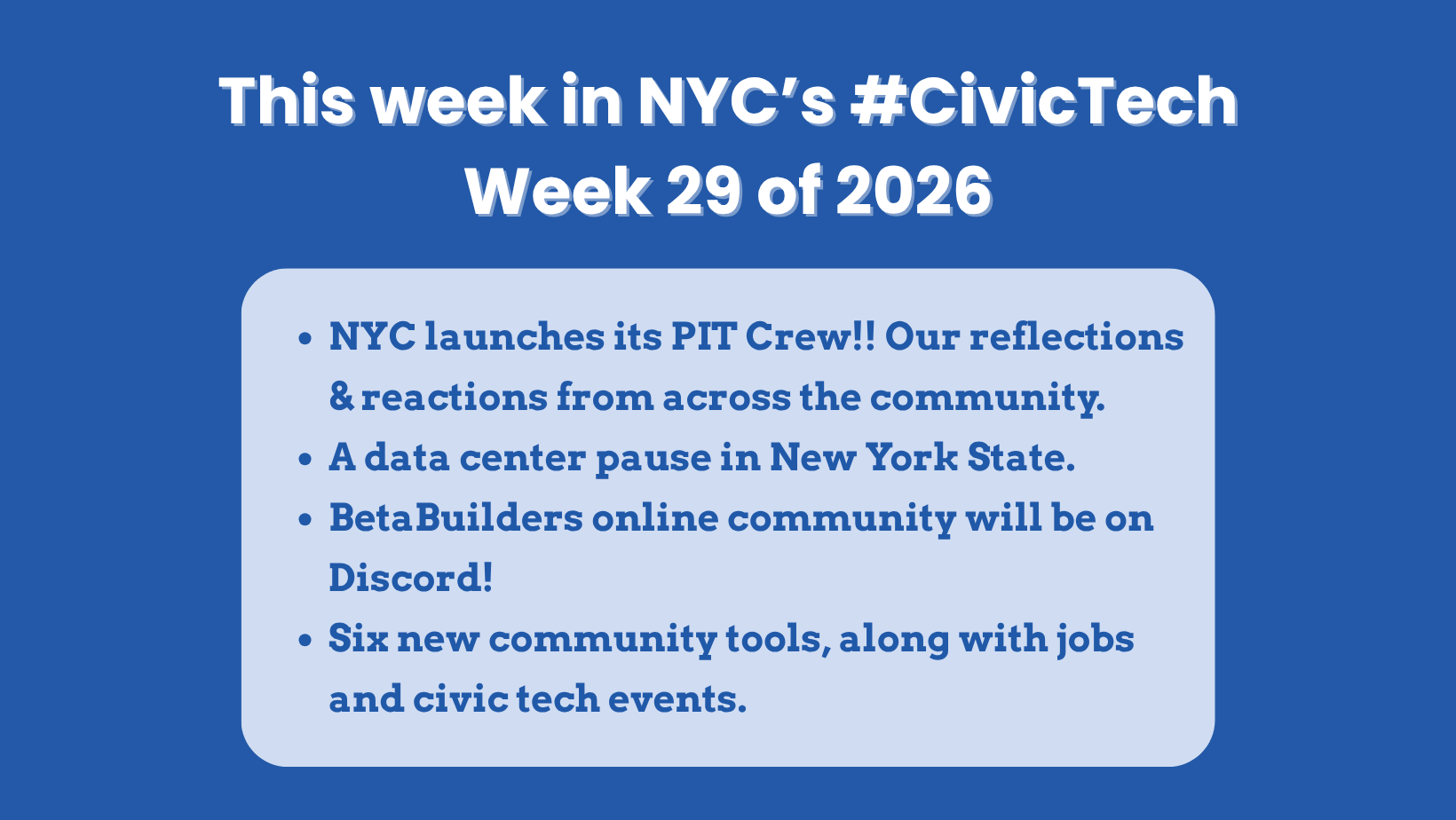
What a week. Ideas that New York’s civic technology community has pushed for years turned into real action.
The city launches its PIT Crew. On Monday, we gathered in Coney Island with Mayor Zohran Mamdani, New York City Chief Technology Officer Lisa Gelobter and her team, State Senator Kristen Gonzalez, who chairs the Senate’s Internet and Technology Committee, City Council Technology Chair Carmen De La Rosa, and the Mayor’s technology transition team to mark the launch of the city’s Public Interest Technology (PIT) Crew. Many of us have wanted to see this for a long time. We would not be here without our colleagues at the Civic Service Design Studio, NYC Opportunity, NYC Digital Services, and the countless civil servants who have worked to make government technology serve New Yorkers. We are grateful to the CTO and her team for standing up the crew and for building on the path those colleagues laid. We are glad to see this work take fuller form inside government, and we look forward to the conversations ahead.
A pause to get data centers right. This week Governor Hochul announced a one-year moratorium on new hyperscale data centers across the state. We welcome it. To move forward well, we need the deeper conversations that keep our energy grid from being overwhelmed and make sure communities actually gain from new technology. It is good to see the state choose to reflect and plan first. We look forward to being part of those conversations as New York works toward the ethical development of its digital infrastructure.
The BetaBuilders community opens soon. We are getting close to opening the BetaBuilders online community on Discord, which will replace Slack by year’s end. Say goodbye to Slackspam! Becoming a BetaBuilder comes with early access. If you’re already a donor, you should have received an early-bird invitation to CityCamp NYC 2026, and you’ll soon get your invite to the Discord server. This is a work in progress, and we appreciate your patience. We hope you’ll join us on September 19 at CityCamp NYC 2026, our civic sandbox!
With that, a few updates worth your time. If you run our MCP servers, please update them. Thanks to an eagle-eyed civil servant, the Schedule C MCP now carries MOCS and contracting data, filling a gap the PDFs left open. And for something fun, take a look at our repo reconstructing the city’s first public data directory, from April 1993. More to come next week.
Support BetaNYC 💗
- Become a BetaBuilder You’re not giving a donation, you’re building civic infrastructure. $5 a month makes you an Informed Neighbor, which keeps this newsletter free and comes with the exclusive online space, member happy hours, and an invitation to the members-only summer party. The levels above it are just as specific: $10 funds an intro data or AI 101 class like the ones listed below, $26 brings a Mapping for Equity event to your borough, and $100 covers a Civic Innovation Fellow’s monthly stipend. Monthly is the default, because building never finishes. (beta.nyc/donate)
Upcoming Events with BetaNYC 🎊
- July 21, 2026 at 12:00 pm — Introduction to AI (AI 101) with Council District 2 & BetaNYC — Office of Council Member Harvey Epstein and BetaNYC
- July 23, 2026 at 3:00 pm — Mapping for Equity: Data Entry Class with BetaNYC at Mosholu Library — BetaNYC
- July 29, 2026 at 12:00 pm — Introduction to AI (AI 101) with Council District 23 & BetaNYC — Office of Council Member Linda Lee and BetaNYC
- August 4, 2026 at 12:00 pm — Introduction to AI (AI 101) with Council District 10 & BetaNYC — Office of Council Member Carmen De La Rosa and BetaNYC
- September 19, 2026 — CityCamp NYC 2026 our civic sandbox. — BetaNYC
Civic Tech News & Updates 🗽
- Mayor Mamdani forms a PIT Crew to embed technologists across city government The new Public Interest Technology Crew will deploy technologists inside agencies to fix the systems New Yorkers actually use. (ABC7 NY)
- Governor Hochul orders a one-year pause on new hyperscale data centers The executive order halts new state permits for large data centers while the state studies their strain on the grid and their benefit to communities. (Times Union)
- DOGE officially ended on July 4 The federal Department of Government Efficiency has wound down, and agencies are now trying to refill the jobs it cut. (The Independent)
- Maryland’s data chief on shifting government culture The state’s chief data officer reflects on the slow, ongoing work of getting an entire government to treat data as a public asset. (Route Fifty)
- NYC wants your input on the future of internet access The city is running an Internet Access Survey to shape its broadband and digital-equity work, and it wants to hear from residents. (City of New York)
AI Roundup 🤖
- Two members of Congress take on AI Paris Marx argues that one of the two is listening to experts while the other echoes industry hype, though both back the federal data-center moratorium bill. (The Nation)
- Americans and AI in 2026 Pew’s latest survey maps how Americans use chatbots and smart devices, and how uneasy they remain about AI’s impact. (Pew Research Center)
- When Congress hallucinates Marci Harris of POPVOX examines what happens when lawmakers lean on AI tools that confidently make things up. (Marci Harris, POPVOX)
- What if every Massachusetts resident had their own AI agent? A concept paper proposes public infrastructure that would give residents their own AI agents to navigate government, rather than a single state-run bot. (Ramesh Raskar)
- A risk taxonomy for auditing AI Eticas publishes open infrastructure for turning AI principles into measurable audits of fairness and privacy in production systems. (Eticas)
Community Wins, and Featured Tools 🛠️
- Open Crash Map charts US fatal-crash density An interactive map of fatal-crash density across the United States, built on NHTSA’s FARS data so anyone can see where roads are deadliest. (Open Crash Map)
- NYC Precinct Day replays a day on the police radio Pick any of the city’s 77 police precincts and any day in 2025, and it pulls every 911 call and radio run the NYPD dispatched there from the city’s own records, rebuilding the map, the timeline, and the response breakdown live. (Josh Greenman)
- NYC Sim puts a model of the city in your browser A browser-based simulator of New York City that lets you explore and tinker with a model of Manhattan. (NYC Sim)
- Close maps the country by travel time Pick the amenities that matter to you, and Close colors every block by how far it sits from the most distant one, on the premise that a neighborhood is only as accessible as its farthest essential. (close.city)
- TicketTriage NYC opens FY2025 parking-ticket data A new public hub that turns official NYC Department of Finance and Open Data records into plain-English tables and downloadable parking-ticket data. (TicketTriage NYC)
- A map for 50 years of the Metropolitan Diary Austin Steinhart pins five decades of the New York Times’ Metropolitan Diary column to the places its small city memories happened, marking the column’s 50th anniversary. (Austin Steinhart)
Jobs & Opportunities 💼
- Emerging Technology & Urban Futures Fellow — Regional Plan Association — Launches a new RPA inquiry into how emerging technology, transportation, and land use intersect, starting with aerial mobility. Deadline: July 31.
- International Symposium on Urban Systems — NYU (Climate Week NYC) — A call for papers for a symposium on urban systems at NYU during Climate Week NYC on September 22; registration is open. Abstract deadline: August 14.
- Emerging Technology & AI Governance & Enablement Lead — Code for America — Builds AI governance policy and staff enablement across Code for America’s programs. Deadline: Rolling.
- Product Manager II, Discovery (Term-Limited) — ACLU — A three-year role in the ACLU’s Technology Department, driving product discovery for civil-liberties tools. Deadline: Rolling.
- Data Architect — ACLU — Leads data architecture and governance in the ACLU’s National office. Deadline: Rolling.
- Support Specialist, Enterprise Technology — ProPublica — Provides IT support for the newsroom’s staff out of ProPublica’s New York City office. Deadline: Rolling.
- Temporary Software Engineer, Product — The Marshall Project — A four-month, part-time remote contract building product and interactive storytelling for criminal-justice journalism. Deadline: Rolling.
- Managing Director — TechCongress — The number-two leadership role overseeing programs, operations, and finance for the tech-policy fellowship. Deadline: Rolling.
- Program Coordinator, Undergraduate Humanities Fellowships and Public Programs — New York University — Coordinates undergraduate humanities fellowships and public programming at NYU. Deadline: Rolling.
- Funding Opportunities — W.T. Grant Foundation — Open research funding streams supporting studies that reduce inequality and improve outcomes for young people. Deadline: Rolling.
Events 📅
- July 21, 2026 — AI Business Hub Workshop for Small Business Owners — Fordham University AI Business Hub
- July 21, 2026 — The Common News at the NYC PIT Pop Up — The Common News
- July 22, 2026 at 12:00 pm — Futureproofing Humanity in the AI Revolution — William & Mary Law School’s Digital Democracy Lab
- July 25, 2026 — Community Climate Innovation Challenge Idea Lab — DSSG NYC, G.I.V.E., and Climate Cafe NYC
- July 26, 2026 — AI Building Workshop for Social Impact
- July 28, 2026 at 6:00 pm — Summer Happy Hour — New York Focus
- August 8, 2026 — Day of Data Albany 2026 — Capital Area SQL Server User Group (Albany, not NYC)
Media to Watch, Listen, or Read 🎥
PIT Crew reactions
- [READ] An open letter to the new NYC PIT Crew The Federation of American Scientists lays out what a public-interest technology team inside City Hall should take on first. (Federation of American Scientists)
- [READ] The PIT Crew takes on scam subscriptions Erie Meyer connects the new crew to click-to-cancel enforcement and the fight against subscriptions that are hard to quit. (Erie Meyer)
- [READ] Mayor Mamdani invests in tech capacity to solve real problems Don Moynihan reads the PIT Crew as a bet on building public-sector capacity rather than outsourcing it. (Don Moynihan)
- [READ] Making government work from within A case for reforming government by strengthening its own technologists instead of routing around them. (Liberal Currents)
- [READ] We need a PIT crew for news Ben Werdmuller argues local journalism needs the same public-interest-technology treatment the city is giving its services. (Ben Werdmuller)
- [READ] A skeptic’s take on the fly-in model Matthew Burton warns that parachute tech teams fix visible problems while leaving the underlying plumbing untouched, though he calls City Hall’s preliminary COGE report the sharpest diagnosis of government-IT woes he has seen. (Matthew Burton)
- [READ] COGE will live or die on modernizing civil service An op-ed arguing that Mamdani’s efficiency commission succeeds only if it can modernize how New York hires and keeps public servants. (Crain’s New York Business)
Reports and essays
- [READ] A UN warning on AI and inequality A new United Nations report cautions that AI could widen the gap between rich and poor nations without deliberate policy intervention. (The Guardian)
- [READ] How Connecticut Public used AI to find local stories A public broadcaster’s account of using AI to surface local reporting leads without replacing its journalists. (Local Media Association)
- [READ] Building the government we need for what’s next A framework for the capacities public institutions should build now to meet the next decade’s demands. (Center for Civic Futures)
- [READ] Tech should serve, not supplant, democracy An essay drawing on DemocracyNext’s “Deliberative Muscles and AI” paper, arguing deliberative tools should strengthen democratic habits rather than hollow them out. (Evens Foundation)
- [READ] Imagining broadband policy of, by, and for the people A case for building broadband policy around the communities it is meant to serve. (Tech Policy Press)
- [READ] What 250 years mean for America’s democracy Keesha Gaskins-Nathan reflects on the country’s semiquincentennial and what funders of civic participation should take from it. (Funders’ Committee for Civic Participation)
- [READ] Government AI Navigator case studies A growing library of case studies on how public agencies are actually deploying AI. (Apolitical)
- [READ] Reboot Democracy A feature on Beth Simone Noveck’s new book about repairing democratic institutions with better technology and governance. (rebootdemocracy.ai)
- [READ] New data on gentrification and neighborhood change A national dataset tracking how neighborhoods changed across US cities from the 1970s to the 2010s. (NCRC)
- [READ] Public Advocate names a CCRB appointment Public Advocate Jumaane Williams appointed Mark Winston Griffith, founding executive director of the Brooklyn Movement Center, to the Civilian Complaint Review Board on July 9. (NYC Public Advocate)
Also worth your time
- [READ] How Flock cameras wrongly tracked me over ‘stolen’ plates A first-person account of an automated license-plate-reader error that sent police after the wrong driver for days. (The Drive)
- [READ] Wildfire smoke and air-quality safety for New Yorkers A practical guide to staying safe when wildfire smoke pushes the city’s air quality into unhealthy territory. (The City Reporter)
- [WATCH] Vibe Code Show & Tell Civic Tech Field Guide’s first show-and-tell on vibecoding, with Nathan Storey walking through Civic AI Tools, his project bridging open government data into the AI ecosystem via Model Context Protocol, along with his setup, how he handles security on vibecoded projects, and how he fights scope creep. (YouTube)
What did you think of today’s newsletter? We’d love to hear your feedback and ideas. Reply to this message or leave a comment.
Want to sponsor this newsletter or be featured in future ones? Share your community resources, projects, and events.
Did a friend forward this to you? Subscribe on our website, via email, or on LinkedIn.
We use AI tools to help scan and organize civic tech news each week — all editorial decisions are made by the BetaNYC team, per our AI Policy.
Build with NYC’s civic data. BetaNYC publishes free, open-source MCP connectors giving AI assistants direct access to NYC Council legislation, city spending and contracts, Council discretionary funding, 311 service data, the City Record, the NYC Charter and Administrative Code, and NYS Open Legislation. If you’re building with AI and civic data, explore them on GitHub.
Take care of each other, and have a great weekend!
