
Building civic infrastructure is never a thing you ever finish. The City we want to see will always be under construction. Bit by byte, we are at a unique moment in history with the tools, resources, and hope to address systemic issues and injustice, yet continuing to face the uncertainty of authoritarianism and climate change. As we have said every year, we will get through this together.
Halfway through 2026, here is what we have built. Here is what we argued for, and how we have responded.
Also, we’re migrating away from Slack. We hope you can join us as a BetaBuilder!

The big news — PIT Crews.
In July, New York City launched its Public Interest Technology (PIT) Crew: five in-house teams of product managers, designers, engineers, user researchers, and data experts, building digital public goods for New Yorkers instead of buying them. The city put more than $5 million behind it and is hiring for 15 roles.
We have been asking for this since 2013, when New Yorkers in all five boroughs wrote The People’s Roadmap to a Digital New York City. We asked again in 2021, after the vaccine websites failed the people who needed them most, and again in November 2025, in our recommendations to the incoming administration. In-house capacity was the ask every time. This year the city said yes.
Decades in the making: New York City launches its PIT Crew. Read the history of the moment.
Join us on August 12 to hear from the OTI leadership organizing the PIT Crews. Register here.
Scraping the City Budget PDFs.
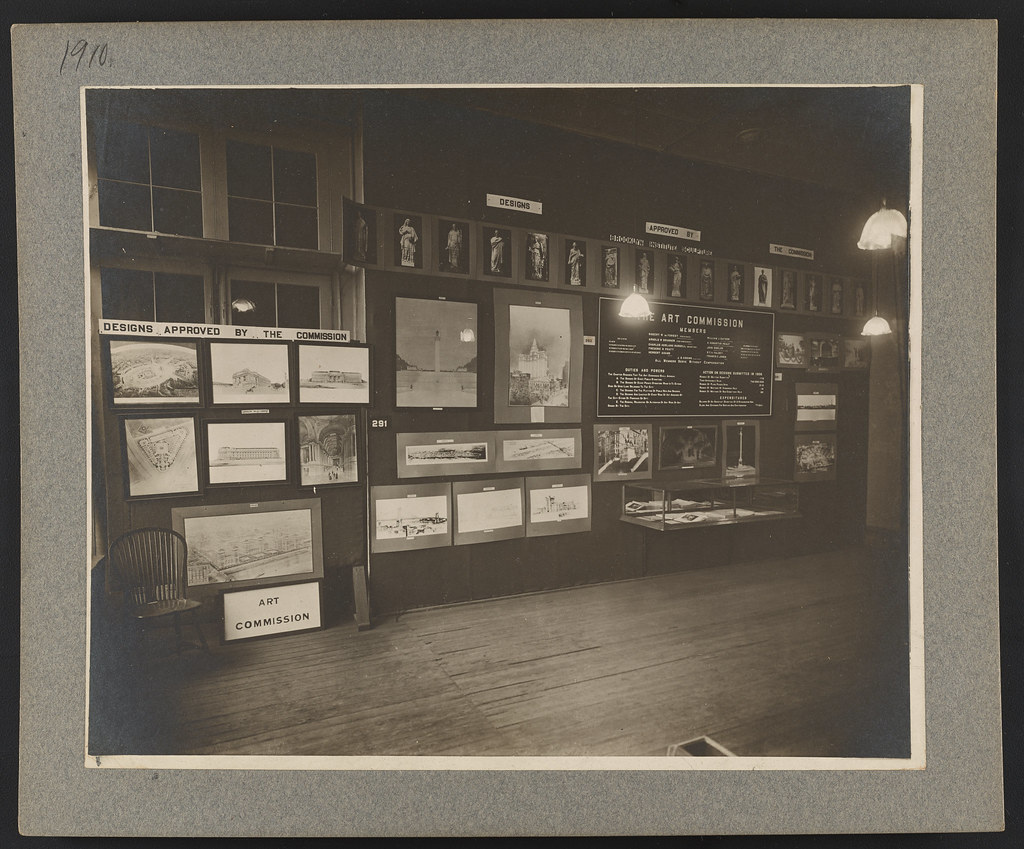
We turned twenty years of budget PDFs into open data
City Council budget allocations have been public for two decades via PDFs. In July, we extracted 19 fiscal years, FY2009 through FY2027, into structured, machine-readable data: Schedule C discretionary funding, Section 254 capital changes, terms and conditions, transparency resolutions, and a crosswalk back to Legistar. The FY2027 discretionary schedule reconciles to $655,764,999.
It is a public GitHub repository, New-York-City-Budget, with clean CSVs, a data dictionary, quality reports, and a server that lets you ask it questions in plain language. We built it so anyone can check the city’s math. Our ask for the Council is simple: publish Schedule C and the Section 254 capital schedule to the NYC Open Data portal, in structured format, within 24 hours of passage, so nobody has to do this again.
We turned two decades of Council budget PDFs into open data. Read more.
We argued for digital sovereignty at the Charter Revision Commission.
In June, Jordan Shapiro, Associate Board Program Manager at BetaNYC, testified before the Commission on Government Efficiency, a Charter Revision Commission, on the city’s ability to own and freely control its own digital infrastructure.
The argument is older than software. In the 1840s, New York decided it would not pay a licensing fee for its own water, and built the Croton Aqueduct. The city’s laws, data, and services deserve the same treatment. We asked the Commission to make digital sovereignty a governing principle rather than a procurement afterthought, to require every city law, rule, code, and executive order to be published in machine-readable form on infrastructure the city controls, and to expand the Office of Technology and Innovation (OTI) mandate so service design capacity sits inside agencies, modeled on the Open Data Coordinator network.
We want a government built for an era where computing is as ordinary and as public as clean water.
Read Jordan’s COGE testimony here.
Read COGE’s Preliminary report including the commission’s thoughts on Jordan’s testimony.

We fought for the money to make FOIL work.
Last year, the Council passed a law requiring the Department of Records and Information Services (DORIS) to build and maintain a centralized portal for Freedom of Information Law requests, where the public can submit a request, track every step of it, and read the records released. Every stage has to be published in machine-readable, searchable form, and all of it has to be available through a public API, so the record of what the city does with the right to know is itself open data. That is Local Law 199 of 2025, Intro 1235, sponsored by Council Member Gale A. Brewer.
A law without a budget line is a press release. In June, we testified at the Executive Budget hearing, alongside partner organizations, asking the Council to fund it: $255,000, made of $105,000 a year for a permanent developer, $110,000 for systems architecture and user experience design, and $40,000 a year for cloud storage. That is what it costs to make the right to know actually usable.
Read the law LL 199 of 2025 (Int 1235-2025) here.
We graduated a new class of public interest technologists.
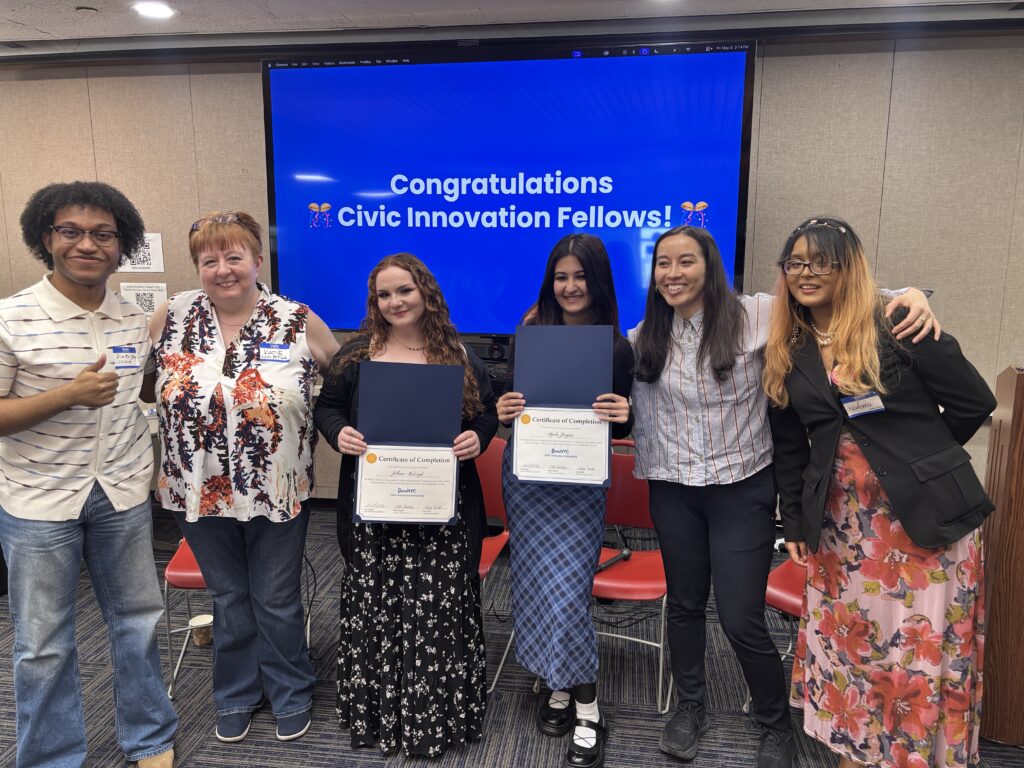
Ayela Janjua and Jillian Melough finished our 2026 Civic Innovation Fellowship in June. They organized Mapping for Equity workshops, ran data entry classes, and staffed CityCamp NYC, BetaBagels, Open Data Week, and NYC School of Data.
The point of the fellowship is that public interest technology is not only code. It is storytelling, data analysis, facilitation, and leadership.
“I feel a lot more hopeful about technology… seeing the Public Interest Tech community come together to use tech for the betterment of the public good is incredibly heartwarming.”
Ayela Janjua, 2026 Civic Innovation Fellow, BetaNYC
Read how we celebrated our 2026 Civic Innovation Fellows. Watch their showcase and celebration as part of BetaBagels 15 on YouTube.
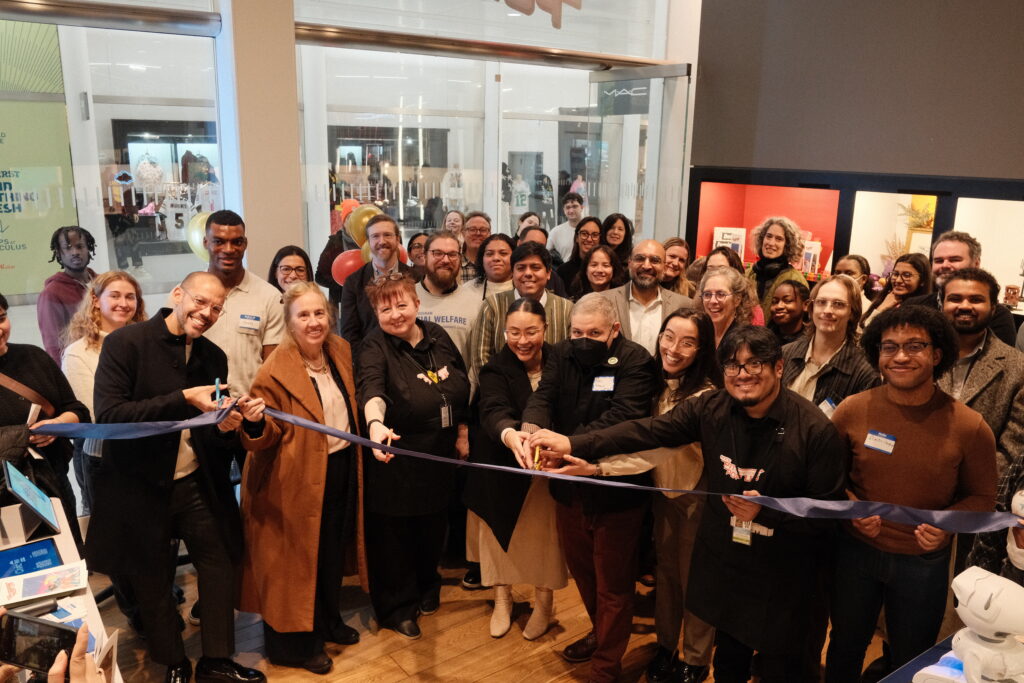
And we helped put civic tech in a storefront at the World Trade Center.
The CUNY Public Interest Tech Lab, directed by Rev. Dr. Katie Cumiskey, conceived the NYC PIT Pop Up: a living lab of interactive installations and civic technology demonstrations, in a storefront at the Oculus at the World Trade Center Transit Hub. It started with eleven days in November 2025 and came back in January through April 2026. We were a partner on the relaunch, on siting it and on bringing the community through the door, alongside the Public Interest Technology University Network (PIT-UN), the CUNY Office of Research, elected officials, the Siegel Family Endowment, and city agencies.
Most people will never read a charter revision testimony. A lot of them walk through the Oculus.
Read the NYC PIT Pop Up open house and relaunch press release.
And here are some 2026 data points to know.
We launched SEVEN new AI Tools for NYC’s Democracy. As personal AI agents proliferate, we want to make sure government information is easily accessible. All of our tools are open-source. Come build code with us. PRs and feature requests are welcome.
We kicked off a brand-new AI 101 initiative and hosted 6 hands-on AI literacy classes. We hosted 42 events across all five boroughs, bringing together over 9,219 attendees. If you’re curious to learn more, check out our events calendar!
Open Data Week and School of Data hit record attendance, with over 6,700 people at Open Data Week and 659 people at School of Data. Read the recap.
None of this happens without people like you choosing to show up for it, month after month.
What we are building next, and how to build with us!
Our Slack has been a home base for this community for nearly a decade! Due to a multitude of reasons, we are closing its doors on October 16. As of July, we have started a migration to Discord, organized around how you actually use us: by program, by topic, and by whatever you are trying to figure out.
There are two easy ways into our new “BetaBuilders” Discord server — attend an event or donate to sustain the community.
Becoming a BetaBuilder at $5 a month helps sustain our weekly newsletter and our events. If you already give monthly, your invitation should be in your inbox. If it is not, let us know, and we will get it to you.
Nobody has to pay their way in. Attending a class or an event opens the same door.
The city we want in ten years is made from what we will build. Come build it with us.
About the featured image. José Beaver, the BetaBuilders mascot, sits on a green cast-iron park bench in City Hall Park, holding a tablet and giving a thumbs up, with New York City Hall behind him in golden afternoon light. He is named for the real José, a beaver who returned to the Bronx River in 2007, the first seen in New York City in over 200 years. This illustration was generated with AI (ChatGPT) in August 2026.