Last week, 70 people came out in the rain to our Civic Tech Summer Showcase. Our Fellow New Yorkers took the mic across five lightning talks on tools they built: Gibson Chu’s interactive map reimagining NYC’s parking spaces; Can Sucuoglu and Sara Eichner’s Hudson River water-quality portal, pulling from 300+ monitoring locations; James Carroll and Michael Sheehan’s CityScroll, which aggregates City Record notices in eleven languages; Matt Keough’s CodeNOW NYC, giving civic-tech projects a path from demo to production; and Ashley Taylor’s Good Standing, a volunteer-rewards platform with artist-designed badges. Thank you to our presenters, everyone who showed up despite the weather, and to Sourabh Chakraborty and Jordan Shapiro for emceeing! Check out the full recap.
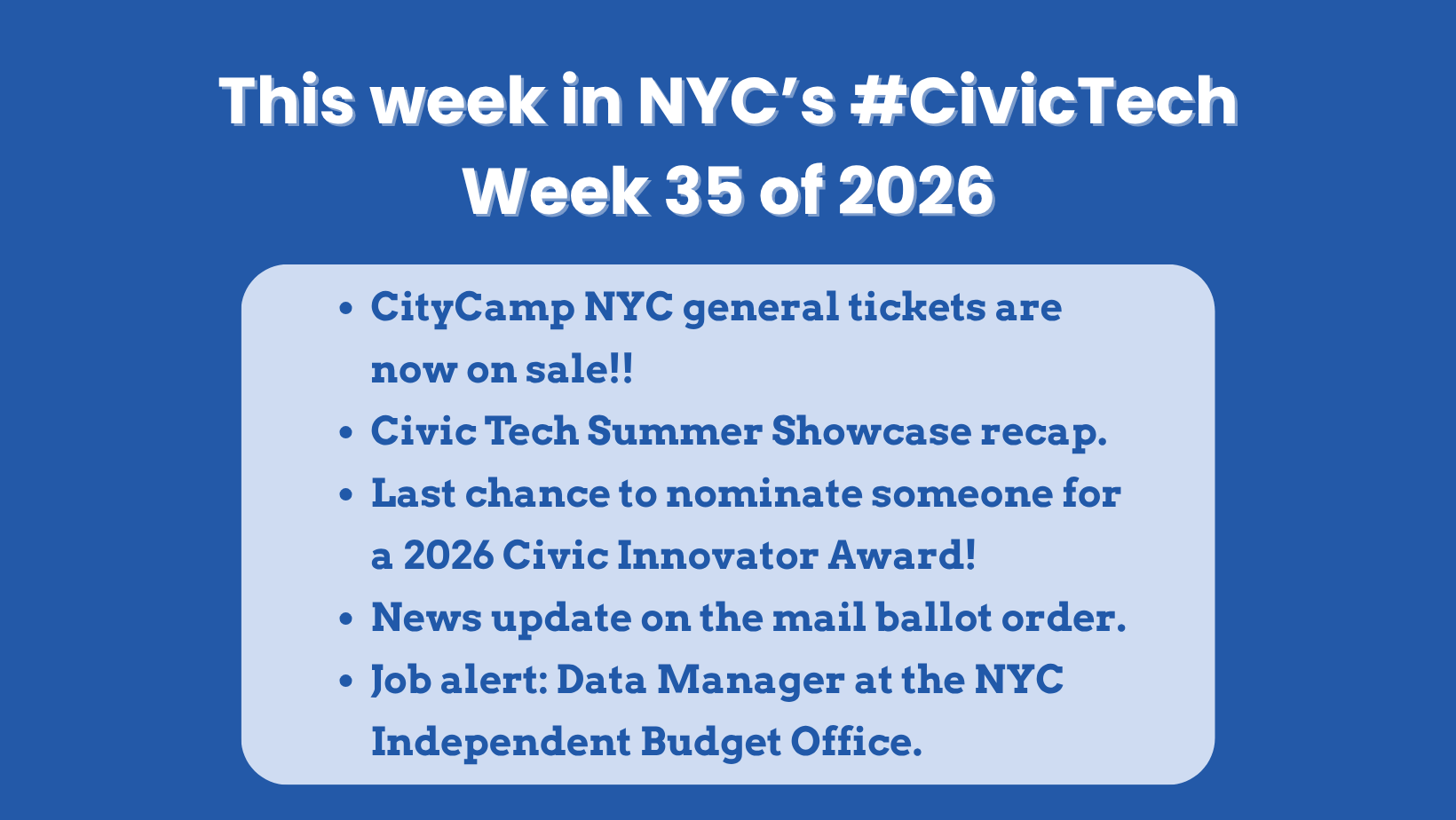
That’s the kind of room CityCamp NYC tries to build for a full day, at a much bigger scale. Join us on September 19 at Hunter College for an unconference where you help set the agenda instead of just sitting in it. General admission tickets are on sale now! This is one you don’t want to miss.
One more thing before you scroll: if you know a New Yorker whose work is making our city more transparent, accountable, accessible, or open, nominate them for a 2026 Civic Innovator Award, which will be presented at CityCamp NYC. Nominations close on August 31.
Support BetaNYC
- Join BetaBuilders, BetaNYC’s home for public interest tech — a Discord-based space for public interest technologists, civic hackers, and curious New Yorkers to swap ideas, get help on projects, and hear about programs first. Become a member and stay plugged into BetaNYC between issues of this newsletter. – beta.nyc/betabuilders
Upcoming Events with BetaNYC
- August 28 at 9:30am CityCamp NYC Ask Me Anything – BetaNYC
- September 16 at 6:00pm Discovering NYC Open Data: Online Session – BetaNYC
- September 19 at 9:00am CityCamp NYC 2026 – BetaNYC
- October 4 at 10:00am Introduction to Artificial Intelligence (AI 101) with BetaNYC – BetaNYC
Civic Tech News & Updates
- Civic-tech veteran warns LLMs will “flood” government services — “Those of us in the civic tech community have seen this before – recall the effect of new 311 reporting apps in cities in the early 2010s… People’s expectations for how they can interact with their governments are changing, and LLMs are enabling that. This change is coming fast, and the most equitable remedies governments have available are more difficult and can take lots of time. If governments don’t start planning (and acting!) now, they’re going to get flooded.” — Mark Headd, drawing a line from the 311-app era to today’s AI agents; paired with a new research paper, “Characterizing Agentic Flooding of Government Services.” – Mark Headd, LinkedIn
- Are Mayor Mamdani’s PIT Crews government innovation, or innovation theater? — Vital City takes a critical look at the PIT Crews program BetaNYC has been tracking, asking whether it’s delivering real service-delivery wins or mostly optics. – Vital City
- 13 fixes for NYC government that don’t require a charter change — Vital City’s list of government-operations improvements the city could make without a ballot measure. – Vital City
- States, including New York, sue to block the federal administration’s mail ballot order — Roughly two dozen states, Washington, D.C., and Pennsylvania’s governor are suing the Trump administration over an order requiring barcoded mail ballot envelopes and voter data-sharing; New York is represented through AG Letitia James, and the suit follows a setback at the Supreme Court. – The New York Times
- What counts as “counting” in the next census? — Gillian Tett looks at planned 2030 Census technical changes that would make it harder to publish data by race, gender, and small geographic area, plus the ongoing citizenship-question fight. – Gillian Tett, Financial Times
AI Roundup
- Meta’s AI glasses may get more invasive, and the apps built to detect them aren’t perfect — “Until comprehensive consumer privacy laws are passed, the Electronic Frontier Foundation (EFF) has warned that Meta seems prepared to make the tech even more invasive in its bid to sell more glasses and stay ahead of rivals in the burgeoning industry.” – Ars Technica
- Zuckerberg’s AI manifesto skips the hardest layer: compute — Rutgers Law’s Ellen Goodman argues you can’t democratize AI while hyperscalers monopolize the compute layer underneath it. – Ellen P. Goodman, Tech Policy Press
- A third of workers using AI say it’s saving them real time — Census Bureau survey data: about a third of recent AI users at work reported saving one to two hours on tasks, with overall adoption at 55% among U.S. workers. National data, not NYC-specific, but a useful benchmark for the local productivity debate. – U.S. Census Bureau
Community Wins, and Featured Tools
- A state-by-state catalog of where local government actually meets the public — An open-source directory of more than 38,000 U.S. jurisdictions and roughly 1,400 identified public-meeting sources (calendars, agendas, portals) — a reference layer other civic-tech tools can build on, not a meetings scraper itself. – National Civics Catalog, GitHub
- A free tool maps where NYC businesses actually are — A non-commercial business-location screening map built on NYC Open Data and other public sources; the builder is looking for methodological feedback and data corrections. – newplace.city
Jobs & Opportunities
- IT Support Staff — NYC Housing Authority — Provides tech support and troubleshooting to public-housing residents and staff, and helps NYCHA locations build digital literacy. Deadline: closes today, August 27.
- Full Stack Developer — Department of Correction — Builds and maintains the department’s web and mobile applications as DOC modernizes into a mobile-first agency. Deadline: August 28.
- Public Engagement Innovation and Design Specialist — Department of Transportation — Creates outreach materials and design collateral to communicate DOT’s transportation-planning work to the public. Deadline: August 31.
- Community Planning & Research Accelerator — Pratt Center for Community Development — Funding and technical assistance for NYC nonprofits working on neighborhood-level social-justice and planning challenges. Applications due August 31, 5:00 PM EST.
- Data Manager — NYC Independent Budget Office — Oversees IBO’s data lifecycle — ingestion, cleaning, analysis, and quality assurance — behind the office’s nonpartisan fiscal and policy research. Deadline: September 15.
- Assistant EHS Management System (MS) Data Coordinator — Department of Environmental Protection — Supports data analysis, compliance tracking, and reporting for DEP’s environmental health and safety programs. Deadline: September 23.
- Senior Director of Engineering — Campaign Finance Board — Leads the team building and maintaining the technology behind NYC’s public matching-funds program, voter guide, and campaign-finance disclosure platforms. Deadline: September 28.
- Public Engagement Content Manager — Department of Transportation — Develops communications and manages digital platforms for DOT’s street-safety and public-engagement campaigns. Deadline: October 4.
- Mainframe Systems Manager — Financial Information Services Agency — Leads a mainframe systems team supporting the city’s payroll and financial infrastructure. Deadline: October 19.
- Senior Advisor for Strategy & Special Projects — Office of the Mayor — Manages implementation of the Mayor’s international priorities and oversees key projects in the Office of International Affairs. Deadline: October 20.
- College Aide — Department of Design & Construction — Supports data-management work on capital projects, collecting and organizing datasets into reports and visualizations. Deadline: October 20.
- AI For The People — Fall 2026 Design Competition — Comp Sci High — Bronx student teams build AI-powered apps addressing community problems, pitching to judges with a path to the Congressional App Challenge. Submissions due October 26, 12:00 PM EDT.
- Data Scientist/Engineer — The Impact Project — Builds and maintains the data pipelines behind this small NYC-based nonprofit’s tracking of federal policy, funding, and workforce changes. Deadline: Rolling.
- Senior Data Scientist — Port Authority of NY & NJ — Leads predictive modeling, operational dashboards, and GIS integration for the Aviation Department’s Data Analytics Warehouse, supporting decision-making across the Port Authority’s NY/NJ airports. Deadline: Rolling.
- Website Manager — Apollo Theater Foundation — Manages and optimizes the Apollo’s website and digital presence for ticketing, fundraising, and audience engagement. Deadline: Rolling.
- Project Designer — it’s electric — Helps design curbside EV-charging infrastructure for city residents who can’t charge at home. Deadline: Rolling.
- Technical Lead — TXI — Leads client engagements building AI-powered digital products and workflows across health, education, and nonprofit sectors. Deadline: Rolling.
- Volunteer for Open House New York Weekend — Open House New York — Support one of more than 1,000 volunteers welcoming visitors and answering questions at 300+ locations citywide during OHNY Weekend. Deadline: September 13.
Events
- August 28 at 11:00am Civic Tech Vibecode Show & Tell #2 – Civic Tech Field Guide
- September 3 at 6:00pm Data Science for Social Good Happy Hour – Data Science for Social Good
- September 8–11 RustConf 2026 – Rust Foundation
- September 9 at 12:00pm AI Identity to Impact Learning Institute – Techbridge Girls
- September 16 at 1:00pm FormFest 2026: Better Government, One Form at a Time – Code for America and the Beeck Center for Social Impact + Innovation
- September 16–17 at 11:00am The Next Wave: AI & Emerging Tech Shaping Tomorrow – PowerToFly
- September 17 at 1:00pm Reboot: AI and the Race to Save Democracy – All Tech Is Human
- September 22 at 9:00am Building on UN Data Commons – UN Statistics Division, at Google NYC
- September 23 at 9:15am Carbon Newbie Summit at Climate Week NYC 2026 – Carbon Newbie Summit
- October 8 at 1:00pm Disrupting Politics: Technology, Democracy, and What Comes Next – All Tech Is Human, featuring Katie Harbath
- October 26 at 12:00pm Ten Lives – New America
- October 29 Responsible Tech Summit 2026: From Principles to Power – All Tech Is Human
Media to Watch, Listen, or Read
- [WATCH] Erin Brockovich takes on data centers — The New Yorker’s video series turns to data-center buildout and its fights with nearby communities. – The New Yorker (Radio Hour)
- [READ] America’s surveillance problem is bigger than Flock — Yale Law’s Stephen L. Carter argues Flock’s 120,000 license-plate readers are one symptom of surveillance that’s become a normalized, ubiquitous part of American life. – Stephen L. Carter, Governing
- [READ] A 7-step guide to AI sovereignty — Tiago Peixoto’s framework for replacing proprietary AI systems with open alternatives, building in-house skill, and keeping the ability to switch vendors. – Tiago C. Peixoto, LinkedIn Pulse
- [READ] Follow the (non-sovereign) vendor — A companion piece to the above, arguing structural dependency on non-sovereign tech vendors creates an enforcement gap that makes governance reforms toothless. – Dion Wiggins (AI-assisted), LinkedIn Pulse
- [READ] The Bronx uncovers a buried stream to fight flooding — Construction is set to break ground this fall on daylighting Tibbetts Brook, sending it back into the open for the first time since 1912, in what’s described as NYC’s first project of its kind. – Bloomberg CityLab
- [READ] Inside NYC’s K-shaped economy — Nancy Jiang traces how income gains have concentrated among millionaires since the pandemic while poverty, SNAP, and cash-assistance enrollment keep climbing — context for the economic debate shaping the Mamdani era. – Nancy Jiang, The City Reporter
- [READ] Just 48 of 324 eligible schools use NYC’s School Streets program — Comptroller Levine finds a cumbersome approval process is keeping most eligible public schools from converting streets into outdoor space for students. – NYC Comptroller Mark Levine
- [READ] NYC has the country’s most expensive bike-share. Could Mayor Mamdani change that? — A look at Citi Bike pricing and who gets priced out as pressure builds for a cheaper, more accessible system. – Next City
- [READ] How the job market is reshaping a generation’s outlook — Jay Caspian Kang on Gallup trend data showing youth job-market confidence has flipped sharply negative since 2023; national data, not NYC-specific, but relevant to the workforce conversation. – Jay Caspian Kang, The New Yorker (Fault Lines)
- [READ] Nobody can say who owns Wall Street’s Charging Bull — Ben Fractenberg goes looking for whoever’s responsible for the statue’s upkeep; NYC Parks says it’s not them. – Ben Fractenberg, The City Reporter
What did you think of today’s newsletter? We’d love to hear your feedback and ideas.
Want to sponsor this newsletter or be featured in future ones? Share your community resources, projects, events, and anything else happening so we can feature them in future posts.
Did a friend forward this to you? There are three ways you can subscribe to our newsletter. Read it on our website, receive it via email, or via LinkedIn!
We use AI tools to help scan and organize civic tech news each week — all editorial decisions are made by the BetaNYC team, per our AI Policy.
Build with NYC’s civic data. BetaNYC publishes free, open-source MCP connectors giving AI assistants direct access to NYC Council legislation, city spending and contracts, Council discretionary funding, 311 service data, the City Record, the NYC Charter and Administrative Code, and NYS Open Legislation. If you’re building with AI and civic data, explore them on GitHub.
Take care of each other, and have a great weekend!
BetaNYC is a civic organization improving lives through civic technology, design, and open data. Subscribe to the newsletter · Support our work · Follow us on Bluesky, LinkedIn, Facebook, Instagram, Threads, Mastodon, Reddit, and YouTube.
