
Hello friends,
This week, we’re sharing an abundance of exciting news! Thank you again to everyone who came out to CityCamp NYC a couple of weekends ago. Your civic pitches, collaborative sessions, and thought-provoking conversations keep the public interest technology community going! For the full rundown and photos of the jam-packed unconference day, check out this lovely recap from Duncan.
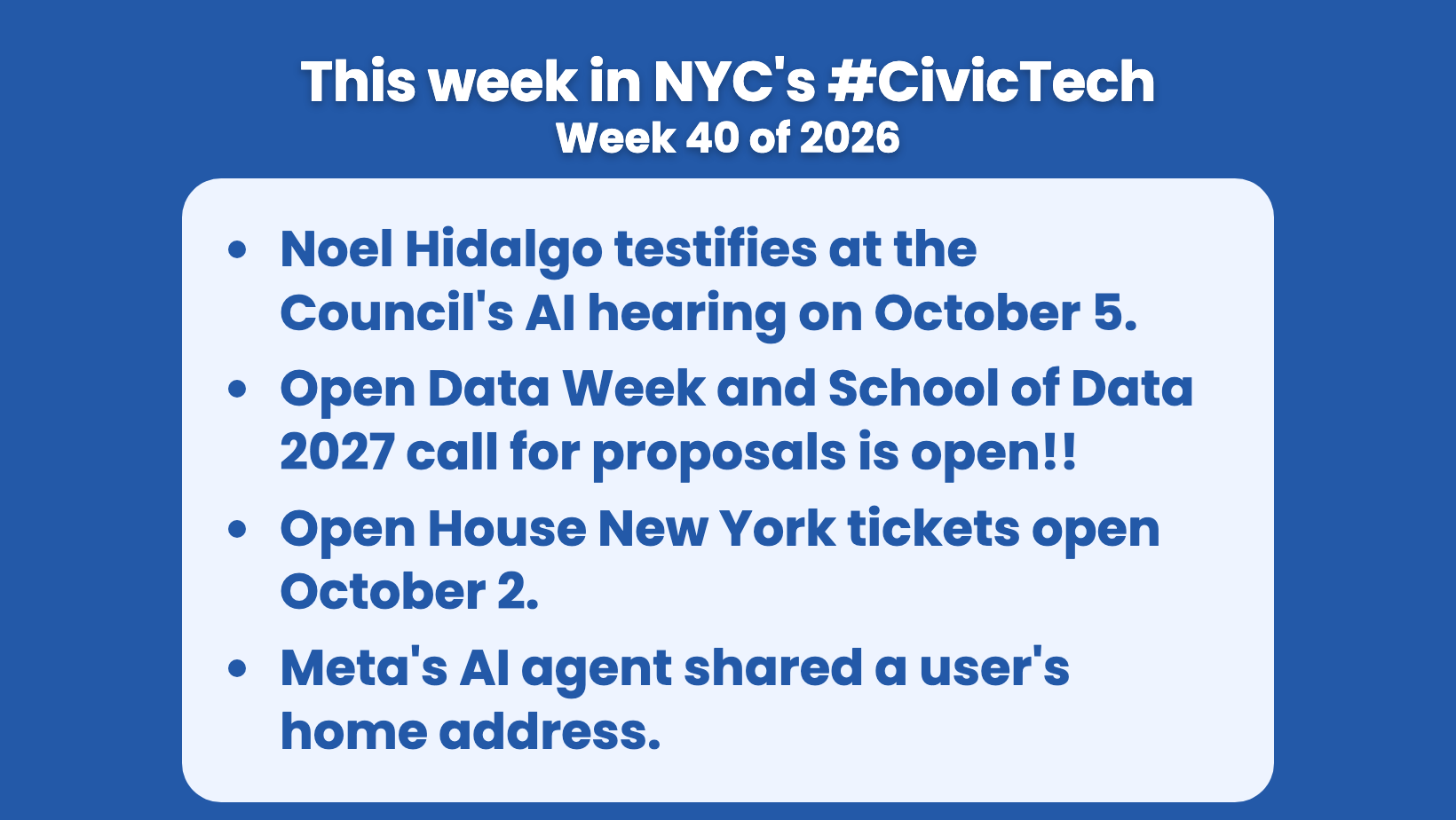
Open data friends, this part’s for you. We’re thrilled to announce that the Open Data Week and School of Data 2027 call for proposals is now live!! In case you missed it, next year’s festival will run for two weeks, from March 27 to April 11, 2027, giving you more time to attend all your dream open data events. Share your ideas and help us build next year’s program by December 6!
Also, our dear friends at Data Through Design have launched their Open Call 2027 and are celebrating their tenth anniversary! They are seeking projects on the theme “evidence of time.” Proposals are due by November 15.
In AI news, the NYC Council’s Committee of the Whole is holding a hearing on the risks posed by artificial intelligence on October 5 at 11:00 am. This is a rare event. Our Executive Director, Noel Hidalgo, will be testifying and wants to know: What should the Speaker and the Council ask the Mayor’s team and AI companies? Email your questions to the_message@beta.nyc to shape BetaNYC’s testimony! You can testify too, in person or in writing. Written testimony is accepted up to 72 hours after the hearing, and the Council explains how to testify.
Lastly, Digital Inclusion Week is coming up, and we’re bringing back our AI 101 classes! Come say hi to Duncan and Gabby at our virtual classes on October 4 at 10:00 am and October 5 at 2:00 pm ET (12:00 pm MT). The October 5 class is part of the Colorado Adult Education Coalition’s Bridging the Digital Divide Conference!
— Gabby, Duncan, and Noel
Support BetaNYC 💗
Support our work and join BetaBuilders. Make a donation or join BetaBuilders, a community for people building New York’s public interest tech.
Upcoming Events with BetaNYC 📅
- October 4 at 10:00 am Introduction to Artificial Intelligence (AI 101) with BetaNYC – BetaNYC
- October 5 at 2:00 pm AI 101 with BetaNYC at the Bridging the Digital Divide Conference – BetaNYC
- October 15 at 9:00 am Data Days Cleveland 2026 – At the Cleveland Public Library; BetaNYC will deliver the 2026 keynote.
- October 16 at 12:00 pm Discovering NYC Open Data: Online Session – the NYC Open Data Team and BetaNYC
Civic Tech News & Updates 🗽
- The Council lines up ten AI bills before its big hearing — Speaker Julie Menin’s package would require outside validation of AI systems before they are deployed in the city, with kill switches and fines of $25,000 per violation. Other bills would create a private right of action, require contractors to report AI safety incidents to Cyber Command within 24 hours, and protect whistleblowers. Anthropic, OpenAI, Google, and Meta are set to testify under oath at the October 5 Committee of the Whole hearing; see Hearings below. – NYC Council · NYC Council
- Federal cuts land on New York’s safety net — About 450,000 New Yorkers lost Essential Plan eligibility when the One Big Beautiful Bill Act’s cuts took effect July 1, and about 200,000 of them likely remain uninsured. Starting October 1, counties and New York City absorb at least $168 million a year in SNAP administrative costs as the federal share drops from 50 to 25 percent. – NEWS10 ABC
- Long Island’s license plate readers, and a push for limits — DeFlock’s open-source map counts more than 330 Flock Safety cameras on Nassau County’s roughly 3,200 miles of road, which puts the county in the top 3 percent nationally for camera density (New York Post). The ACLU is asking New Yorkers to press Governor Kathy Hochul and legislative leaders for limits on when the readers can be used, shorter data retention, and a ban on out-of-state sharing without a judicial warrant. – ACLU
- The federal design system’s new stewards want AI to test accessibility — A Treasury-linked team has taken over the U.S. Web Design System at GSA, removed contributors and blocked comments on its GitHub, and plans to automate as much accessibility testing as possible. Accessibility experts and former staff say AI tools cannot replace manual testing. – FedScoop
- The Council wants answers on the mayor’s influencer outreach — At a Governmental Operations oversight hearing chaired by Council Member Gale Brewer, members criticized Mayor Zohran Mamdani’s administration for sending no one from the Mayor’s Office of New Media to testify. The office reportedly used Signal to send talking points to more than 200 social media influencers. – City & State NY
Community Wins, and Featured Tools 🛠️
- A map for the city’s 9/11 environmental records — What is in Here is a volunteer project, not affiliated with the City, that helps people understand a large public data release before they search it. Its first case covers the 170,000-plus pages released on September 8, with overviews of document types, places, people, and dates that link back to the originals. – What is in Here
- Compare NYC public schools against your own child — Public School Match is a free, independent tool that scores every school against one child’s profile, using public data on academics, demographics, admissions, and commute times. It is not affiliated with NYC Public Schools, and each school profile lists its sources. – Public School Match
- The Legistar guide you wish you’d had — Sumana Harihareswara explains how to find bills, follow committee hearings, and set up alerts in the Council’s legislative system, with warnings about its subtle bugs and pointers to simpler tools like intro.nyc. – Sumana Harihareswara
- Indigenous New York Fashion Week fills the room — The second annual event featured 30 Indigenous designers and 120 Indigenous models, with Indigenous-led hair, makeup, and production teams, and a standing-room-only final show. – Next City
AI Roundup 🤖
- Meta’s new AI agent gave a stranger a user’s home address — Answering a Facebook Marketplace inquiry on a Toronto user’s behalf, Muse agreed to a sale and shared his address with the buyer without his knowledge. The agent launched September 22 and has been downloaded 3 million times. – The Guardian
- America.gov’s AI answers contradict the president — The administration relaunched America.gov with AI answers drawn from official government sources, and the Associated Press found those answers undercut many of the president’s own statements. By the end of the launch, the site had begun declining to answer “political questions.” – Associated Press
- London’s facial recognition trial: one alert, and it was wrong — A six-month British Transport Police trial in London rail stations cost £320,786 and scanned more than half a million faces. It produced a single alert, a false positive, and no arrests, and it has since been expanded to the Underground. Police say the expanded trial has produced three confirmed alerts. – The Guardian
- New grads aren’t losing jobs to AI, yet — A CESifo working paper by Robert Fairlie and Jane Wu finds no evidence of significant, widespread displacement or reduced hiring of recent college graduates because of AI, contradicting a Stanford study from last month. – Ars Technica
- The Senate blocks a data center electricity bill — The Ratepayer Protection Act passed the House 417 to 3, but on September 30 the Senate voted 57 to 43, short of the 60 votes needed to advance it. The bill asks states to consider making data centers pay their own energy and grid costs, and Senate Minority Leader Chuck Schumer said “Republicans are offering a toothless messaging bill.” – NBC News · Politico
Jobs & Opportunities 💼
- Deputy Director, Data Modernization & Exemption Analytics — NYC Department of Finance — Deadline: October 1.
- Business Intelligence Developer — NYC Department of Finance — Deadline: October 1.
- IT Infrastructure Engineer — NYC Employees’ Retirement System — Deadline: October 2.
- Curb Management Planner — NYC Department of Transportation — Deadline: October 17.
- Capital Analyst, Division of Capital Planning — NYC Department of Housing Preservation and Development — Deadline: October 17.
- Capital Analyst — NYC Department of Housing Preservation and Development — Deadline: October 17.
- Senior Director of CRM Modernization — New York City Housing Authority — Deadline: October 18.
- Business Solutions Architect — NYPD — Deadline: October 21.
- Senior IT Solution Architect — NYC Department of Social Services — Deadline: November 15.
- Section Chief, SCADA Development & Planning — NYC Department of Environmental Protection — Deadline: November 16.
- SCADA Support Specialist — NYC Department of Environmental Protection — Deadline: November 16.
- PeopleSoft Developer — NYC Financial Information Services Agency — Deadline: November 16.
- Java Developer — NYC Financial Information Services Agency — Deadline: November 16.
- Data Operations Analyst — Holly
- Staff Software Engineer, Product — Holly
- Chief of Staff — Holly
Events 📅
- October 14 at 9:30 am and 4:00 pm CC Licenses in the Age of AI webinars – Creative Commons. Two online sessions on its new guidance and what it means for education, science, and culture.
- October 16 to 18 Open House New York Weekend – 300 sites across the five boroughs, including MTA bus depots and Con Edison facilities. Most are free; tickets for limited-capacity sites cost $7 and go on sale October 2 at noon. Five picks from Gothamist.
- October 22 at 6:30 pm Transit Techies #39: Phil Cline and Joe Puccio – Transit Techies NYC and NYU Tandon’s Center for Urban Science + Progress, at 370 Jay Street, Room 1201, Brooklyn. Talks on how Swiftly helps transit agencies share bus detours and on WalkNYC, an app that tracks which blocks you’ve walked. Free; register ahead for building access.
- October 24 TransportationCamp NYC 2026 – At NYU Tandon School of Engineering in Downtown Brooklyn. An unconference where attendees propose and lead every session, open to planners, developers, engineers, students, policymakers, and anyone interested in mobility.
Hearings 🏛️
3 hearings ahead. Dates and runway below, so you know what you have time to prepare for.
Short notice
Less than 7 days out. Written testimony is the realistic route here.
- October 5 at 11:00 am — 4 days away · NYC Council
Oversight – Examining the Risks Posed by Artificial Intelligence
Committee of the Whole
Coming up
Enough runway to write and submit testimony.
- October 16 at 10:00 am — 15 days away · NYC Council
Oversight – Municipal Retention Strategies
Committee on Civil Service and Labor - October 20 at 10:00 am — 19 days away · NYC Council
Oversight – Ambulance Response Times
Joint hearing: Committee on Fire and Emergency Management, Committee on Hospitals
Already heard, testimony still open
The Council accepts written testimony for 72 hours after a hearing adjourns. These are still open.
- September 30 at 1:00 pm — heard yesterday · NYC Council
Oversight – New York City’s 311 System
Committee on Technology
Written testimony until October 3.
How to testify at a City Council hearing. In-person testimony needs no pre-registration. Virtual testimony requires signing up in advance. Written testimony is accepted up to 72 hours after a hearing adjourns. Details at council.nyc.gov/testify, or email hearings@council.nyc.gov. State hearings are often invitation-only for oral testimony — check the individual notice.
Media to Watch, Listen, or Read 🎥
Watch or listen
- What AI companies’ own documents say about the web — Jason Koebler walks through court filings that quote internal OpenAI and Microsoft documents on how large language models are harming the web, and Emanuel Maiberg explains how he hijacked a real band’s Spotify page with AI-generated music. – 404 Media Podcast
- Kashmir Hill on the end of privacy — Joseph Cox talks with the New York Times reporter and author of Your Face Belongs to Us about facial recognition moving into surveillance cameras and smart glasses. – 404 Media Podcast · YouTube
Read
- From civic tech to DOGE — Donald Moynihan traces the U.S. civic tech movement from HealthCare.gov through 2024, which made steady inroads into government without gaining the power for profound change, and contrasts it with DOGE, which entered through political power to shrink government. Open access. – Public Administration
- What data brokers actually know about you — Consumer Reports had people request their files under new state privacy laws, and the more than 100 dossiers returned so far show detailed, often inaccurate profiles of income, spending, and location, plus long lists of buyers. – The Markup
- Your car is talking to advertisers — Researchers at Northeastern University and Consumer Reports tested 21 vehicles and 30 companion apps. Every vehicle sent data to at least one third party, and seven apps sent VINs, phone numbers, or precise location to advertising networks. – The Verge
- What governments outside the West said about AI at the UN — Many used General Assembly High-Level Week to ask for a bigger role in setting AI rules, wider access to AI capacity, and safety efforts that do not deepen technological divides. – Tech Policy Press
- A Manhattan Institute case for AI-driven quality-of-life policing — In an opinion piece drawn from his new report, Josh Appel argues the city should use AI to combine 311 complaints, camera feeds, and other city data to predict problems like drag racing, as a successor to CompStat. – City Journal
- Why schools are hitting the brakes on electric buses — Districts cite costs, range, cold-weather failures, and grid upgrades they cannot afford. Only 354 of New York’s 50,000 school buses are electric, and the state’s all-electric deadline has moved from 2035 to 2040. – The New York Times
- Climate groups want a say in the data center fight — Climate organizations are joining local opposition to data centers, but it is not yet clear they can get people to care about the facilities’ effect on the atmosphere. – WIRED
- “Eat the rich, save the planet” outside OpenAI’s Manhattan office — During Climate Week, protesters picketed OpenAI, Google, and Amazon offices over big tech’s energy use. – The Guardian
- A Bay Area group takes on tech-backed Democrats — TechEquity Action, founded by Catherine Bracy, is launching a $1 million campaign against Democrats backed by tech super PACs, which have spent more than $25 million on California legislative races this cycle. – The San Francisco Standard
- Mozilla’s posters put its fellows next to tech billionaires — The campaign around New York contrasts executives like Musk, Zuckerberg, and Bezos with fellows such as Rose Njeri Tunguru, who builds tools to help Kenyans verify election results. – Business Insider
New Data to Note! (2) 📊
Assets published September 22 – September 29, 2026 (7 days). Source: Socrata Discovery API, createdAt.
NYC Open Data (data.cityofnewyork.us) — 2 new
- 2025 Green Taxi Trip Data (new edition of a recurring series) · 2026-09-28 — Taxi and Limousine Commission (TLC)
These records are generated from the trip record submissions made by green taxi Technology Service Providers (TSPs). Each row represents a single trip in a green taxi. - 2025 For Hire Vehicles Trip Data (new edition of a recurring series) · 2026-09-25 — Taxi and Limousine Commission (TLC)
These records are generated from the For-Hire Vehicle (“FHV”) Trip Record submissions made by traditional livery, luxury, and black car bases. The FHV trip records include fields capturing the dispatching base license number and the pick-up…
NYS Open Data (data.ny.gov) — 0 new
- Nothing new this window.
Conclusion
What did you think of today’s newsletter? We’d love to hear your feedback and ideas.
Want to sponsor this newsletter or be featured in future ones? Share your community resources, projects, events, and anything else happening so we can feature them in future posts.
Did a friend forward this to you? There are three ways you can subscribe to our newsletter. Read it on our website, receive it via email, or via LinkedIn!
We use AI tools to help scan and organize civic tech news each week — all editorial decisions are made by the BetaNYC team, per our AI Policy.
Build with NYC’s civic data. BetaNYC publishes free, open-source MCP connectors giving AI assistants direct access to NYC Council legislation, city spending and contracts, Council discretionary funding, 311 service data, the City Record, the NYC Charter and Administrative Code, and NYS Open Legislation. If you’re building with AI and civic data, explore them on GitHub.
Take care of each other, and have a great weekend!
BetaNYC is a civic organization improving lives through civic technology, design, and open data. Subscribe to the newsletter · Support our work · Follow us on Bluesky, LinkedIn, Facebook, Instagram, Threads, Mastodon, Reddit, and YouTube.
