
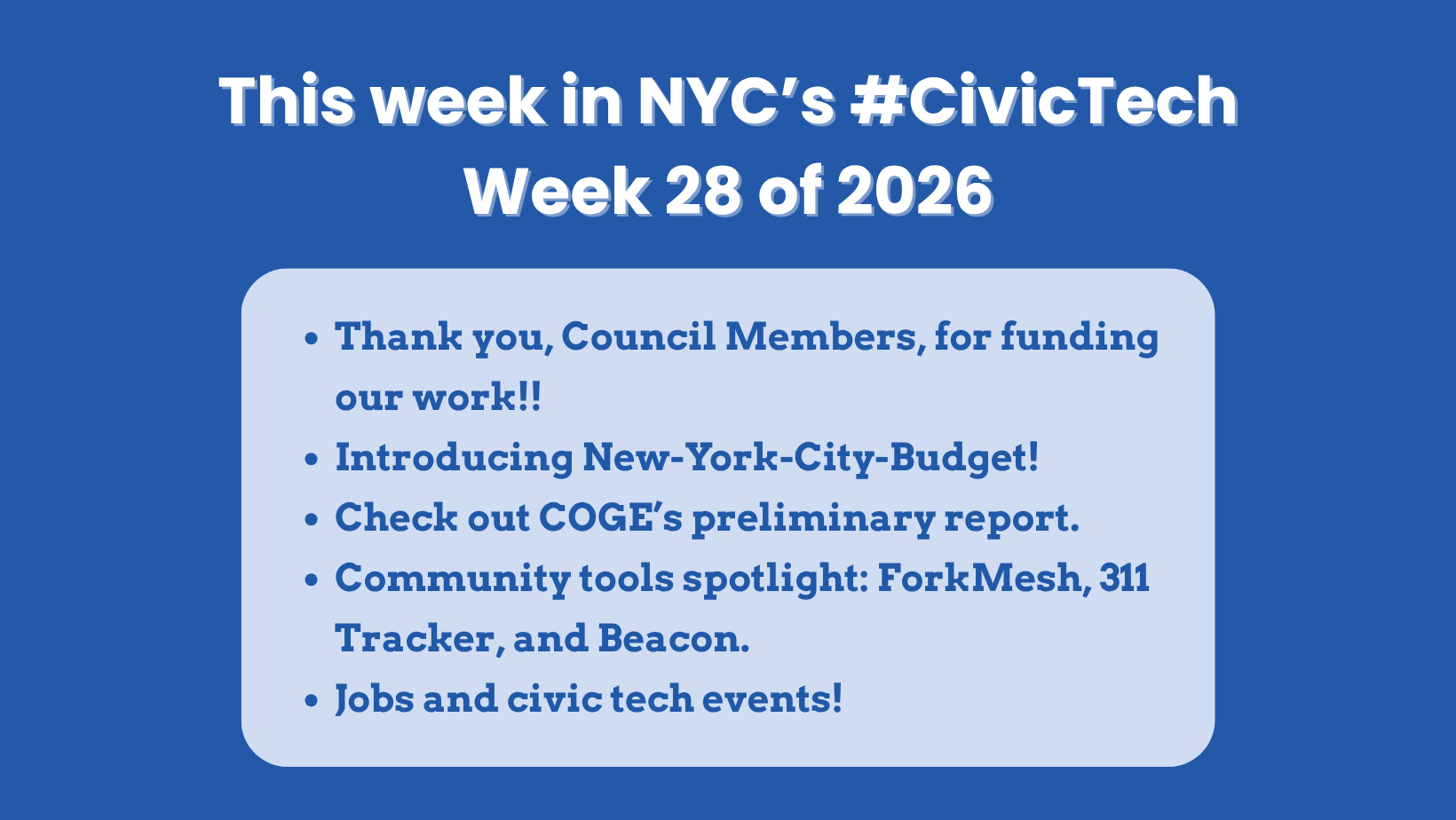
Last week, the City Council adopted a $125.8 billion FY27 budget. On the same day, OTI listed 15 positions – five for a Senior Product Manager, five for a Senior Product Engineer, and five for a Senior Product Designer, all inside the Applications division that runs 311, NYC.gov, and dozens of other resident-facing tools. That’s not three unrelated openings. It’s a full product team, the kind of internal digital service capacity NYC has needed for years; it is what we have wanted for a decade. Thank you, Mayor Mamdani and New York City Council!
What else is in the New York City budget? We were wondering how much money we received for our digital literacy work.
Introducing you to NYC’s latest dataset, BetaNYC/New-York-City-Budget, a public GitHub repo where our AI agent scraped and reconciled twenty years of Council Schedule C discretionary awards (FY2009 to FY2027) into structured, queryable data. No PDF-wrangling required. Read more about the scraping project on our website.
Speaking of Schedule C: thank you to Council Members Gale Brewer, Julie Won, Lincoln Restler, and Eric Dinowitz for their continued support of BetaNYC’s Civic Innovation Lab, Mapping for Equity, and our RADAR work. And we want to welcome Council Members Virginia Maloney, Justin Sanchez, and Harvey Epstein, the newest additions to that list, who designated funding for BetaNYC’s digital capacity work in their first budgets in office. We couldn’t do this work without you!
We want to commend Associate Board Manager Jordan Shapiro, whose testimony before the Commission on Government Efficiency helped shape the Commission’s direction. Their feedback has been incorporated into the Commission’s preliminary report, which anchors digital sovereignty in its technology recommendations. Allies and friends of BetaNYC echoed the call for a unified digital service team capable of providing citywide capacity. Now is the time to make sure New Yorkers have the tools, policies, and values to meet the next century.
Read the preliminary report press release and the full preliminary report (PDF). If you have feedback on the preliminary report or anything else to share with the Mayor’s office, public comments are still open.
Now, on to the difficult work: Anchoring New Yorkers’ understanding of digital sovereignty, organizing CityCamp NYC, hosting open data classes, mapping benches, and Digital Data and AI Literacy to all New Yorkers!
We hope to see you at one of our upcoming events, and we can’t wait to show you how to take over a decade of open government advocacy and turn it into a simple, natural-language query.
Noel Hidalgo (with support from Gabrielle Langston)
Support BetaNYC 💗
Subscribers keep this newsletter free and open, and the No Kings swag page underwrites the public programs we build the rest of our week around: Mapping for Equity, School of Data, and the civic-tech community we convene across the five boroughs.
Upcoming Events with BetaNYC 🎊
- July 10 at 12:00 pm EDT — Discovering NYC Open Data: Online Session — NYC Open Data Team at OTI and BetaNYC
- July 10 at 2:00 pm EDT — Mapping for Equity: Mapping NYC’s Public Amenities in Council District 11 — Office of Council Member Eric Dinowitz and BetaNYC
- July 13 at 10:00 am EDT — Introduction to AI (AI 101) with Council District 4 & BetaNYC — Office of Council Member Virginia Maloney and BetaNYC
- July 21 at 12:00 pm EDT — Introduction to AI (AI 101) with Council District 2 & BetaNYC — Office of Council Member Harvey Epstein and BetaNYC
- July 23 at 3:00 pm EDT — Mapping for Equity: Data Entry Class with BetaNYC at Mosholu Library — BetaNYC
Civic Tech News & Updates 🗽
- A Cornell Tech fellowship director says Mamdani’s efficiency commission needs to fix agency capacity, not just city rules. Ashwini Chhabra, who leads Cornell Tech’s Urban Innovation Fellowship, argues the Commission on Government Efficiency (COGE) should recommend a permanent Mayor’s Office of Government Transformation that embeds skilled staff inside city agencies, pointing to a fellow’s AI-powered street-inspection tool at the Department of Transportation as proof that capacity, not just charter rules, is what’s missing. “The path to government efficiency runs through people and capacity, not just rules and regulations.” (Vital City)
- Abundance New York pitches seven charter amendments for Mamdani’s efficiency commission. Robert Joyce and Catherine Vaughan of Abundance New York lay out specific fixes for COGE to consider, including a five-year city workforce plan to address more than 13,000 vacant positions, consolidated Department of Buildings permitting authority, and raising the small-purchase procurement threshold that hasn’t moved since the 1989 charter. (Vital City)
- Eight veterans of city government tell Mamdani’s commission where to start. A Vital City roundtable convened by founder Elizabeth Glazer brought together former NYC Transit President Sarah Feinberg, former First Deputy Mayor Maria Torres-Springer, Cornell Tech’s Michael Samuelian, and five other former officials to propose fixes for COGE, including standardized cross-agency data sharing and a recurring capacity review modeled on the United Kingdom’s cabinet-level capability reviews. (Vital City)
- NYC’s Department of City Planning launches an interactive map of who speaks what language, and where. The NYC Language Explorer draws on U.S. Census Bureau data to show borough- and community-level language proficiency, including that roughly 1.8 million New Yorkers have limited English proficiency and that Spanish is the most common non-English language citywide. (GovTech)
- Governor Hochul turns AI loose on 18 million words of New York state law to find the fax machines and telegram rules still on the books. The Regulatory Reset initiative, built with the civic tech organization Recoding America and Stanford University, flags outdated requirements, like fee schedules, notary rules, and defunct task forces, for state agencies to eliminate or modernize; humans still decide what actually changes. (The New York Times)
- A Gothamist analysis of city data found NYC inspected only 1,306 of the nearly 6,000 cooling towers in the city in the first half of 2026, as a new Legionnaires’ disease cluster emerged on the Upper East Side. As of April 17, more than half of the city’s cooling towers had gone over a year without a city inspection. (Gothamist)
- New York State extended NY HELPS, the program that lets governments hire faster by waiving civil service exams, through June 2028, but New York City is again opting out despite its own vacancy crisis. The program has filled more than 60,000 government jobs statewide; NYC’s vacancy rate has hovered around 4.5% since 2024. (New York Focus)
- Government agencies across the 11 U.S. host cities for the 2026 FIFA World Cup are deploying GIS mapping and predictive analytics to manage crowds, public safety, and infrastructure for an expected 5 million visitors. In New York City, LinkNYC kiosks will livestream matches for residents and visitors, and the city has published a GIS map of World Cup information on its website. (GovTech)
AI Roundup 🤖
- A one-night hackathon turned NYC Open Data into 20 working prototypes, from a flood-resilience dashboard to a voice-input benefits form. At a State Capacity Ecosystem hackathon in New York City, more than 80 participants split into 20 teams and used AI tools to build working prototypes in a matter of hours. “AI meant for the first time we could weigh in on design and product decisions instead of beelining towards writing code.” (Henry Grunzweig, State Capacity Ecosystem)
- Two former FTC attorneys want settlement money from AI lawsuits to fund a public media-literacy campaign. Gaurav Laroia and Charlotte Slaiman point to the 1998 tobacco settlement’s Truth Initiative and Finland’s media-literacy programs as models for a dedicated “Truth Campaign” against AI-enabled deepfakes and scams. (Tech Policy Press)
- Bernie Sanders introduces legislation to put $7 trillion of AI wealth directly in the public’s hands. The American AI Sovereign Wealth Fund Act would impose a one-time 50% tax on the largest AI companies’ stock, depositing those shares into a fund managed by an independent, bipartisan commission; Sanders estimates a 5% annual dividend could pay out more than $1,000 per American to start. (WIRED, Sen. Bernie Sanders)
- The UN’s first independent scientific assessment of AI warns that “current safeguards cannot keep pace with the growth of AI’s capabilities.” The Independent International Scientific Panel on AI, drawing on scientists from all five UN regions, examined AI’s societal, economic, security, and governance implications in a preliminary report feeding into the first Global Dialogue on AI Governance, held in Geneva July 6-7. (United Nations)
Community Wins, and Featured Tools 🛠️
BetaNYC Expands Open NYC Council Budget Data Back to 2009
BetaNYC’s open dataset of NYC Council budget records now spans twenty fiscal years, not three. What started as Fiscal 2025 through 2027 now runs back to Fiscal 2009: Schedule C discretionary funding, Terms and Conditions, and Section 254 capital changes, each checked against the Council’s own printed totals. The dataset also now includes years of Transparency Resolutions, and each award still carries the recipient’s EIN so it joins directly to nonprofit filings, Council districts, and city contract records. It’s free, openly licensed, and live now on GitHub.
While we were in Legistar, we also found and fixed a bug in our nyc-council-mcp tool that was quietly hiding thousands of Council resolutions from search. It’s live now as version 2.2.0.
311 Tracker: A Free Lookup Tool for Building Complaints, Violations, and Rent-Stabilization Status
311 Tracker is a free, searchable database that lets New Yorkers look up a residential building’s 311 complaints, housing violations, eviction history, and rent-stabilization status. The tool draws on NYC Open Data and, per the site, covers roughly 834,400 buildings, 1.8 million 311 complaints, and 2.0 million HPD violations, updated daily. Built solo by a submitter going by “pankaj.”
ForkMesh Wants to Keep Civic-Tech Projects From Disappearing When Their Maintainers Do
ForkMesh is building local-first source code preservation and collaboration infrastructure for projects that need to stay accessible over time. The idea is to help public-interest software, civic tech tools, open data projects, and volunteer-maintained repositories avoid depending on a single platform or server as the only place their work lives.
Beacon: A Data-Mapping Tool for Community Organizations
DataKind built Beacon, a platform that combines public data on economic security, health, and housing with an organization’s own data to produce clear, shareable, place-based maps. It’s aimed at community development groups, health agencies, housing advocates, funders, and legal aid providers who need to identify service gaps and back up outreach or advocacy work with evidence.
Jobs & Opportunities 💼
Sorted by application deadline.
- Hack Your Summer (Session B) — Coding it Forward — Free, unpaid. Deadline: July 10.
- IT Project Coordinator — Department of Transportation — Deadline: July 11.
- Senior Data Analytics Specialist — Dept of Parks & Recreation — Deadline: July 13.
- Network Administrator — District Attorney, Kings County — Deadline: July 15.
- OpenAI People-First AI Fund — grant, not a job. $50 million for US-based 501(c)(3) nonprofits ($500K–$10M budgets). Deadline: July 15.
- Claude Corps — Anthropic — 12-month fellowship. Host organizations can apply too. Deadline: July 17.
- Project Administrator for Planning — Dept of Parks & Recreation — Deadline: July 20.
- Natural Resources Designer — Dept of Parks & Recreation — Deadline: July 20.
- Preservation Project Manager — Dept of Parks & Recreation — Deadline: July 24.
- Consultant Project Manager for Architecture — Dept of Parks & Recreation — Deadline: July 24.
- Senior Project Manager for Architecture — Dept of Parks & Recreation — Deadline: July 27.
- Civic Science Fellow — Institute for Advanced Study, School of Social Science — 18-month fellowship. Deadline: July 29.
- Senior .Net Developer — Dept of Citywide Administrative Services — Deadline: July 29.
- Director, Legal Affairs — Office of Emergency Management — Deadline: July 31.
- Indigenous Data Champions Fellowship — Indigenous Data Alliance — Paid, year-long fellowship. Deadline: August 1.
- Chronic Disease Data Analyst, Bureau of Chronic Disease Prevention — Dept of Health/Mental Hygiene — Deadline: August 25.
- Senior Product Manager — NYC Office of Technology and Innovation — Brooklyn. Deadline: August 14.
- Senior Product Engineer — NYC Office of Technology and Innovation — Brooklyn. Deadline: August 14.
- Senior Product Designer — NYC Office of Technology and Innovation — Brooklyn. Deadline: August 14.
- Team Leader, Sprint Team — Department of City Planning — Deadline: August 28.
- Deputy Director, Sprint Team — Department of City Planning — Deadline: August 28.
- Data & Metrics Analyst — Campaign Finance Board — Deadline: August 28.
- Application Developer — Bronx District Attorney — Deadline: August 29.
Events 📅
- July 10 at 11:00 am — Vibe Code Show & Tell — Daniel Mackisack
- July 10 at 6:00 pm — NYC Creative AI July Forum — NYC Creative AI, hosted by ZeroSpace and Daydream
- July 14 at 2:00 pm — How Government Acts: Putting Data to Work — InnovateUS
- July 14 at 2:30 pm — Rapid Response Data Briefing: Critical Rulemaking for the 2030 Census — Association of Public Data Users
- July 15 at 11:30 am and 4:30 pm — Summer PIT Stop at the NYC PIT Pop Up — NYC PIT Pop Up
- July 15 at 1:00 pm — Government Is Triage: Using Data to Decide What Your Team Does This Week, and Getting it Done — 17A
- July 21 — Community Board Best Practices Gathering — Abundance New York
- July 21 at 5:00 pm — AI for Social Good Meetup — Anew, in partnership with AI for Good NYC
- July 24 at 8:00 am — Black Python Devs Leadership Summit 2026 at PyOhio — Black Python Devs, in partnership with PyOhio
- August 6-7, from 11:00 am to 3:00 pm each day — 2026 Conference — Civics of Technology
- Deadline: July 31 — AI x Investigative Journalism Forum — Speaker Pitch — Hacks/Hackers
- Now through summer — Trees Count — NYC Street Tree Census — NYC Parks
Media to Watch, Listen, or Read 🎥
- [READ] Inside NYC’s Luddite festival, where hundreds gather in Tompkins Square Park to unplug. WIRED’s Vittoria Elliott reports from the Summer of Ludd, a weeklong, deliberately non-digital series of talks and workshops in the East Village organized anonymously by a group calling itself New York’s Luddite Renaissance. (WIRED)
- [READ] A GDPR compliance guide for US nonprofits. Whole Whale walks through when GDPR actually applies to American nonprofits, the eight core rights it grants, and six concrete steps to get compliant. (Whole Whale)
What did you think of today’s newsletter? We’d love to hear your feedback and ideas. Reply to this message or leave a comment.
Want to sponsor this newsletter or be featured in future ones? Share your community resources, projects, and events.
Did a friend forward this to you? Subscribe on our website, via email, or on LinkedIn.
We use AI tools to help scan and organize civic tech news each week — all editorial decisions are made by the BetaNYC team, per our AI Policy.
Build with NYC’s civic data. BetaNYC publishes free, open-source MCP connectors giving AI assistants direct access to NYC Council legislation, city spending and contracts, 311 service data, the City Record, the NYC Charter and Administrative Code, and NYS Open Legislation. If you’re building with AI and civic data, explore them on GitHub.
Take care of each other, and have a great weekend!
