
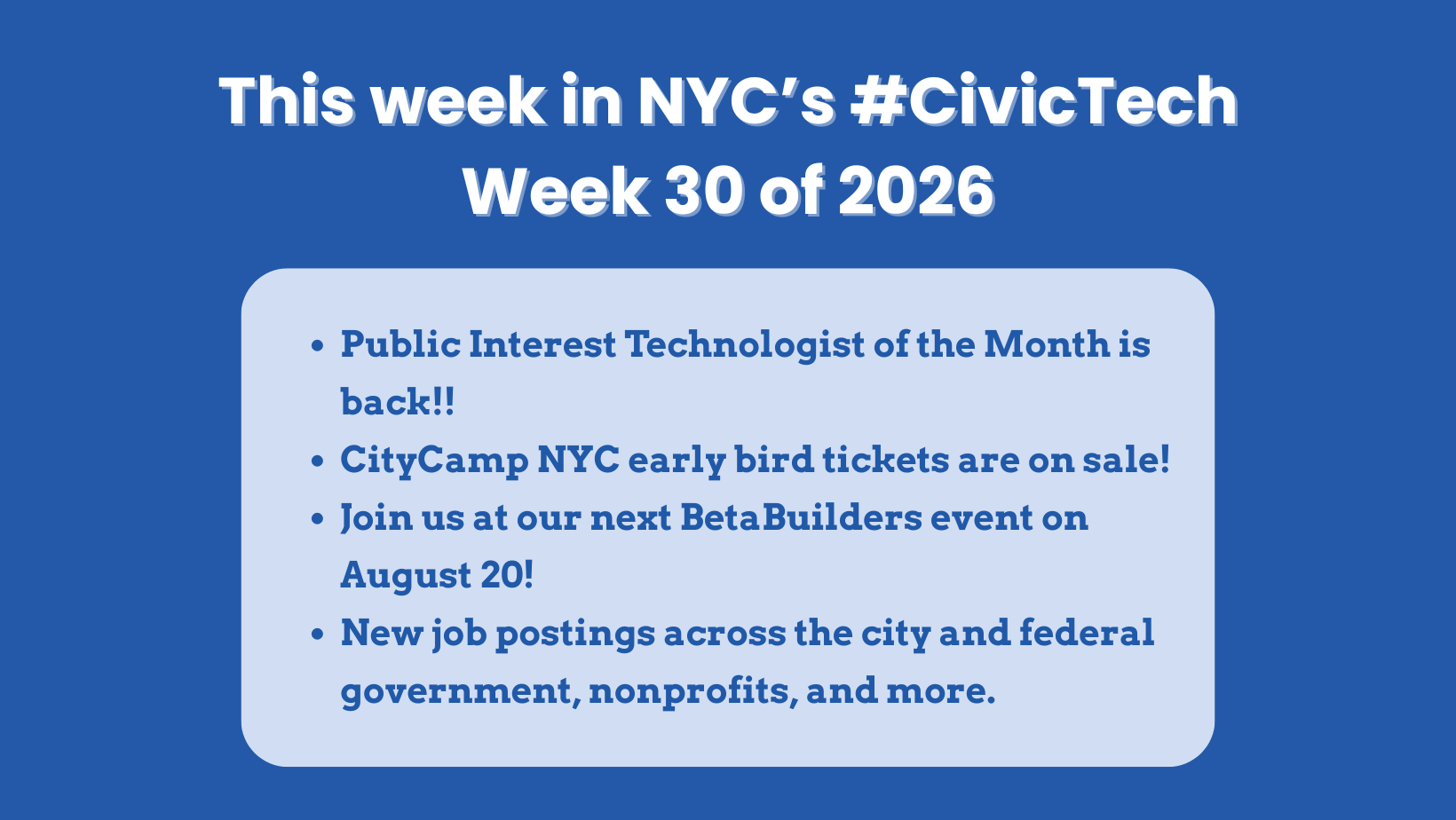
This month we’re spotlighting Ariel Kennan as our Public Interest Technologist of the Month! In Noel’s words, Ariel is “the reason BetaNYC is a technology, data, and design community.” Her reframing of civic tech around the design of systems, not just the data inside them, shaped how we think about this work. She spent a decade building service design inside government, from NYC Opportunity’s Service Design Studio to Georgetown’s Digital Benefits Network, and now she’s taking the next step: the Axiom Foundation, an effort to turn tax and benefit law into open, machine readable code that anyone can run, audit, or reform. It launches publicly on July 28. Read the full interview.
Speaking of building things: CityCamp NYC 2026 early bird tickets are on sale now! Join us September 19 at Hunter College for a day of unconference sessions on technology, data, policy, and community organizing. There’s no fixed agenda. You pitch the sessions, we build the day together. We’re also recruiting volunteers for setup, registration, wayfinding, and accessibility support. Learn more and apply today.
And mark your calendar for August 20: our next BetaBuilders gathering, the Civic Tech Summer Showcase, at the Brooklyn Heights Library. Come see what our community has been building! Have a project of your own, professional, academic, or just something you made for fun? We would love to see it. Submit by August 3 for rolling review.
Lots to build this week. Let’s get to it.
— Noel Hidalgo and Gabrielle Langston
Support BetaNYC
- Become a BetaBuilder — On August 20 we’re gathering at the Brooklyn Heights Library for the Civic Tech Summer Showcase, where our community shows off what they’ve built all year. None of it happens without people who chip in monthly. $5 a month makes you an Informed Neighbor, which keeps this newsletter free and gets you into the exclusive online space and member happy hours like this one. Come build with us. – beta.nyc/betabuilders
Upcoming Events with BetaNYC
- July 29, 2026 at 12:00 pm Introduction to AI (AI 101) with Council District 23 & BetaNYC – Office of Council Member Linda Lee and BetaNYC
- August 4, 2026 at 12:00 pm Introduction to AI (AI 101) with Council District 10 & BetaNYC – Office of Council Member Carmen De La Rosa and BetaNYC
- August 10, 2026 at 6:00 pm Discovering NYC Open Data: Online Session – NYC Open Data Team at OTI and BetaNYC
- August 20, 2026 at 5:45 pm Civic Tech Summer Showcase – BetaNYC
- September 19, 2026 CityCamp NYC 2026, our civic sandbox. – BetaNYC
Civic Tech News & Updates
- New York pauses new AI data centers; Hochul defends the move — The state’s one-year pause on data centers drawing 50 megawatts or more lets existing facilities keep running while it studies grid strain and community benefit; Governor Hochul defended the pause directly in a letter to the editor (subscriber-only) answering a Wall Street Journal editorial that had called it self-sabotage. – Next City
- Are Waymo robotaxis actually safer than NYC’s for-hire drivers? — A new report from the Sam Schwartz Transportation Research Program at Roosevelt House finds Waymo has about 67% fewer injury crashes overall than NYC’s for-hire fleet, but a 1.5 times higher rate of crashes involving serious injury or death; Waymo disputes the framing, and Governor Hochul has since withdrawn support for a bill that would let Waymo operate outside the five boroughs. – Stephen Nessen, Gothamist
- City Council weighs a Legionnaires hotline after the UES outbreak — The Council speaker faulted the Mamdani administration’s response to the Upper East Side Legionnaires’ outbreak, with a public hotline among the proposals now on the table. – Gothamist
- Mayor Mamdani may ask voters to speed up bus and bike lane construction — The Commission on Government Efficiency has proposed cutting the time it takes to build new street-safety projects, and a ballot question is now being weighed to get there faster. – Gothamist
- City government is quietly expanding AI use, even as Mamdani avoids it himself — Mamdani personally avoids AI tools, but he inherited a government already deploying them: he killed the prior administration’s MyCity chatbot even as agencies expand AI use from traffic sensors to child-welfare case review. – City & State New York
AI Roundup
- California bill would strip AI-generated public comments of legal standing — SB 1159 would redefine “person” under California law to exclude AI systems from regulatory comment processes, a response to more than 20,000 AI-generated comments that opposed clean-air rules at a Southern California regulator. – Beth Simone Noveck, LinkedIn
- AI exposure is correlated with a rise in solo business formation — A new analysis finds solo business formations and self-employment rose in AI-exposed sectors and occupations after early 2024, while comparison groups stayed flat or declined. – Liya Palagashvili, Mercatus Center
- One-time AI approval doesn’t work when the models keep moving — The case for treating AI governance as continuous re-adaptation rather than a single sign-off, since both the models and the regulations they answer to keep shifting underneath. – O Shackleton
- The State of Open Source AI, v1 — A field-wide snapshot of where open-source AI development stands as of July 2026. – Mozilla (PDF)
Community Wins, and Featured Tools
- City Ledger turns 18 years of budget data into a public dashboard — Built on BetaNYC’s own NYC budget dataset, City Ledger shows how the city has distributed funding across the five boroughs over nearly two decades, with an AI grant-matching feature layered on top. – City Ledger
- A Venmo-style feed for the New York City budget — A new tool reimagines city budget data as a social feed, in the spirit of Venmo, making public spending scrollable instead of buried in a PDF. – Budgetmo
- A dataset tracking the footprint of every building in New York City — OTI’s NYC Building Footprints dataset covers more than a million structures, updated weekly via aerial photogrammetry at roughly 95 percent accuracy, to track construction and demolition citywide. – Jon Keegan, Beautiful Public Data
- A standing catalog of open datasets hosted on AWS — A third-party-maintained registry of open datasets available on AWS infrastructure, useful as a starting point when a civic-tech project needs data it doesn’t want to host itself. – Registry of Open Data on AWS
- The civil engineer leading Mamdani’s $900 million Fast Buses plan — Diniece Mendes, a DOT civil engineer, is leading the Fast Buses initiative’s 50 priority bus corridors, concentrated in Black and brown neighborhoods that have waited longest for better transit. – Gerren Keith Gaynor, TheGrio
- Two pilot “field hearings” test a new way to preserve civic testimony — The first two Local Impact Field Hearings, in Iowa on NPS funding cuts and a suspended USDA program, are built as infrastructure for capturing civic evidence the Congressional Record misses; collaborators include the House Digital Service, POPVOX Foundation, Internet Archive Europe, and Democracy Forward. – Lorelei Kelly, LinkedIn
Jobs & Opportunities
- Technical Project Manager — Department of Correction — Manages IT projects for the department from planning through implementation, including stakeholder communication and oversight of development teams. Deadline: July 29.
- Digital Collections Coordinator — Library of Congress — Coordinates digital preservation and access initiatives for the Geography and Map Division’s special collections, working across IT and digital media teams. Deadline: July 29.
- Media Education Associate — Department of Parks & Recreation — Coordinates daily operations of a recreation center media lab and leads digital learning workshops for participants of all ages across the five boroughs. Deadline: July 31.
- Civic Science Fellow — Open Environmental Data Project — A fellowship with an organization building open tools and public data partnerships for environmental decision-making. Deadline: August 2.
- Deputy Director, Digital Transformation and AI Policy & Advocacy — Gates Foundation — Advances policy and advocacy goals for the foundation’s Digital Public Infrastructure and Inclusive Financial Systems teams, including how AI-enabled services get built on trusted digital-ID and data-sharing foundations. Deadline: August 7.
- National Communications Director — TechTonic Justice, Inc. — Leads national communications strategy to expose AI harms and build public power for low-income communities. Deadline: August 16.
- Policy Analyst — Office of the Mayor — Develops briefings and memos for executive decision-making and coordinates policy initiatives across city agencies. Deadline: September 14.
- Senior Policy Analyst, Housing — Office of the Comptroller — Conducts policy research and oversight on housing affordability, production, tenant protections, and homelessness to support the Comptroller’s housing initiatives. Deadline: September 15.
- Policy Director, Housing — Office of the Comptroller — Leads the Comptroller’s housing policy and oversight agenda, coordinating housing initiatives across the office. Deadline: September 15.
- Lead Data Scientist, Justice Processes — Office of Criminal Justice — Designs, tests, and communicates data-driven policy solutions to improve efficiency across the city’s criminal justice system. Deadline: September 18.
- College Aide (Graduate) — Department of Design & Construction — Supports Design-Build initiatives with research, technical document review, stakeholder coordination, and project records management. Deadline: September 18.
- Rail Planning, Emerging Talent Intern (Fall) — MTA — Supports the Division of Operations Planning’s work designing subway and bus service for New York City Transit. Deadline: Rolling.
- Building Better Cities Collaborative — NYU Schack Institute of Real Estate — A two-semester leadership fellowship for mid-career built-environment professionals, with a founding cohort starting this September. Deadline: Rolling (submit an Expression of Interest by July 29 for a 25% founding-cohort discount).
- Senior Researcher, AI Civics — Data & Society Research Institute — Leads inter-organizational research partnerships and collaborative design work for Data & Society’s AI Civics program. Deadline: Rolling.
- Digital Accessibility Lead — New York Public Library — Leads digital accessibility strategy across NYPL’s digital spaces, reporting to the Chief of Staff of the Digital Department. Deadline: Rolling.
- Senior Digital Designer, Climate Science — Project Drawdown — Translates Project Drawdown’s climate science research into visual stories across digital platforms for a range of audiences. Deadline: Rolling.
- Senior Campaign Organizer — Association for Neighborhood & Housing Development — Leads campaigns to preserve and expand NYC’s affordable housing supply, combining grassroots organizing with policy advocacy. Deadline: Rolling.
- Senior Project Manager, Real Estate & Development — Habitat for Humanity NYC & Westchester County — Manages affordable homeownership development projects from acquisition through construction and disposition. Deadline: Rolling.
Events
- July 25, 2026 at 9:00 am EDT Community Climate Innovation Challenge Idea Lab – DSSG NYC, G.I.V.E., and Climate Cafe NYC/Climate Imaginarium
- July 26, 2026 at 10:00 am EDT AI Building Workshop for Social Impact – Kristen Brown and Ashley Taylor
- July 28, 2026 at 6:00 pm EDT Databases for the People: How to Use AI to Unlock Library Archives – Aboard (registration approval required)
- July 31, 2026 at 6:00 pm EDT Young Professionals Summer Garden Party – Open Plans
- August 4, 2026 at 2:00 pm EDT Our Phalt: Mapping Safer Streets, Byte by Byte – Our Phalt
- September 18, 2026 at 10:00 am EDT Fall 2026 Business & Tech Career Fair – CUNY Macaulay Honors College is recruiting employers to table (registration requires a Handshake account)
Media to Watch, Listen, or Read
- [READ] BetaNYC’s Mapping for Equity project helps Bronx residents map their own neighborhoods — Coverage of the July 10 Mapping for Equity event on Mosholu Parkway with Council Member Eric Dinowitz. – Michelle Mullen, The Riverdale Press
- [READ] Mosholu Parkland: FOMP, BetaNYC, and Council Member Dinowitz map the community together — More coverage of the July 10 event, this time from Future of Mosholu Parkland’s side of the partnership. – Síle Moloney, Norwood News
- [READ] NYC wants your input on the future of internet access — The city’s Internet Access Survey is open now to help shape digital-equity policy and investment. – City of New York
- [READ] A data breach reveals Madison Square Garden tracked celebrities’ sexual orientation — A leaked “talent” database shows MSG risk-scored around 400 of nearly 40,000 entries and tagged 93 as LGBTQIA; Mayor Mamdani, who cosponsored a biometric-collection ban as an Assembly member, turns up in a separate 10.5-million-record database from the same breach. – Noah Shachtman and Maddy Varner, WIRED (subscriber-only)
- [READ] City Council approves land use projects for nearly 3,250 new homes — More than half of the approved units are affordable, per the Council’s own release. – NYC Council
- [READ] New York City nets 40,000 new jobs — A continuing Wall Street boom is keeping the city’s economy expanding even against tariffs, inflation, and rising rents. – The City Reporter
- [READ] City redesigns bus lanes on Fordham Road — New offset bus lanes are planned from Sedgwick Avenue to Boston Road, in the same Bronx corridor as this week’s Mapping for Equity coverage. – NY1
- [READ] Brooklyn’s dollar vans get squeezed by Mamdani’s Flatbush Avenue bus plan — MTA Chair Janno Lieber has pushed for years to get dollar vans out of bus lanes; the new Flatbush Avenue plan may finally force the issue. – Gothamist
- [READ] Editor’s note: anti-Mamdani forces want open primaries — Opinion arguing that bringing independents into New York’s primaries could hurt democratic socialists’ odds. – City & State New York
- [READ] Retailers are collecting your biometrics, and some local governments are fighting back — Facial and voice recognition is already running in some NYC-area retail stores; the piece traces where county-level bans are gaining ground. – Next City
- [READ] Data centers are draining Virginia dry. Could rainwater harvesting be the fix? — Part of Next City’s “In the Shadow of the Server” series on data center infrastructure, this piece follows a family business that eliminated its water bill with a small-scale rainwater system. – Next City
- [READ] Washington may take years to act on the new housing law. States can move now. — The 21st Century ROAD to Housing Act became law without a presidential signature; the piece argues states don’t need to wait on federal implementation to act. – Next City
- [READ] The 130-year-old entity that could fix NYC’s broadband crisis — Empire City Subway’s existing conduit network across Manhattan and the Bronx is already a lever for broadband competition, the authors argue, without a single new dig. – Suzi Ragheb and Katherine Jin, NYC Policy Forum
- [READ] Hewlett Foundation commits $20M a year to emerging technology and security — The foundation’s program page outlines $20 million in exploratory grants this year, then a five-year, $20-million-a-year commitment starting in 2027. – William and Flora Hewlett Foundation
- [READ] A living resource for state-level SNAP payment accuracy data — Part of US Digital Response’s SNAP Payment Accuracy Playbook, linking a periodically updated spreadsheet of state SNAP data and error rates. – US Digital Response
- [READ] Five ways to take climate action with kids in NYC — From Climate Imaginarium on Governors Island (weekends through October 25) to the next Walk & Roll to School Day, a running list of family-friendly climate options. – Anya Kamenetz, Macaroni KID Brooklyn NW
- [READ] Atlassian tests a portable format for design-system documentation — A look at DESIGN.md, an open-source Markdown format for design context, tried against Atlassian’s own MCP server and AI skills. – Kylor Hall and Andrew Campbell, Atlassian
- [READ] UK tech advocates alarmed by a plan to scrap the technology department — Incoming PM Andy Burnham has asked officials to draw up plans folding the UK’s science and technology policy into a larger business department. – Kiran Stacey, The Guardian
- [READ] Scrapping Digital ID was the wrong right decision — Sarah Gold argues the UK’s Digital ID failure was in how it was announced and framed as mandatory, not in the underlying concept. – Sarah Gold, Writing by IF
- [READ] The US is counting traffic deaths wrong — David Zipper argues deaths-per-capita, not deaths-per-mile, is the honest way to measure road safety. – David Zipper, Bloomberg CityLab (subscriber-only)
- [READ] How to attract the next generation of civic technologists — Three proposals for recruiting young technical talent into government roles. – Emily Tianshi and Medhya Goel, Government Technology
What did you think of today’s newsletter? We’d love to hear your feedback and ideas.
Want to sponsor this newsletter or be featured in future ones? Share your community resources, projects, events, and anything else happening so we can feature them in future posts.
Did a friend forward this to you? There are three ways you can subscribe to our newsletter. Read it on our website, receive it via email, or via LinkedIn!
We use AI tools to help scan and organize civic tech news each week — all editorial decisions are made by the BetaNYC team, per our AI Policy.
Build with NYC’s civic data. BetaNYC publishes free, open-source MCP connectors giving AI assistants direct access to NYC Council legislation, city spending and contracts, Council discretionary funding, 311 service data, the City Record, the NYC Charter and Administrative Code, and NYS Open Legislation. If you’re building with AI and civic data, explore them on GitHub.
Take care of each other, and have a great weekend!
BetaNYC is a civic organization improving lives through civic technology, design, and open data. Join our Slack · Subscribe to the newsletter · Support our work · Follow us on Bluesky, LinkedIn, Facebook, Instagram, Threads, Mastodon, Reddit, and YouTube.
