Hello friends,
In NYC, early voting starts this weekend. Before I talk about the local picture, let me talk about the broader situation. We find ourselves at a unique inflection point, where citizens want accountability, yet the system seems rigged against it. In BetaNYC’s AI policy, we explicitly describe AI as a frank conversation about power. Who has it? Who can wield it? Who can capitalize on it? Who can ultimately hold it accountable?
The American electorate seems to be wrestling with a similar question: who will hold people in power accountable?
It is obvious that we are living in a new era of theft. The laws that were designed to apply equally do not. Some may say that has always been the case, but it is plain and clear that justice is not equal. As we move forward, who will help us wield democratic systems to enable just representation?
In our classes, we frequently talk about technology having a political manifestation. We also talk about technology not just being a digital object. Technology is everything around us, from the pipes in our homes to the doorknobs we touch, the tables we sit at, and the forks we use. Everything we have made is a form of technology, and in everything we have made, values have been manifested. Now more than ever, we must understand that values, accountability, and technology go hand in hand.
So, how does this intersect with the five charter revisions?
Democracy is a form of technology we invented to ensure a proper civil society. Our municipal constitution is our charter. The charter revision process is our democratic opportunity to revise that constitution.
Increasingly, our democratic practice uses the tools of digital technology. In our testimony to the Commission on Government Efficiency, we spoke about digital sovereignty. Next week I will be in Barcelona exploring these issues explicitly, because we very clearly need infrastructure that stands independent of the broligarchy.
Here is my interpretation of the five questions we will see on the ballot.
– Question 1 would move a community feedback process to the City Record (the City’s change log) and could create an online portal for feedback.
– Question 2 would simplify the paperwork that people have to submit online. It also lets the Mayor hand the power to approve no-bid contracts over $5 million to agencies.
– Question 3 (the most complicated of the five) anchors street safety improvements in crash data and creates an opportunity for more online engagement around those projects. It also streamlines the disposition of City-owned property and requires the DCAS commissioner to provide notifications to the administrative state.
– Question 4 asks the Department of Buildings to build a new website that it is already building.
– Question 5 is about a formula that would determine when, and how much, we should put in the rainy day fund.
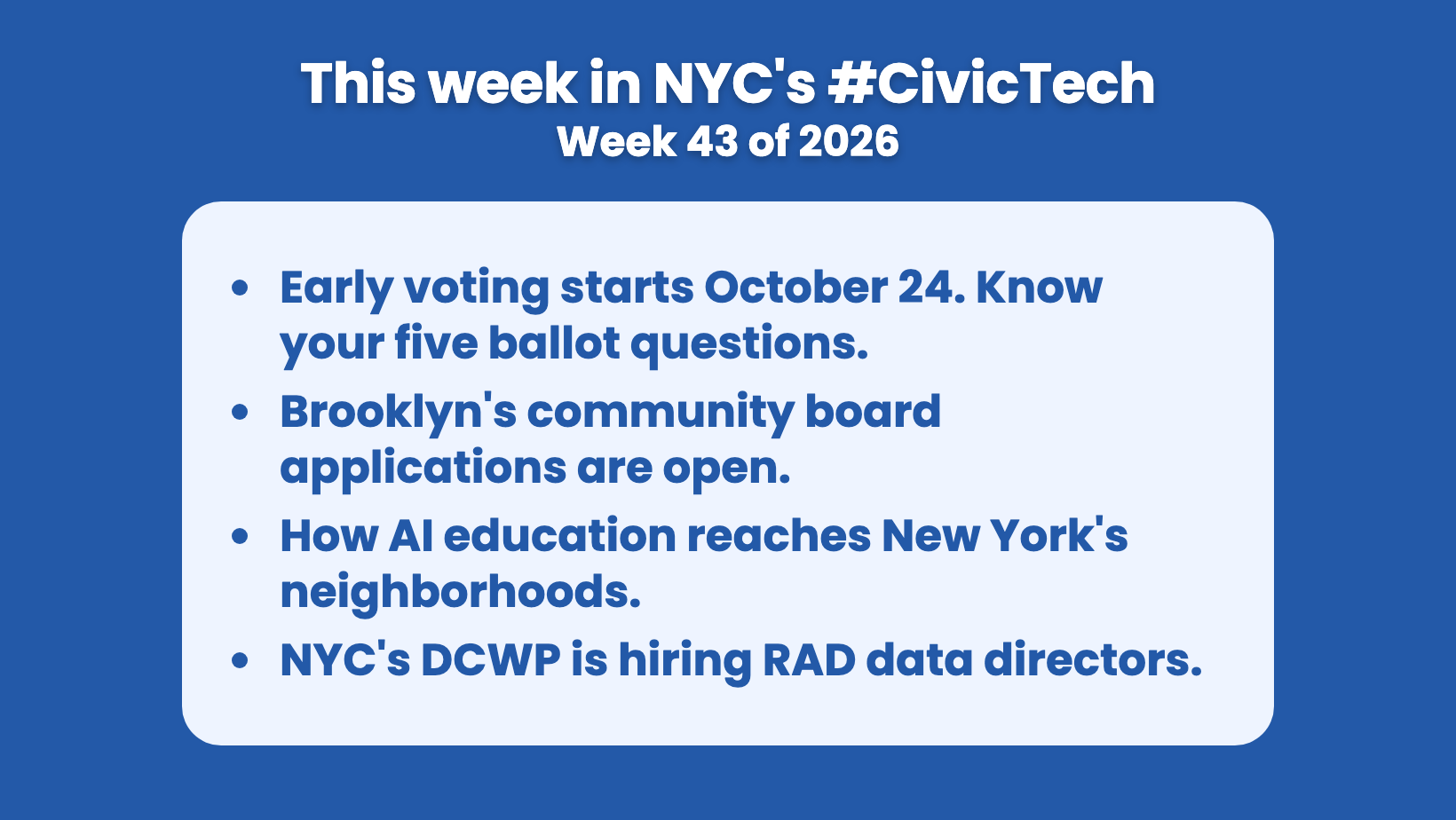
I highly encourage you to listen to Ben Max’s conversation with COGE’s Patrick Gaspard and Ann Cheng this week. Then, make your election plan. Read the ballot questions, research who’s on your ballot, and tell your friends that early voting starts October 24. Encourage everyone in your network who can vote to vote. Let’s make sure the future world is brighter and stronger than the one we entered.
Speaking of a stronger democracy, tomorrow we’ll have a short session on tools you can plug into your AI agents to surface information used across democratic practice. Thank you to all of our readers and friends who have submitted bug tickets and improvements to our MCPs.
– Noel Hidalgo
Support BetaNYC
- Become a BetaBuilder — BetaBuilders are New Yorkers who sustain the city’s civic infrastructure. For $5 a month, you join the BetaNYC Discord, where classes and open data work get planned, and you help keep our newsletter, classes, and open data resources free for everyone. – Become a BetaBuilder
Upcoming Events with BetaNYC
- October 23 at 2:00 pm BetaBagels 017: Building Civic AI for NYC’s Open Government – Virtual. Demos of open civic AI tools, plus a recap of the Council’s October 5 AI hearing.
- November 10 at 9:00 am Urban Tech Summit 2026 – Cornell Tech, Roosevelt Island. BetaNYC’s Noel Hidalgo speaks on AI in city operations.
- November 12 at 5:45 pm Autumn Civic Tech Showcase – BetaNYC at the NYU Jacobs Academic Building, 6 MetroTech Center, Brooklyn. BetaBuilders and friends show projects that use technology to serve New York City. Apply to present by October 25.
- November 16 at 6:00 pm Discovering NYC Open Data: Online Session – the NYC Open Data Team and BetaNYC
Civic Tech News & Updates
- Help plan CUNY’s summit for community board members — CUNY is bringing together community board members from all five boroughs for a one-day summit, and board members and district managers are planning the day. This 5-minute survey asks what you want to see, learn, and discuss, and responses are due October 23. – CUNY
- Subpoenaed, SpaceXAI testifies on AI safety — After the Council’s first subpoena on record against a private actor, SpaceXAI testified before the Committee on Technology on October 16. A whistleblower told the committee that only three of the company’s 200 technical employees worked on AI safety training. – NYC Council
- A new city team to help New Yorkers keep their benefits — Mayor Zohran Mamdani’s $3 million Health and Affordability Resource Team will help New Yorkers through new federal Medicaid and SNAP work requirements. City officials say up to 900,000 residents could lose Medicaid coverage. – Gothamist, benefits team
- The Council weighs earlier warnings on Legionella — After two deadly outbreaks this summer, Council Member Lynn Schulman’s bill would require cooling tower owners to report Legionella at 10 colony-forming units per milliliter instead of 1,000. – Gothamist, Legionella bill
- The city takes a share of NYU’s quantum lab — In exchange for $30 million to build QFab, a quantum technology lab at NYU, New York City will receive 15 percent of any proceeds from intellectual property developed there. It is the first deal from Mayor Mamdani’s reimagined Economic Development Corporation. – The New York Times
Community Wins, and Featured Tools
- Brooklyn’s community board applications are open — Brooklyn Borough President Antonio Reynoso’s office is taking applications for all 18 of Brooklyn’s community boards through February 8, 2027. BetaNYC’s Andrew Kittredge helped the office develop its community board application and keep it digital. – Office of the Brooklyn Borough President
- Training the people who teach AI in their neighborhoods — At BetaNYC’s October 8 Train-the-Trainer Workshop for the NYC Council’s AI Community Engagement (AICE) initiative, 34 staff from 22 nonprofits learned to teach AI basics in their own communities. In this year’s survey of nonprofit staff, privacy and security topped the list of what they want AICE to cover. – Duncan Ballantine, BetaNYC
- New York’s design system wins a national award — The New York State Design System received a 2026 Government Experience Project Award from the Center for Digital Government. NYS ITS says the award recognizes its team’s commitment to “accessible, equitable and people-first digital services for all New Yorkers.” – NYS Office of Information Technology Services
- A lifetime achievement award for the State Senate’s Jim Bell — Jim Bell received the 2026 Lifetime Achievement Award from the National Association of Legislative Technology, the IT staff section of the National Conference of State Legislatures. He credits the New York State Senate’s leadership and team. – Jim Bell, New York State Senate
- A student-built restroom finder wants testers — Restroom Ready, built by Columbia students, will show a restroom’s entry rules, the route inside, and reported conditions before you walk over. It’s still in development, and you can join the waitlist. – Restroom Ready
AI Roundup
- The 311 app’s new AI search, put to the test — Tim Donnelly tried the NYC 311 app’s AI-enabled Smart Search to report his building’s sewer backup, and found it wanting. – The New York Groove
- Tell researchers how AI is changing your work — The Asian American Business Development Center’s confidential survey asks individual users, small business owners, and corporate employees how AI is changing their lives, work, and communities. It takes a few minutes. – Asian American Business Development Center
- AI-ready cities need civic infrastructure first — Sari Ladin-Sienne and Hollie Russon Gilman argue that cities must build civic engagement and digital systems together, drawing on the Responsive Cities Network, 10 cities working with the Knight Foundation. – Data-Smart City Solutions, Harvard Kennedy School
- Will AI open doors for disabled workers, or close them? — Anne Marie Piper, Chancey Fleet, Cynthia L. Bennett, and co-authors find that AI could improve workplace accessibility, but it “poses significant risks and can create new barriers for disabled workers.” – Communications of the ACM
- A magazine writes an AI ban into its union contract — Under its new union contract, Current Affairs will not publish AI-generated text or art. “No AI generated articles or illustrations in the magazine!” writes editor Nathan J. Robinson. – Current Affairs
Jobs & Opportunities
- Senior Help Desk Technician — Kings County District Attorney’s Office — Deadline: October 26.
- Parking Data Analyst — NYC Department of Transportation — Deadline: October 29.
- Bus Stop Seating Data Coordinator, Furniture & Operations Unit — NYC Department of Transportation — Deadline: October 30.
- College Aide — NYC Department of Transportation — Deadline: October 30.
- Director, Rapid Bus Delivery — NYC Department of Transportation — Deadline: November 1.
- 2027 Fellowship — Processing Foundation — Nominations, including self-nominations, close November 1. An eight-month paid fellowship for people based in the U.S.
- Data Scientist — NYC Police Department — Deadline: November 3.
- Analytics & Reporting Engineer, Division of Strategic Operations & Analytics — NYC Department of Housing Preservation and Development — Deadline: November 14.
- Chief Administrative Officer — NYC Department of Small Business Services — Deadline: November 18.
- Executive Director, Research and Analytics Division — NYC Department of Consumer and Worker Protection — Deadline: November 20.
- Civic Hosts, The Public Assembly on AI — BLOOM Project — Applications due November 20. Local organizations host community assemblies on AI decisions, such as whether a data center gets built. Info session: November 10 at 1:00 pm ET.
- Policy Advisor, Multifamily Climate Solutions — NYC Department of Environmental Protection — Deadline: December 7.
- GIS Analyst, Bureau of Environmental Surveillance and Policy — NYC Department of Health and Mental Hygiene — Deadline: December 13.
- Director, Research and Evaluation, Bureau of Queens Neighborhood Health — NYC Department of Health and Mental Hygiene — Deadline: December 13.
- Data Engineer — NYC Department of Sanitation — Deadline: December 13.
- College Aide — NYC Department of Design and Construction — Deadline: December 13.
- NYCAPS Systems Analyst — NYC Financial Information Services Agency — Deadline: December 14.
- Chief Planning, Data Analytics, and New Initiatives Officer — NYC Department of Social Services — Deadline: December 18.
- IT Community Technician — NYC Department of Probation — Deadline: December 18.
- PIT Crew Executive Director Fellow — NYC Office of Technology and Innovation
- Open roles — NYC Office of Technology and Innovation — Openings across infrastructure, applications, data strategy, cybersecurity, and more.
- 2027 Community Advisory Board RFP — Zero Irving — Up to $200,000 for workforce development programs held at Civic Hall that expand skills, training, and career access for New Yorkers.
- Director of Grantmaking & Strategy — Humanity AI
- Nonprofit Mobilization Coordinator — Rebuild Local News
- Director of Product & Delivery Management — Bloom Works
- Chief Technology & AI Officer — U.S. Digital Response
Events
- October 23 at 11:00 am to October 24 Spooky Civic AI Hackathon: Build Weekend – 3percentclub. In person in New York and on Zoom. Teams build AI tools for New York City; the robotics track starts at 11 am, the rest at 6 pm. Free; in-person spots need approval.
- October 23 at 12:00 pm to October 25 Virtual AI For Good Datathon – DSSG NYC and DSSG Berlin, on Google Meet. Volunteers work remotely on data problems for nonprofits in New York and Berlin. Free, with a suggested $5 donation.
- October 25 at 2:00 pm Spooky Civic AI Hackathon: Demo Day – 3percentclub, in Midtown and on Zoom. Teams show what they built at science-fair tables, then the top five demo on stage. Free and open to everyone.
- October 28 at 2:00 pm Government Digital Services That Work – Institute for Responsive Government, the Beeck Center, and U.S. Digital Response. A webinar for state and local leaders building or strengthening digital service teams.
- October 29 at 12:00 pm Vibe coding show and tell: October edition – Hacks/Hackers, on Zoom. Live demos of projects built with AI coding tools. Demo pitches are due October 27 at noon.
- October 29 to 30 2026 NYSACC Conference on the Environment – NYSACC and the Manhattan Solid Waste Advisory Board, at Cornell Tech, Roosevelt Island. On using AI and technology to reach zero waste. Paid registration.
- November 5 to 12 “The State of the State”: PIT-NY at the NYC PIT Pop Up – CUNY Public Interest Technology Lab’s PIT-NY Regional Hub, at the Oculus, World Trade Center. Public interest technology showcases; register for each day.
- November 14 at 1:30 pm Math Walk 5 – Jordan Jones, at Knickerbocker and Myrtle Avenues, Brooklyn. Ask shoppers how they actually got to local businesses, compare it with what owners assume, and work out the margin of error. $7.
Hearings
1 hearing ahead. Dates and runway below, so you know what you have time to prepare for.
Short notice
Less than 7 days out. Written testimony is the realistic route here.
- October 28 at 10:00 am — 6 days away · NYC Council
Oversight – Mayor’s Office of Ethnic & Community Media and Government Spending on Advertisements
Committee on Governmental Operations, State & Federal Legislation
Already heard, testimony still open
The Council accepts written testimony for 72 hours after a hearing adjourns. These are still open.
- October 20 at 10:00 am — heard 2 days ago · NYC Council
Oversight – Ambulance Response Times
Joint hearing: Committee on Fire and Emergency Management, Committee on Hospitals
Written testimony until October 23.
How to testify at a City Council hearing. In-person testimony needs no pre-registration. Virtual testimony requires signing up in advance. Written testimony is accepted up to 72 hours after a hearing adjourns. Details at council.nyc.gov/testify, or email hearings@council.nyc.gov. State hearings are often invitation-only for oral testimony — check the individual notice.
Media to Watch, Listen, or Read
Watch or listen
- What the five ballot questions would change — Grace Rauh, executive director of Citizens Union, explains the five proposals on the November ballot aimed at streamlining city government, and why Citizens Union supports them. (30 minutes) – The Brian Lehrer Show, WNYC
- Inside the governor’s race after the debate — Spectrum News political director Bob Hardt joins Ben Max to break down the October 13 debate between Gov. Kathy Hochul and Nassau County Executive Bruce Blakeman. (49 minutes) – Max Politics, Gotham Gazette
Read
- Congestion pricing is paying for subway elevators — Four elevators at the 42nd Street–Bryant Park/Fifth Avenue station are the first upgrades the MTA has labeled “Made Possible by Congestion Pricing,” and 23 stations will be made ADA-compliant with the program’s money. – The City Reporter
- The data center industry’s new pitch: field trips — As backlash grows, industry-friendly groups are courting young people. One nonprofit recommends a children’s story in which a honey badger gets a guided tour of a data center. – Wired
- A senator’s 100% tax on data center incentives — Sen. Bernie Moreno (R-Ohio) introduced the RECLAIM Act, which would impose a 100% tax on any state or local incentive for AI data centers and ban federal ones. – Politico
One New Dataset to Note!
- The Condo Book Project — Half Ave Company
A searchable database of more than 8,000 Attorney General offering plans for NYC condos, with prices, floor plans, and project teams. Paid Pro tier.
NYC Open Data (data.cityofnewyork.us) — 0 new
- Nothing new this window.
NYS Open Data (data.ny.gov) — 1 new
- Open NY Quarterly Report October 2026 · 2026-10-15 — Open Data Reports
Having trouble viewing the report in the Preview pane? Just click the Download button below to download a copy of the report.
Before you go
What did you think of today’s newsletter? We’d love to hear your feedback and ideas.
Want to sponsor this newsletter or be featured in future ones? Share your community resources, projects, events, and anything else happening so we can feature them in future posts.
Did a friend forward this to you? There are three ways you can subscribe to our newsletter. Read it on our website, receive it via email, or via LinkedIn!
We use AI tools to help scan and organize civic tech news each week — all editorial decisions are made by the BetaNYC team, per our AI Policy.
Build with NYC’s civic data. BetaNYC publishes free, open-source MCP connectors giving AI assistants direct access to NYC Council legislation, city spending and contracts, Council discretionary funding, 311 service data, the City Record, the NYC Charter and Administrative Code, and NYS Open Legislation. If you’re building with AI and civic data, explore them on GitHub.
Take care of each other, and have a great weekend!
BetaNYC is a civic organization improving lives through civic technology, design, and open data. Subscribe to the newsletter · Support our work · Follow us on Bluesky, LinkedIn, Facebook, Instagram, Threads, Mastodon, Reddit, and YouTube.
